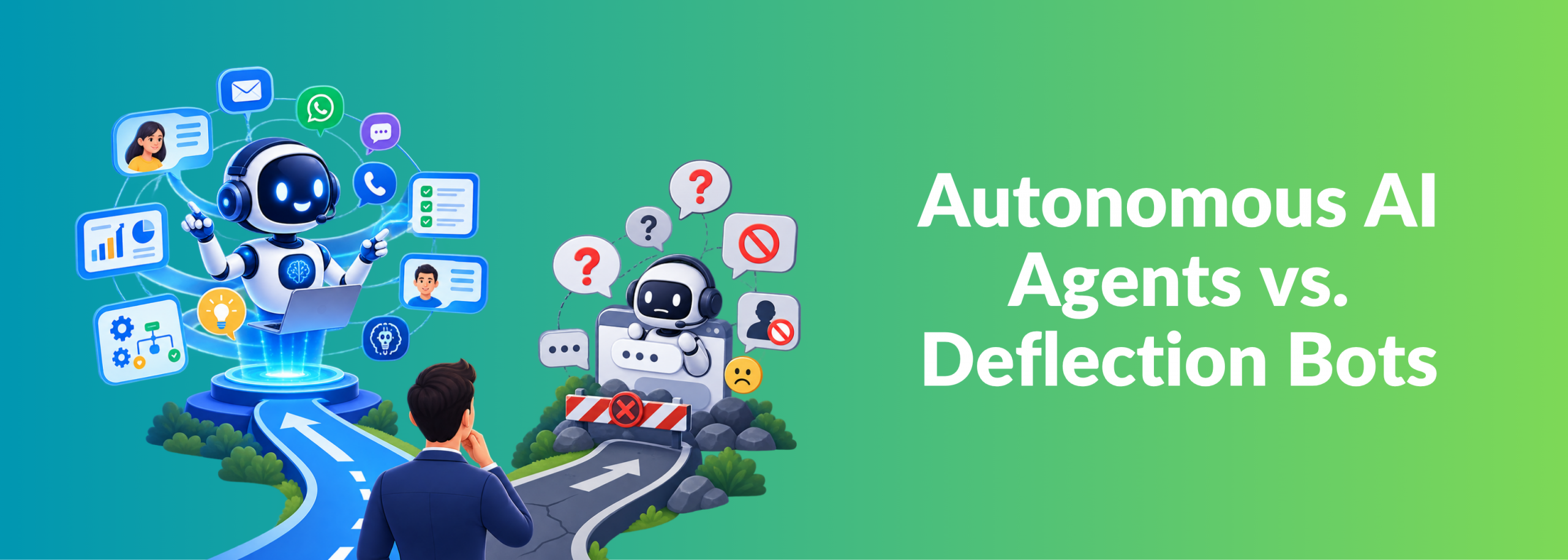
Autonomous AI Agents vs. Deflection Bots: What AI CX Platform in 2026?

If you’ve sat through a vendor pitch in the last year, you’ve probably noticed something: everyone calls their chatbot an AI agent now. The word bot quietly disappeared from marketing decks somewhere around 2024, and agentic showed up in its place. Convenient timing, considering how much money is riding on the AI CX label.
But here at ClearTouch, we think the label matters a lot less than what’s actually happening behind it. And what’s actually happening, in most cases, is still deflection, dressed up in agentic language.
So, let’s talk plainly about the difference between a deflection bot and an autonomous AI agent, why that difference decides whether your customers stay or churn, and what we believe actually defines a modern AI CX platform in 2026.
The Deflection Era Promised Efficiency, But Delivered Frustration
Deflection bots were built to answer one question:
how do we keep this customer from reaching a human agent?
That’s not a cynical read; it’s literally how the ROI was calculated. Fewer tickets reaching live agents meant lower cost per contact, and lower cost per contact made the CFO happy.
The problem is that customers didn’t call in because they wanted a conversation. They called in because something was broken, delayed, or confusing, and they needed it fixed. A deflection bot, built on decision trees and canned responses, could recognize a handful of intents, such as track my order, reset my password, check my balance, and fall apart the moment the conversation veered off-script. Ask it something it didn’t anticipate, and you’d get the customer service equivalent of a shrug: “I’m sorry, I didn’t understand that. Let me connect you to an agent.”
Which, ironically, is exactly what the bot was built to prevent.
This is the legacy most AI-CX platforms are still quietly built on. A large language model has been bolted onto the old decision tree so the responses sound more natural. Still, the underlying architecture is unchanged: it can talk about a problem, but it can’t actually do anything about it.
What Autonomy Actually Means in an AI Agent
Autonomy isn’t a marketing adjective. It’s a specific, testable capability: can the system take an action and complete an outcome without a human clicking approve at every step?
A genuinely autonomous AI agent in a CX context needs to clear a few concrete bars:
It has to understand context, not just intent. Recognizing that a customer said “track my order” is intent detection; chatbots have done that since 2018. Understanding that this is the customer’s third contact about the same delayed order, that they’re already frustrated, and that a generic tracking link will make things worse; that’s context. Autonomous agents pull from the full customer history, across every channel, not just the current chat window.
It has to take real action, not just generate a real-sounding answer. This is the line that separates agentic AI from conversational AI dressed up in agentic clothing. A modern agent doesn’t just tell a customer their refund should be processed shortly; it initiates the refund, checks it against policy, schedules the pickup, and confirms the new delivery date, all inside the same conversation, by actually calling into the CRM, the payment system, and the logistics platform.
It has to know its own limits. True autonomy also means knowing when not to act, for instance, when a decision carries compliance risk, financial exposure, or emotional weight that genuinely needs a human’s judgment. An agent that hands off a distressed, high-value, or regulation-sensitive case to a live agent with full context attached is behaving more intelligently than one that either stonewalls the customer or barrels ahead with a decision it shouldn’t be making alone.
It has to learn from what happened, not just what was said. Every resolved case, every escalation, every moment a customer got frustrated is a signal. Autonomous agents are supposed to use that signal to improve on the next case, not just log a transcript.
Miss any of those four, and what you have is a well-dressed deflection bot, not an autonomous agent.
Deflection Bots vs. Autonomous Agents: The Real Comparison
Put side by side, the contrast is less about intelligence and more about accountability for the outcome.
A deflection bot’s job ends the moment it produces a response. Whether that response actually solved the customer’s problem is somebody else’s metric to worry about, usually the live agent who inherits the case anyway, now with an annoyed customer who’s already explained their issue once to a machine that couldn’t help.
An autonomous agent’s job doesn’t end until the outcome is resolved. It’s measured on containment that actually holds, meaning the customer didn’t come back an hour later with the same complaint, not containment that simply moved the conversation out of the ticket queue.
That distinction shows up everywhere once you know to look for it. Deflection bots are evaluated on self-service rate. Autonomous agents should be evaluated on first-contact resolution and whether the customer had to repeat themselves. Deflection bots hand off with a transcript dump. Autonomous agents hand off with a synthesized summary, a recommended next action, and every relevant fact already pulled up for the live agent. Deflection bots treat every session as a fresh start. Autonomous agents treat every session as one chapter in a much longer customer relationship.
Why This Distinction Matters More in 2026 Than It Did in 2023
Three years ago, “does the bot sound natural” was a reasonable bar for AI CX tools, because most of them didn’t. That bar has been cleared industry-wide, and natural language generation stopped being the differentiator once every vendor had access to the same class of large language models.
What’s left to differentiate on is exactly the part deflection-era bots were never built for: integration depth, decision accuracy, and the judgment to know when a human needs to step in.
Enterprises adopting AI CX platforms in 2026 aren’t asking “can it chat convincingly” anymore. They’re asking whether it can be trusted with a live transaction, whether it respects compliance boundaries in regulated industries like banking, healthcare, and collections, and whether it actually reduces the burden on human agents instead of just relocating frustration further down the funnel.
That’s a much higher bar, and it’s the one that correlates with customer retention and agent morale, not a nicer-looking deflection dashboard.
What ClearTouch Believes a Modern AI CX Platform Actually Requires
We build contact center technology for industries where getting this wrong is expensive, such as banking, healthcare, collections, insurance, and revenue cycle management. In those environments, a bot that sounds helpful but can’t verify an account, honor a compliance rule, or escalate correctly isn’t a minor inconvenience. It’s a liability.
So, our view of a modern AI CX platform isn’t “replace the agent with an autonomous system and call it done.” It’s built on a different premise: AI should absorb the repetitive, structured work end-to-end, and it should make the human agent measurably better at the work that still needs a human, like the judgment calls, the empathy, and the genuinely complicated cases.
In practice, that means real-time agent assist that surfaces the next-best-action and relevant knowledge base content the moment a call starts, not after the agent has already fumbled through it.
It means speech analytics and sentiment analytics that catch a frustrated or at-risk customer early enough to actually change the outcome, not just log it for a QA report afterward.
It means compliance and regulatory guardrails like HIPAA, FDCPA, GDPR, PCI-DSS, built into the workflow itself, not bolted on as an afterthought.
And it means every channel, such as voice, chat, email, SMS, WhatsApp, and social, all feeding into one unified customer history, so no one, human or AI, is working from a partial picture.
We say this plainly because it’s a defensible, unfashionable position in an industry that loves the word autonomous: AI can’t replace a human agent’s empathy, but it can absolutely amplify it. The platforms that will define AI CX in 2026 are the ones that treat automation and human expertise as a single system working toward the same outcome, not a race to see how many humans you can remove from the loop.
The Bottom Line
Deflection bots were optimized to reduce contact/call volume. Autonomous AI agents need to be optimized to resolve the actual problem, and modern AI CX platforms need to be built to make human agents faster, sharper, and less burned out in the process. That’s harder to build, and much easier to defend to a customer who just wants their problem solved the first time they ask.
Frequently Asked Questions
A deflection bot is designed to reduce the number of conversations that reach a human agent, usually by matching a customer’s message to a scripted response. An autonomous AI agent is designed to resolve the customer’s actual problem, including taking real actions like processing a refund or updating an account, and only hands off to a human when the situation genuinely calls for human judgment.
Not necessarily, and at ClearTouch we’d argue it shouldn’t be the goal. The strongest results come from AI absorbing repetitive, structured interactions so human agents spend their time on complex, high-stakes, or emotionally sensitive cases, like the work that actually benefits from a person. Contact centers that use AI this way tend to see better retention and agent morale, not just lower headcount.
Look at first-contact resolution, repeat-contact rate (did the customer have to come back for the same issue), average handle time for escalated cases, and customer sentiment after the interaction. These metrics measure whether the problem actually got solved, which is a far better proxy for AI CX quality than how many conversations were kept away from a human agent.