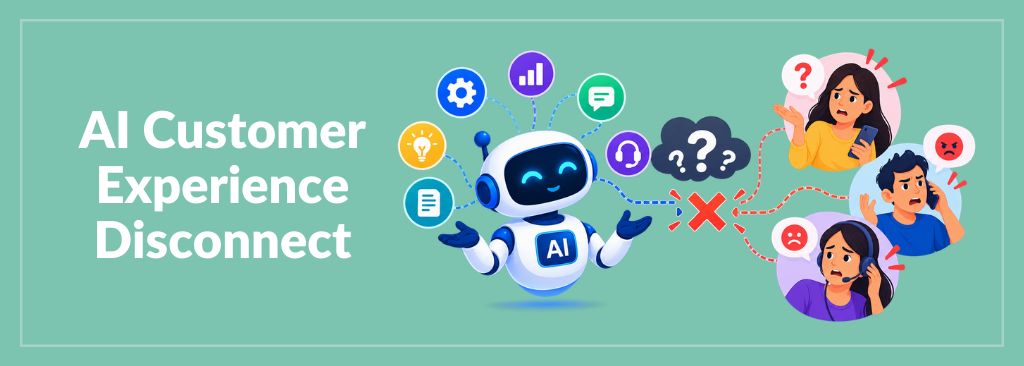
Why Customer Experience Isn’t Keeping Up with the AI Boom

I’ll start with a confession. Whenever a colleague walks me through their newest AI success story, I end up asking the same mildly irritating thing: “Lovely. Would any of your customers be able to tell?”
Most of the time, the room goes quiet.
We’re living through the biggest technology boom I’ve seen in my career. AI is writing code, closing the books, scanning X-rays and predicting machine failures. Budgets are growing every quarter. And yet, when I call a bank, chase a refund or try to change a flight, the experience feels almost exactly the way it did a few years ago. Sometimes worse.
That gap has been bothering me for a while. So, in this post, I want to unpack it with you: what the boom looks like elsewhere, why customer experience (CX) hasn’t caught the same wave, and what I think we can actually do about it.
Meanwhile, Everywhere else is Booming
Let me set the scene, because the contrast is the whole point.
In software teams, AI coding assistants have gone from novelty to default in a remarkably short time. Developers I talk to now treat them like a colleague who drafts the boilerplate, writes the tests and explains unfamiliar code. In finance, AI is reconciling accounts, flagging fraud and drafting reports that used to eat entire weekends. In manufacturing, predictive maintenance models spot failing equipment before it breaks. In healthcare, AI helps clinicians read scans and cut down the paperwork that buries them.
The data supports this too. In WRITER’s 2026 survey, almost every executive (97%) reported rolling out AI agents within the previous twelve months, and people using AI day to day said they were getting about five times as much done. Accenture, meanwhile, found that close to nine in ten leaders intend to raise their AI spending this year.
Notice what these wins have in common, though. They’re mostly internal. The work stays inside the organisation, the people using the AI are employees, and success is counted in hours saved or tasks finished. A developer who ships faster doesn’t need anyone outside the company to notice for it to count as a win.
Customer experience doesn’t get that luxury. Its scorecard sits in somebody else’s hands.
So Why is CX Stuck?
Here’s the uncomfortable truth as I see it: CX is where AI stops being a productivity tool and starts being a promise. And promises are much harder to keep.
That same WRITER survey, the one with the impressive personal productivity figures, found fewer than a third of organisations (29%) getting meaningful returns from generative AI. Accenture’s figure for companies seeing lasting impact across the whole business was similar, at 32%. The efficiency exists. It just isn’t reaching the people we serve.
Nowhere is that clearer than in customer service. This year Qualtrics polled over 20,000 shoppers in 14 markets. When AI handled their service requests, it let them down almost four times as often as AI did in other parts of their lives. Service bots ended up near the bottom of their list of helpful AI experiences.
Adobe’s CX AI Maturity Index tells a similar story from the inside. Roughly one company in eight has customer journeys that AI coordinates from start to finish, and fewer than one in ten personalize experiences with AI in real time. Put simply, AI shows up somewhere in nearly every CX stack, yet very few businesses have it joined up across the whole journey.
I don’t think the problem is the technology. I think it’s everything around it.
The Challenges Holding CX Back
When I break it down, I keep landing on five problems.
#1 We bought AI to save money, not to solve problems.
Let’s be honest about the motive. A lot of CX AI was approved on a cost-per-contact spreadsheet. The Qualtrics team reached a similar conclusion: when savings drive the rollout, customers pick up on it quickly. And when deflection is the target, the customer starts to look like the thing standing in the way.
#2 Our data lives in silos.
To a customer, a late delivery, a double charge and an angry chat are one problem. To most companies, they’re three systems owned by three teams. Adobe’s findings point to the same split, with content, customer data and journeys managed separately. An AI that only sees one piece of the picture can only ever give a partial answer.
#3 We measure the wrong things.
Tickets closed, minutes saved, chats deflected. These look brilliant on a dashboard and tell you nothing about whether the problem was solved. A study by TELUS Digital and Ryan Strategic Advisory found that roughly two in three enterprises don’t use AI to check quality or coach their service operations. That leaves most companies flying blind on how their customer-facing AI behaves, until an unhappy customer tells them.
#4 Trust is wearing thin.
Qualtrics found that more than half of consumers now worry most about what happens to their personal data when service is automated. About half also suspect AI is there to keep them away from a real person. That fear is rational. We’ve all been trapped in a chatbot loop.
#5 We layered AI on top of legacy workflows.
This is the big one for me. Most service workflows were built around people passing work along to other people. Slotting AI into one stage makes that stage quicker, but the overall journey stays just as clunky.
What I Think We Should Do About It
Here’s the encouraging part. Fixing this isn’t about waiting for smarter technology. It’s about making different choices.
Start with the customer’s problem, not the cost line. Before approving any CX AI project, I’d ask one thing: which customer pain does this remove? If the honest answer is “it lets us hire fewer agents,” go back to the drawing board. Savings will follow a genuinely better experience. The reverse rarely happens.
Connect the context. AI in CX is only as good as what it can see. That means stitching together orders, billing, service history and product data so the AI (and the human who picks up next) understands the whole situation. Once that’s in place, you can go a step further and contact customers about a problem, like a stuck order or a declined card, before they even notice it.
Measure what customers experience. Track first-contact resolution, customer effort and retention alongside internal speed. Build monitoring of your AI’s quality into the foundations from day one. Without visibility into how it treats customers, you’re relying on luck rather than management.
Never hide the human. Hand the repetitive queries to AI and free your strongest people for the conversations that are sensitive, tricky or consequential. Make it easy to reach a person, and be transparent about how you use customer data. Trust takes years to earn and one bad bot conversation to lose.
Redesign the journey, not just the step. Map how a customer issue actually flows today, then rebuild it around what AI and people each do best. That’s slower and less glamorous than buying a new tool, but it’s where the real gains are.
The Question Worth Asking
I don’t believe CX is doomed to lag behind. I think it’s simply the hardest test of AI, because it’s the one place where the people judging the results don’t work for us.
Other sectors can celebrate speed. CX has to deliver something customers actually feel. So, when the next impressive AI dashboard lands on your desk, try my irritating question on it: would a customer notice the difference, and do we have the evidence?
A confident answer means the AI is genuinely improving the experience. A long silence tells you where the real work begins.