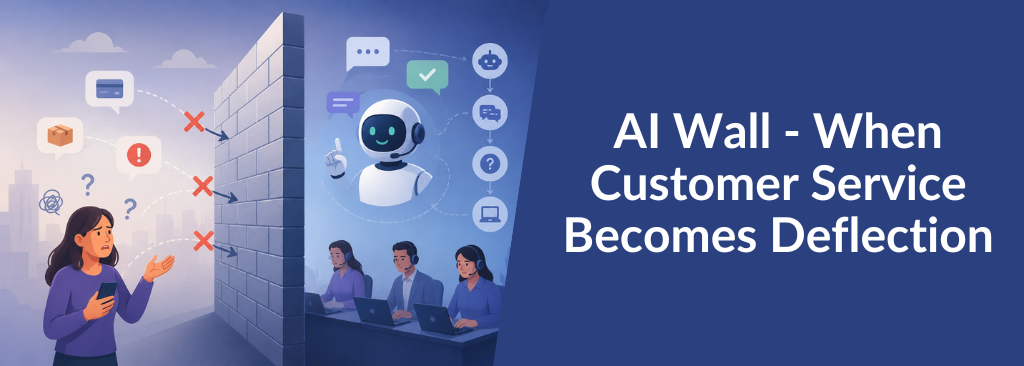
The AI Wall: When Customer Service Becomes Customer Deflection

Have you ever been stuck arguing with a chatbot that simply refuses to understand you?
Not because your request is unreasonable, but because the system was never designed to actually help you; it was designed to make you give up.
I had that experience recently. I ordered food through a delivery app. What showed up at my door was someone else’s meal entirely.
Wrong items, wrong everything. Simple enough problem, right?
Return the food, get a refund, move on.
Except I couldn’t.
The app’s AI support system kept looping me through the same set of scripted options, none of which matched my situation.
No matter how I phrased my complaint, the bot couldn’t grasp why I wanted to return the order. And when I tried to reach an actual human being? That option simply didn’t exist.
The AI was the gatekeeper, and it had no intention of letting me through.
A few days later, I ran into the exact same wall, this time with one of the largest banks in India, where I’ve been a customer for years. A straightforward query that needed a human’s judgment call. Instead, I got the same runaround: a chatbot that could handle the easy stuff but crumbled the moment my problem fell outside its playbook. No escalation path. No human fallback. Just a polite digital dead end.
And that’s when it hit me. This isn’t a glitch. It’s a AI Strategy in CX.
The Efficiency Trap
Here’s the thing about AI in customer service that nobody in the boardroom wants to say out loud: for a lot of companies, the AI isn’t there to resolve your problem. It’s there to make resolving your problem someone else’s headache, specifically, yours.
The numbers tell a compelling story from the other side of the fence. ServiceNow’s recent CX research found that 53 percent of customers expect AI to improve speed and efficiency. That sounds great on a slide deck. But the same study found that 50 percent of customers say their top frustration is a lack of empathy. Speed and empathy, it turns out, aren’t the same thing. And when companies optimize ruthlessly for one, they tend to crush the other.
There’s nothing wrong with using AI to handle simple, repetitive tasks. Checking an account balance, tracking a delivery, and resetting a password are exactly the kinds of interactions where automation makes life better for everyone. As a recent analysis in Contact Centres put it, these routine queries can often be resolved in seconds without human intervention, cutting wait times and letting companies handle higher volumes.
But my wrong food order wasn’t a password reset. My banking issue wasn’t a balance check. These were situations that required judgment, context, and a basic acknowledgment that something had gone wrong. And the AI had none of that to offer.
The Empathy Problem is Really a Design Problem
It’s tempting to frame this as “AI lacks empathy,” shrug, and move on. But that lets the companies off the hook too easily. The real issue isn’t that AI can’t be empathetic. It’s that most companies haven’t bothered to build systems where empathy can actually reach the customer.
ServiceNow’s research uncovered a telling statistic: service representatives spend only 45 percent of their time actually addressing customer issues. The rest? Navigating between systems. Eighty percent of agents have to log into three to five separate platforms just to resolve a single problem.
That’s not an AI problem; that’s an architecture problem. And when you layer a chatbot on top of that broken architecture, you don’t get better service. You get a shinier door on the same broken building.
Mark Ashton of ServiceNow described agents as functioning like middleware, the human glue holding fragmented systems together. When the systems behind the scenes are disconnected, even well-meaning agents struggle to deliver the kind of service customers expect. Replace those agents with a bot that has even less ability to navigate complexity, and you get exactly what I experienced: a wall.
The Human Agent Isn’t Dying; It’s Being Locked Away
There’s a widely held fear that AI will kill the contact center agent. The reality is more subtle and, in some ways, more troubling. AI isn’t eliminating human agents so much as it’s hiding them behind an impenetrable layer of automation.
As AI filters out simpler queries, the average complexity of issues reaching human agents is actually going up. The level of expertise agents need has gone up multifold, including stronger communication skills, deeper product knowledge, and sharper judgment. The role is evolving, not disappearing.
But here’s the catch. If companies use AI primarily as a deflection tool, a way to prevent customers from ever reaching those skilled agents, then all that evolution is meaningless. You can have the most empathetic, well-trained support team in the world, but it doesn’t matter if the customer can never get to them.
That’s the quiet betrayal happening across industries right now. Companies invest in AI to “improve the customer experience” while simultaneously making it harder for customers to access the one resource that actually does: another human being.
When AI Helps vs. When AI Hides
To be fair, AI in customer service isn’t inherently a villain. Used well, it can be genuinely transformative. Real-time agent-assist tools can surface relevant information during calls, automate call summaries to reduce post-call paperwork, and implement predictive systems that flag at-risk customers before they churn, all of which are meaningful improvements.
Read : What is churn? and how to prevent it.
ServiceNow’s Ashton shared an example of a utility company that deployed AI during a natural disaster to summarize calls and reduce agent workload. It worked, and the productivity went up. But talk time also increased because agents lost their natural pauses between calls, and the company had to deliberately reintroduce breathing room so teams could sustain empathy during emotionally draining conversations.
That example captures the tension perfectly. AI can optimize a process while simultaneously degrading the human experience within it. The tool isn’t the problem. The lack of thoughtfulness in how it’s deployed is.
The Question Companies Should be Asking
The companies getting this right aren’t asking, “How do we automate more?” They’re asking, “Where does automation create value, and where does it destroy trust?”
There’s a version of this future that actually works. AI handles the straightforward stuff quickly and well. When things get complicated or emotional or just plain messy, there’s a clear, easy path to a human who has the context and authority to help. The AI doesn’t just deflect; it equips. It hands the agent a summary of what happened, what the customer needs, and what’s already been tried.
But that version requires companies to see customer service as something more than a cost center to be squeezed. It requires treating the human agent as an asset worth investing in, not an expense to be eliminated. And it requires designing AI systems with the customer’s resolution in mind, not just the company’s efficiency metrics.
The Wall Needs a Door
I eventually got my food delivery issue sorted, not through the app, but by posting about it on social media. The bank issue took multiple branch visits. In both cases, the “AI-first” approach didn’t save anyone time. It just shifted the effort and frustration onto me.
And I know I’m not alone. Millions of customers across every industry are hitting the same wall every day. They’re not anti-AI. They’re not technophobes clinging to the past. They just want their problem solved, and they can tell the difference between a system that’s trying to help them and one that’s trying to get rid of them.
AI can make customer service faster. It can make it smarter. But until companies build a door into that wall, a genuine path to human help when the machine falls short, they’re not improving the experience. They’re just automating the frustration.
And frustrated customers don’t stay customers for long.