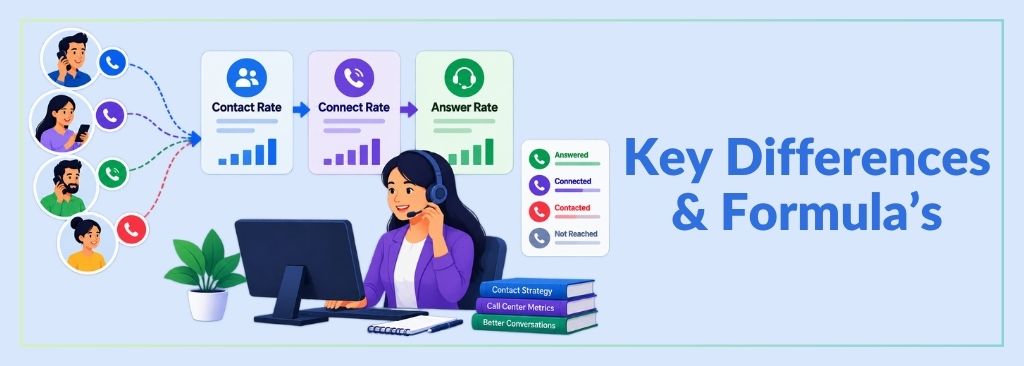
Contact Rate vs. Connect Rate vs. Answer Rate

If you’ve ever sat in a sales or contact centre review and heard three people use contact rate, connect rate, and answer rate to mean the same thing, you’re not alone. These three numbers get swapped around constantly. The trouble is, they measure very different moments in a call, and mixing them up can send you chasing the wrong problem.
Here’s the simplest way I know to think about it.
Every outbound dial Travels Down a Short Funnel:
- The call gets picked up. By anything: a person, a voicemail box, an IVR, a receptionist.
- A live human is on the line. No machines.
- You’re talking to the right person. The actual prospect or customer you meant to reach.
Answer rate measures the first step. Connect rate measures the second. Contact rate measures the third. Each one is narrower than the last, so on any healthy report you’d expect answer rate to be the highest and contact rate to be the lowest.
One quick caveat before we dig in. Not every vendor or team defines these terms the same way. Some dialers call any live pickup a contact, for example. The definitions below are the most common, but the real win is getting your own team to agree on one set and stick with it.
What is Answer Rate?
Answer rate is the share of your dials that get picked up by anything at all. It doesn’t care who or what answers. A voicemail greeting counts. So does an IVR menu, a fax tone in some systems, or a busy receptionist.
Calculate Answer Rate:
Answer rate = (Answered calls/Total dials) x 100
Example:
Say your team makes 1,000 dials on Monday. Of those, 750 ring out, hit a busy signal or fail outright. The other 250 get answered: 110 by voicemail or another machine, and 140 by real people. Your answer rate is 250 ÷ 1,000 × 100 = 25%.
So, what does answer rate actually tell you? Mostly, it’s a health check on your numbers and your caller ID. If it suddenly drops, the usual suspects are a stale list full of disconnected numbers, or your outbound numbers getting flagged as “Spam Likely” by carriers. People can’t answer calls their phone has already hidden from them.
What it won’t tell you is whether your reps are having conversations. A list packed with numbers that roll straight to voicemail can post a lovely answer rate and still produce almost no pipeline. That’s why you need the next metric.
What is Connect Rate?
Connect rate is the share of your dials that reach a live human being. Machines are out. Anyone with a pulse who says “hello” is in, whether that’s your prospect, their assistant, a family member or someone who’s had the number for six months and has never heard of you.
Calculate Connect Rate:
Connect rate = (Live human connects/Total dials) x 100
Example:
Back to Monday’s 1,000 dials. We had 250 answers, and 140 of them were real people. Your connect rate is 140 ÷ 1,000 × 100 = 14%.
This is the metric most sales leaders actually care about day to day, because it’s the closest proxy for “how often do my reps get to open their mouths?” It reflects everything that influences whether a person picks up: the time of day you call, whether you show a local number, how fresh your data is and how well your dialer handles answering machines.
A word on the denominator. Some teams divide by answered calls instead of total dials, which turns connect rate into “what share of answers were human.” That’s a useful number too, but it’s a different one. If you’re comparing your figures with a benchmark or a vendor’s claims, check which denominator they used. It’s the single most common reason two connect rates refuse to line up.
What is Contact Rate?
Contact rate is the share of your dials that reach the right person, the one you actually set out to speak to. In collections and contact centres you’ll often hear this called a right-party contact, or RPC. Gatekeepers, wrong numbers and “she’s not in today” don’t count.
Calculate Contact Rate:
Contact rate = (Right party contacts/Total dials) x 100
Example:
Of Monday’s 140 live connects, 45 were receptionists or assistants, 15 were wrong numbers, 10 were people who asked to be called back by someone else, and 70 were the actual prospects on your list. Your contact rate is 70 ÷ 1,000 × 100 = 7%.
Contact rate is the metric that sits closest to revenue. You can’t book a meeting, collect a payment or renew a policy with a receptionist. If your connect rate looks healthy but contact rate is low, the problem usually isn’t your dialer. It’s your data: outdated direct dials, switchboard numbers and contacts who’ve moved on.
You’ll also see contact rate measured per record rather than per dial. In that version, you divide the number of unique people you reached by the number of people you tried to reach. It’s a great way to see how much of a list you’ve genuinely worked through, especially across multi-attempt cadences, so pick whichever view fits the question you’re asking.
Contact Rate vs. Connect Rate vs. Answer Rate
Put the three side by side and the pattern is easy to see. Each metric is a slice of the one above it.
| Metric | What counts | Formula | Example | What it mostly reflects |
| Answer rate | Any pickup, human or machine | Answered calls/Total dials | 250/1000 x 100 = 25% | Number health, caller ID reputation |
| Connect rate | Live humans only | Live connects/Total dials | 140/1000 x 100 = 14% | Timing, local presence, AMD, dialer setup |
| Contact rate | The right person only | Right party contacts/Total dials | 70/1000 x 100 = 7% | Data accuracy, targeting |
The real value comes from reading them together. Here are three patterns I see a lot.
High answer rate, low connect rate.
Lots of pickups, few humans. You’re probably hitting a wall of voicemail, or your answering machine detection is misfiring. Look at when you’re calling and how your AMD is tuned.
Healthy connect rate, low contact rate.
Your reps are talking to plenty of people, just not the right ones. That points straight at your list: switchboard numbers, outdated contacts or poor targeting.
Everything dropping at once.
When all three slide together, suspect your caller ID first. Spam labelling hits the very top of the funnel, so it drags every number below it down too.
How to improve all three
Look after your numbers and dialer. Register your outbound numbers with carriers and branded-caller-ID services, rotate them sensibly and retire any that get flagged. Local presence dialing, where people see a number from their own area, tends to lift pickups. Then match the dialer mode to the job: power or parallel dialing for high-volume prospecting, preview dialing when reps need to research before each call.
Clean up your list. Bad data is the quiet killer of contact rate. Verify numbers before a campaign, favour direct dials and mobiles over switchboards, remove duplicates and scrub against do-not-call registries. A smaller, accurate list will beat a big, stale one every time.
Tune your AMD. Answering machine detection saves reps from listening to voicemail greetings, but it has trade-offs. Set it too aggressively and it hangs up on real people. Set it too slowly and the person hears dead air, says “hello?” twice and puts the phone down. Test settings, review recordings and track how many humans get misclassified.
Get smarter about when and how you call. Look at your own data to find the hours and days when connect rates peak for each segment, and schedule around them. Space out retries rather than hammering the same number. And don’t rely on calls alone: an email or LinkedIn message before a call makes your name familiar, which makes people more likely to pick up.
Frequently Asked Questions
Connect rate counts every call that reaches a live human, whoever they are. Contact rate only counts calls that reach the specific person you were trying to speak to. A receptionist counts as a connect but not a contact, so contact rate is always the same as or lower than connect rate.
Answer rate counts any pickup, including voicemail, IVRs and other machines. Connect rate strips the machines out and counts only live people. If your answer rate is high but your connect rate is low, most of your answers are probably voicemail.
Divide the number of right-party contacts by the total number of dials, then multiply by 100. For example, 70 right-party contacts from 1,000 dials gives a 7% contact rate. Some teams divide by unique records attempted instead of dials, to see how much of a list they’ve reached.
There’s no universal benchmark, because it depends heavily on your industry, data source, call type and how you define a contact. As a rough guide, cold B2B outbound often sees per-dial contact rates in the low single digits, while warm leads, inbound callbacks and existing customers can run far higher. The most useful benchmark is your own trend over time, compared across lists and campaigns.
Start with your caller ID: keep numbers registered and unflagged, and try local presence. Then call at the times your own data shows people actually pick up, space out retries, tune your answering machine detection and warm people up with email or social touches before you call.
Yes, in both directions. Good AMD means reps spend their time on live humans instead of voicemail greetings, which raises productive connects per hour. But a poorly tuned setup can misread real people as machines and drop them, or create a pause that makes people hang up. Those are lost connects, and in several markets, abandoned calls also count against regulatory limits. Test and monitor your settings regularly.