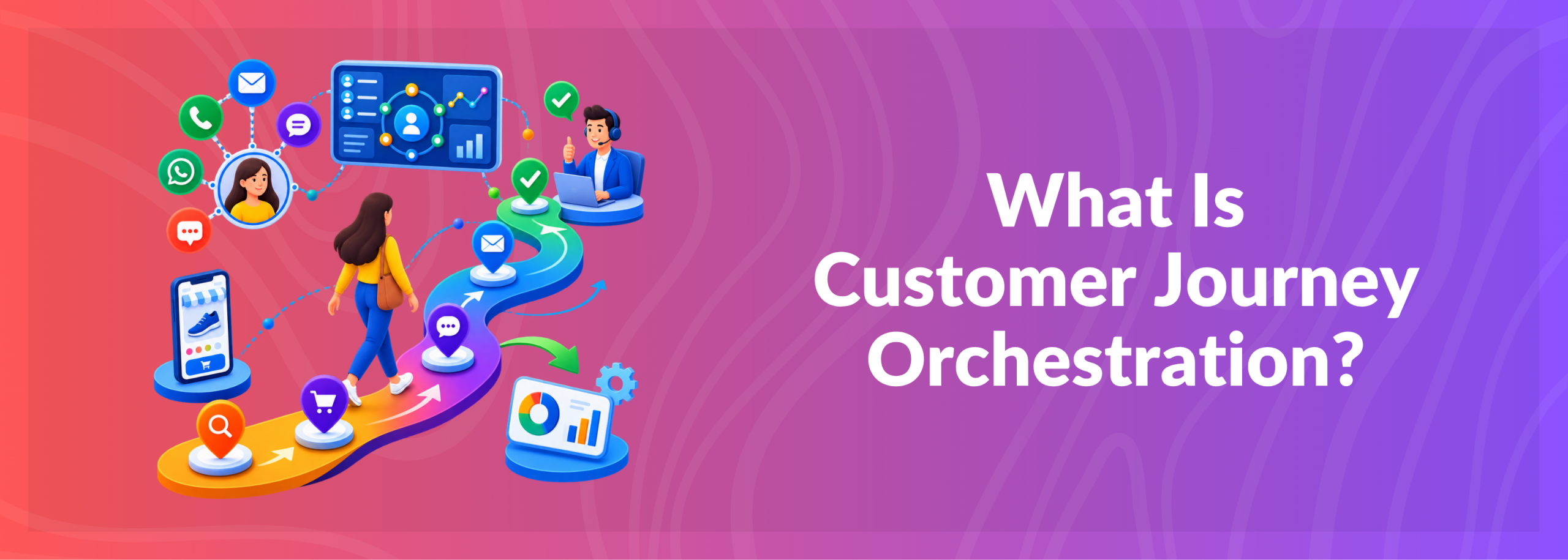
What Is Customer Journey Orchestration?

Your customer doesn’t think in channels. They think in moments.
They get a payment reminder on WhatsApp, click a link, land on your website, start a chat, give up halfway, call your number the next morning, and expect the agent to already know what went wrong. To them, that’s one continuous experience and one journey. To most contact centers, though, it’s five disconnected events, handled by five different systems that have never spoken to each other.
That gap between how customers experience you and how your contact center sees them is exactly what customer journey orchestration is built to close.
In this guide, we’ll break down what journey orchestration really means, the four building blocks that make it work, and the honest reason your traditional contact center, no matter how many channels you’ve bolted on, simply wasn’t designed to deliver it.
What Is Customer Journey Orchestration?
Customer journey orchestration is the practice of seeing, deciding, and acting on a customer’s entire journey in real time across every channel, every touchpoint, and every interaction, so that each next step feels connected to the last.
Notice the word “orchestration.” It’s deliberate. An orchestra isn’t just a room full of talented musicians. It’s talented musicians playing together, reading the same sheet, following the same conductor, arriving at the same beat. Take away the coordination, and you don’t have music; you just have noise.
That’s the difference between a contact center and journey orchestration. A traditional contact center has the instruments: a dialer, an IVR, a chat window, an email queue, and maybe a chatbot. Journey orchestration is the conductor that makes them play as one.
Put simply, orchestration does three things at once:
- It watches the customer’s journey unfold across channels in real time.
- It decides what the smartest next move is for that specific customer, right now.
- It acts on that decision instantly, such as by routing, automating, nudging, or handing off to a human without the customer ever feeling the seams.
When those three happen together, the journey flows. When they don’t, the customer repeats themselves, waits longer, and quietly starts looking at your competitor.
The Four Building Blocks of Journey Orchestration
Journey orchestration isn’t a single feature you switch on. It’s four capabilities working in concert: visibility, decisioning, execution, and outcomes. Get all four right, and you have orchestration. Miss one, and you’re back to noise.
Let’s walk through each.
1. Journey Visibility: You Can’t Orchestrate What You Can’t See
Everything starts here. Before you can guide a journey, you have to be able to see the whole thing, as it happens, not stitched together in a report three days later.
Journey visibility means bringing together three things you probably already have, but in scattered pieces:
Real-time analytics. Not yesterday’s dashboard. Live signals like who’s stuck in your IVR right now, which chat just went silent, and which customer has called three times this week. Real-time analytics turn your contact center from a rear-view mirror into a windshield. You stop reacting to what already went wrong and start spotting it as it happens.
Unified customer data. Every journey leaves a trail like a WhatsApp message here, an abandoned cart there, a complaint from last month, a payment that bounced. On their own, these are just fragments. Pulled together into a single, 360-degree view, they become a story. And when your agent can see the whole story the moment a customer connects, nobody has to repeat themselves, and nothing gets lost in the transition.
Journey intelligence. This is where the data starts earning its keep. Journey intelligence reads the patterns across thousands of journeys and tells you what’s actually going on, like where customers drop off, which paths lead to resolution, which ones lead to churn, and what a “good” journey even looks like for your business. It turns raw dashboards into insights that actually mean something.
Here’s the honest test: if your team can’t answer “what is this customer trying to do, and where are they in that process?” in a single glance, you don’t have journey visibility yet. You have channels.
2. Journey Decisioning: Knowing the Smartest Next Move
Seeing the journey is step one. Knowing what to do about it is step two, and this is where most contact centers fall flat.
Journey decisioning is the brain of orchestration. It takes everything visibility surfaces and answers one question, continuously, for every customer: what’s the best thing to do next?
AI does the heavy lifting. A human supervisor can’t watch ten thousand journeys at once and make a fresh decision for each one, every second. AI can. It weighs the context, like who the customer is, what they’ve done, how they’re feeling, what’s worked for similar customers, and recommends the next move in real time.
Intelligent routing puts the customer in the right hands the first time. Not the next available agent. The right agent by skill, by language, by history, by intent. A customer asking about a loan product gets the loan specialist, not a five-minute transfer carousel. Routing that’s based on the journey, not just the queue, is what kills the dreaded “let me transfer you” moment.
Automation handles what doesn’t need a human. A balance inquiry, appointment confirmation, or a simple status check doesn’t need to take up an agent’s or a customer’s patience. Decisioning knows when to let automation handle it and when a human absolutely needs to step in.
Next best action turns service into a relationship. This is decisioning at its sharpest. Based on where the customer is in their journey, what’s the one move that helps them most right now? Maybe it’s offering a payment plan instead of chasing the outstanding bala
nce. Maybe it’s a proactive WhatsApp before the customer even has to call. Next best action means you stop treating every interaction as an isolated transaction and start treating it as one step in a relationship.
The difference is subtle but enormous. A traditional contact center asks, “How do we handle this call?” Orchestration asks, “What does this customer need next?” Same customer, completely different outcome.
3. Journey Execution: Making It Happen Without the Seams Showing
A brilliant decision that takes thirty seconds and three screens to act on isn’t brilliant anymore. Execution is where orchestration either delivers or quietly falls apart. This is the part the customer actually feels.
Omnichannel, not multichannel. This distinction matters more than the marketing makes it sound. Multichannel means you’re present on voice, chat, email, SMS, WhatsApp, and social, but each runs in its own lane, with its own history, its own agents. Omnichannel means those channels are stitched into one continuous conversation. The customer can start on WhatsApp, switch to a call, and finish on email, and the thread never breaks. The agent always sees the full history, no matter where the journey began. Fewer repeats, faster responses, a personal touch every time.
Workflow management keeps the journey moving. Real journeys have steps like verify, approve, escalate, follow up, and close the loop. Workflow management makes sure each step happens in order, without anything slipping through the cracks. The promised follow-up actually goes out. The escalation reaches the right desk. Nothing waits in limbo because someone forgot.
A unified agent desktop ends the screen-juggling. Ask any agent what slows them down, and they’ll point to the screens. CRM here, helpdesk there, knowledge base in a third tab, call history in a fourth. A unified agent desktop pulls it all into one place, like customer, context, history, and tools, on a single screen. The agent stops hunting for information and starts actually helping. Faster for them, smoother for the customer.
Self-service that hands off gracefully. Plenty of customers would rather solve it themselves, and you should let them. A good IVR, a smart chatbot, a payment portal. But the magic isn’t the self-service. It’s the handoff. When a chatbot can’t crack it and the customer needs a human, that transition should be frictionless, and the agent should already have the full context. The customer should never feel like they’ve started over. That’s execution done right.
When visibility, decisioning, and execution work together, here’s how the customer feels: they were understood, helped quickly, and never had to explain themselves twice. They won’t call it orchestration. They’ll just call it good service.
4. Journey Outcomes: The Part the Business Actually Cares About
All of this is lovely in theory. But orchestration has to show up where it counts, in numbers your leadership recognizes and your customers feel. This is where the work pays off.
CSAT (Customer Satisfaction) climbs because customers stop repeating themselves, stop waiting, and stop getting bounced around. Satisfaction isn’t a mystery. It’s mostly the absence of friction, and orchestration is, at its heart, a friction-removal engine.
FCR (First Contact Resolution) improves because the right customer reaches the right agent with the right context the first time. When the agent already knows the story and has the tools to act, more issues get solved in one go. Higher FCR means lower costs and happier customers, a rare win that helps both sides of the ledger.
Retention rises because customers leave due to accumulated friction far more often than they leave after a single bad day. Every journey you smooth out is a reason to stay that you’ve quietly banked. Orchestration protects the relationships you’ve already worked hard to win.
Loyalty deepens because consistently good experiences compound. When a customer trusts that you’ll know who they are, remember their history, and make things easy every single time, they stop shopping around. Loyal customers cost less to serve, forgive the occasional slip, and, as anyone in this business knows, are far happier to loosen their purse strings.
These four outcomes aren’t separate goals. They’re the natural result of getting the first three building blocks right. Visibility, decisioning, and execution are the how. CSAT, FCR, retention, and loyalty are the why.
Why Traditional Contact Centers Can’t Deliver Journey Orchestration
Here’s the part nobody likes to say out loud: you can’t orchestrate journeys on infrastructure that was never built for journeys.
This isn’t about your team trying harder or buying one more add-on. Traditional contact centers, even modern, cloud-based ones with every channel switched on, hit the same structural walls. Let’s be honest about what they are.
Channels were built as silos, then duct-taped together. Most contact centers grew one channel at a time. Voice came first. Then the email got bolted on. Then chat. Then somebody added WhatsApp because customers demanded it. Each arrived as its own system, with its own data and its own view of the customer. Adding channels isn’t the same as connecting them. You can have all six and still have the customer repeat their story six times.
They’re reactive by design. A traditional contact center waits for the phone to ring. It’s built to handle interactions as they come in, one at a time. Orchestration is proactive; it watches the journey and acts before the customer has to pick up the phone in frustration. You can’t be proactive about a journey you only see the moment it lands in your queue.
Data lives in fragments. When your customer history is scattered across a CRM, a helpdesk, a dialer, and three channel tools that don’t talk to each other, there is no single source of truth. And without a unified view, even the best agent is working half-blind. Decisioning needs complete context; fragmented data can’t provide it.
They optimize the interaction, not the journey. This is the deepest issue and the hardest to see. Traditional contact centers measure and manage individual interactions, such as handle time, this call, that chat. But a great journey can be made up of interactions that each look unremarkable on their own. When you optimize only the interaction, you can hit every metric on a single call and still lose the customer over the course of the journey. Orchestration zooms out to the thing the customer actually experiences: the whole arc.
There’s no conductor. Going back to where we started, even if a contact center has visibility tools, routing rules, and automation, these features usually run as separate components that don’t coordinate. Nobody’s holding the baton. Real orchestration requires visibility, decisioning, and execution to function as a single, connected system in real time. Bolt-on features, however good individually, don’t add up to that on their own.
None of this is a criticism of contact centers. They were the right tool for an era when customers had two or three ways to reach you and were happy to wait. That era is over. Customers now move across six channels in a single afternoon and expect you to keep up. The job changed. The tooling has to change with it.
What the Shift Actually Looks Like
Moving from a traditional contact center to journey orchestration isn’t a rip-and-replace nightmare, nor is it about chasing every shiny tool. It’s about closing the four gaps we’ve covered, in order:
- Unify the view first. Pull your scattered customer data and channels into a single, real-time picture. Without visibility, nothing else has anything to stand on.
- Add the brain. Layer in AI-led decisioning, intelligent routing, and automation so the system can work out the next best action, and not just react to whatever lands in the queue.
- Tighten execution. Give agents a unified desktop, connect your channels to enable true omnichannel conversations, manage workflows end-to-end, and make self-service hand off gracefully.
- Measure what matters. Metrics to Track CSAT, FCR, retention, and loyalty, the journey-level outcomes, and not just interaction-level vanity metrics.
The good news: the kind of infrastructure that used to be the preserve of large enterprises is no longer locked behind enormous budgets and year-long deployments. Cloud-based platforms have democratized journey orchestration, so a growing business can access the same capabilities a giant uses on a subscription, without the lock-in, paying only for what they use.
Great experiences shouldn’t come with strings attached.
See What Orchestrated Journeys Could Do for Your Customers
Your customers are already moving across channels, switching mid-conversation, and expecting you to keep up. The only question is whether your contact center can move with them, or whether it’s still handling one disconnected interaction at a time.
ClearTouch brings visibility, decisioning, and execution together on a single cloud platform, so every journey flows and nothing gets lost in the transition. No contracts, no lock-in, no strings attached; just better experiences for the customers you’ve worked hard to win.
Request a Demo and see what journey orchestration looks like for your business. Deliver connected customer journeys with TCN Operator. Unify customer data, enable AI-powered decisioning, and orchestrate every interaction across voice, chat, email, WhatsApp, and social from a single cloud contact center platform.
Frequently Asked Questions
A contact center handles individual interactions as they arrive, such as calls, chats, or emails. Customer journey orchestration sits above all of that and coordinates the entire journey across channels in real time, deciding the smartest next step for each customer and acting on it. The contact center is the set of instruments; orchestration is the conductor that makes them play together.
Omnichannel is a crucial part of orchestration, but it isn’t the whole thing. Omnichannel is about execution, like connecting your channels so the conversation flows without breaks. Orchestration adds the layers above it: visibility into the full journey and decision-making to know what to do next. You can have omnichannel without true orchestration, but you can’t have orchestration without omnichannel.
Not at all. The smarter path is to close the gaps in sequence. Start by unifying your customer view and data, then layer in decisioning and automation, then tighten execution. Modern cloud platforms are API-ready and plug-and-play, so you can integrate with the CRM, helpdesk, and tools you already use rather than tearing everything out.
AI is the engine of journey decisioning. It watches the journey in real time, weighs the context for each customer, and recommends the next best action, whether that’s routing to a specific agent, triggering an automation, or prompting a proactive outreach. It does at scale what no human supervisor could: make a smart, individual decision for thousands of journeys at once.
Watch the journey-level outcomes, not just interaction metrics. If CSAT is climbing, first-contact resolution is improving, customers are repeating themselves less, and retention and loyalty are trending up, then your orchestration is doing its job. If your handle time looks great but customers still churn, you’re optimizing interactions, not journeys.
It used to be. Today, cloud-based platforms have made it accessible to businesses of every size on a pay-as-you-go basis. You don’t need every channel or an enterprise budget to begin; even a few well-connected channels with unified data and smart decisioning will start delivering better journeys.