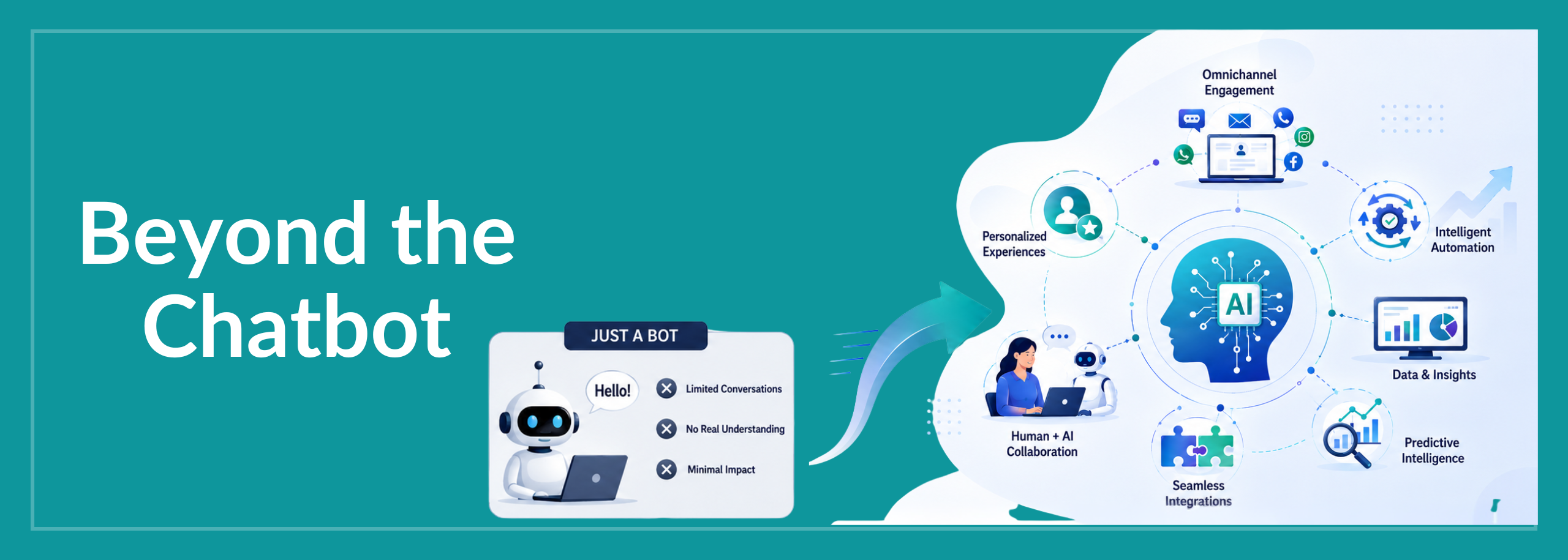
Beyond the Chatbot: Why Your AI Investment Needs to Be Bigger Than a Bot

Your customers are already using AI for customer service. They’re just not using yours.
A recent Gartner study found that customers are three times more likely to turn to third-party GenAI tools like ChatGPT, Google’s AI Overviews, or Apple Intelligence than to a company’s own chatbot when they need help.
And can you blame them?
These tools are on their phones already. They’re part of the daily routine. Nobody has to navigate an unfamiliar support portal or sit in a queue. Gartner predicts that by 2027, 40% of all customer service issues will be resolved through these unofficial third-party tools, without a customer ever touching a brand’s own channels.
If you’re a contact center leader who just spent the last year building a chatbot, that stat probably stings.
But this isn’t a reason to stop investing in AI. It’s a reason to rethink how you’re investing in it.
The Chatbot Got You in the Door. Now What?
I’ll give the chatbot its due. It’s a reasonable place to start an AI journey. It’s visible, it’s fairly easy to deploy, and it gives leadership something to point at when they want to know what the AI budget produced. For many contact center teams, the customer-facing chatbot was the first real proof that AI could be useful in their operations.
But it also has a ceiling, and we’re hitting it.
Gartner’s own research shows that only 14% of cust svc issues are fully resolved through self-service channels today. Almost half of those failures (43%) come down to irrelevant content or poor navigation. And 61% of service leaders admit they have a backlog of knowledge articles that need updating. So, when the chatbot pulls from a knowledge base that hasn’t been touched in months, it’s going to disappoint people. That’s not an AI problem. That’s an operations problem that AI is making more visible.
When the C-suite asks, “What are we getting for our AI spend?” a chatbot with a 14% resolution rate won’t cut it. The budget conversation gets awkward fast.
Stop Thinking About Tools. Start Thinking About the Platform
This is where things need to change, especially for those of us in the CCaaS space. The real value of AI in customer service isn’t in any single tool. It’s in how AI shows up across the entire contact center operation. And as a CCaaS provider, we’re sitting in the right spot to make that happen for our customers.
Think about what a contact center actually does in a given day. Agents handle calls, chats, and emails. Supervisors watch queues and coach people. Quality analysts review interactions. Workforce managers forecast call volumes and build schedules. Ops leaders stare at dashboards and make resourcing calls. Every single one of those workflows can benefit from AI, not just the chat window on the website.
When you bring AI across the platform instead of treating it as a standalone feature, the impact adds up. AI can listen to live calls and pull up relevant knowledge articles for agents in the moment, cutting handle times without hurting quality. It can automatically summarize every interaction, so agents aren’t spending 10 minutes on after-call work. It can score 100% of interactions for quality, compared to the 2-3% that human analysts typically get to. It can forecast contact volumes with more precision. It can catch shifts in customer sentiment mid-conversation and flag them to supervisors before things go sideways.
None of those are chatbots. All of them save money or improve outcomes in ways that are easy to measure.
Why CCaaS Providers Should Care About This More Than Anyone
When AI capabilities are built into the platform itself, rather than bolted on as separate products, every customer on that platform benefits at the same time. A CCaaS provider that builds AI-powered agent assist, automated quality management, intelligent routing, and predictive analytics into its core offering isn’t helping a single enterprise deploy a single chatbot. It’s raising the baseline for every contact center it serves.
For our customers, the businesses running their contact centers on our platform, this means they don’t need their own AI team or a big R&D budget to start seeing results. They gain capabilities that continuously improve, are maintained as part of the platform, and are designed to work together rather than in isolation.
And for their customers, the people calling or chatting in for help, it means faster answers, better-informed agents, and conversations where someone actually seems to understand the problem. Because that Gartner finding about third party GenAI? The reason people reach for ChatGPT instead of a company chatbot isn’t that they love AI. It’s because ChatGPT requires less effort. The bar has been set. If you meet it through your own channels, people will use them. If you don’t, they’ll keep going elsewhere.
The Chatbot ROI Trap
There’s a pattern I keep seeing. A company deploys a chatbot. They measure deflection rates. The numbers are underwhelming. Someone concludes that AI doesn’t deliver enough value. The project stalls. The budget gets questioned. And the company falls behind while competitors quietly integrate AI more deeply into how they run things.
The problem was never AI. It was the narrowness of the use case.
Gartner says 91% of customer service leaders are under pressure to implement AI right now. That pressure isn’t going to go away because of a chatbot. It’s going to take a broader approach, one where AI touches agent performance, operational efficiency, customer experience, and business intelligence all at once. When AI reduces average handle time by 15%, improves first contact resolution by 20%, automates quality scoring across every interaction, and gives leadership real-time visibility into what’s driving customer contacts, that’s a story executives actually want to hear. That’s a business case, not a science project.
So, What Should You Actually Do?
If you’re a contact center leader reviewing your AI strategy in CX right now, I’d start with a different question than most people ask. Instead of “should we build a chatbot?”, try “where are our biggest operational pain points, and where can AI make the most difference across the whole operation?”
Sometimes the answer will still be a customer-facing bot. Fine. But more often, the biggest wins are behind the scenes: helping agents find answers faster, automating quality reviews, optimizing workforce schedules, making sense of the data you’re already collecting. As a CCaaS provider, our job is to make those capabilities accessible, integrated, and always improving, so our customers can spend their energy on what actually matters: delivering great service.
The standalone chatbot era is wrapping up. What comes next is AI woven into how contact centers operate, end to end. The question isn’t whether to invest in AI. It’s whether you’re spreading that investment wide enough to get returns worth talking about.