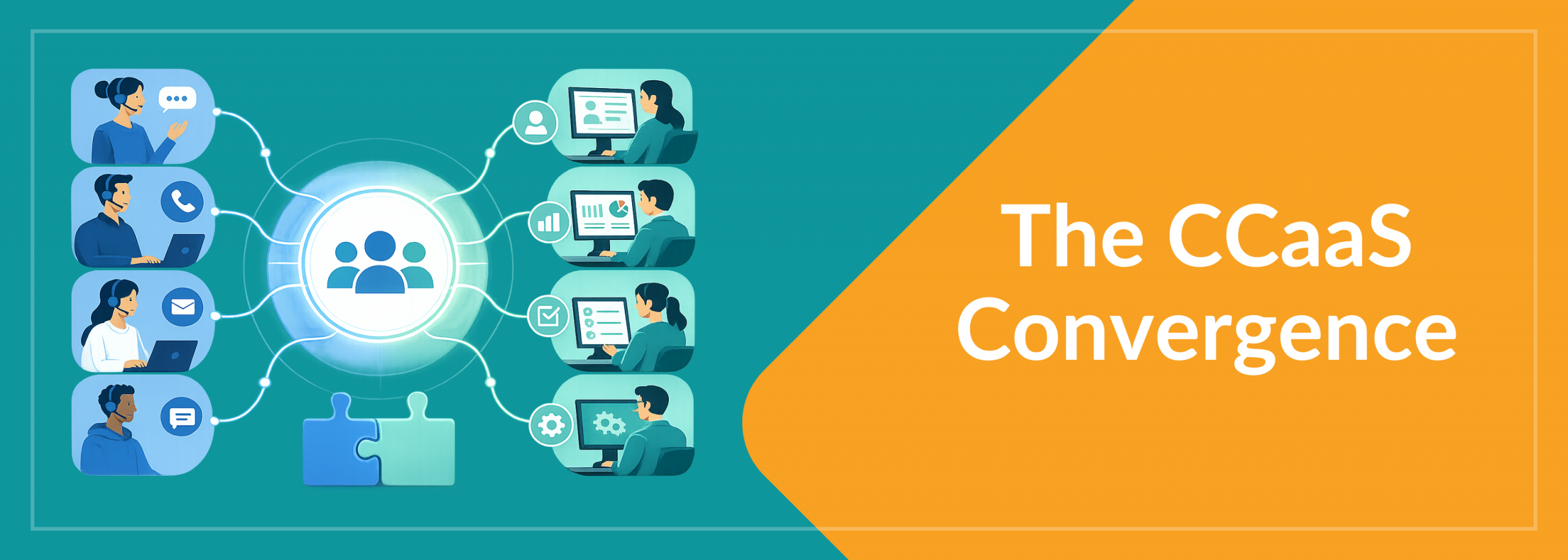
The CCaaS Convergence: Why Your Agents and Back-Office Can No Longer Be Siloed

Picture this. A customer calls in about a billing discrepancy on their enterprise account. Your agent pulls up the ticket, sees the charge, and knows it doesn’t look right, but the specifics sit with the finance team.
So, the agent puts the customer on hold, opens a completely different application, searches for someone in accounts receivable, sends a message, waits for a response, gets none, tries calling someone else, and eventually tells the customer they’ll need to call back.
The customer hangs up, frustrated. The agent logs it as unresolved. And somewhere in the building, the person who could have answered the question in thirty seconds had no idea the call was even happening.
This isn’t a fringe scenario. This is Tuesday morning in most contact centers. And it’s exactly why the wall between your contact center and your back-office collaboration tools can’t stand any longer.
The Market Is Already Moving Fast
If you’ve been watching the communications space even casually, you’ve probably noticed something: the biggest players are no longer treating unified communications and contact center platforms as separate product lines.
UC providers have started embedding contact center capabilities directly into their collaboration suite. Microsoft has been weaving contact center functionality deeper into Teams through its Dynamics 365 integration. Zoom has been pulling its meeting, phone, and contact center products into a single platform layer. This isn’t a coincidence, and it isn’t a marketing exercise. These companies are responding to something their customers have been telling them for years: the separation between “tools employees use to talk to each other” and “tools employees use to talk to customers” is creating real, measurable damage.
Industry research backs this up. Studies by firms such as Metrigy have found that organizations running unified stacks see measurable improvements in first-call resolution and customer satisfaction compared to those maintaining separate systems. And roughly 95% of enterprises now say they consider integrating unified communications and contact center capabilities important. The question has shifted from “should we integrate?” to “how quickly can we get there?”
The Back-Office Silo Is Where First Call Resolution Goes to Die
Let’s talk about first call resolution for a moment, because it’s one of those metrics everyone chases but few organizations set up to actually achieve. Here’s the uncomfortable truth: FCR doesn’t fail because your agents lack knowledge or training. It fails because your agents lack access.
Think about what happens when a customer calls with a question that crosses departmental lines. Maybe it’s a technical issue that needs input from engineering. Maybe it’s a contract question that requires someone from legal. Maybe it’s a shipping problem that only the logistics team can untangle. In a siloed environment, your agent’s only options are to transfer the call, escalate a ticket, or promise a callback. Every one of those options adds time, creates friction, and increases the chance that the customer simply gives up.
Now imagine your agent could see, in real time, that a product specialist in engineering is available right now. They send a quick message with the customer’s account details attached, get a response in under a minute, and relay the answer while the customer is still on the line. That’s not a fantasy. That’s what presence sharing and a converged communication stack make possible. When your internal collaboration tools and your contact center platform share a single directory, a single view of availability, and a single way to exchange context, your agents stop being isolated and start being connected to the full weight of your organization’s expertise.
From Escalation to Swarming: Solving Problems as a Team
There’s a model gaining traction in customer service circles that fundamentally rethinks how complex issues get resolved. It’s called swarming, and it flips the traditional tiered support model on its head.
In a conventional setup, difficult cases climb a ladder. Tier one can’t solve it, so it goes to tier two. Tier two takes a look, maybe asks for more information, and pushes it to tier three. Each handoff means the customer has to wait longer, often re-explain the problem, and deal with someone new who’s starting from scratch.
The Consortium for Service Innovation, which developed the Intelligent Swarming methodology, describes a different approach: one agent owns the case from start to finish, but pulls in the right experts collaboratively and in real time, rather than passing the baton.
Here’s what that looks like in practice. A customer calls about a failed software deployment. Instead of escalating the ticket up the chain, the agent opens a dedicated channel right there on the same platform and brings in a solutions architect and a deployment engineer. The three of them work through the problem together while the customer is still on the line or briefly on hold. The agent remains the single point of contact, the experts contribute their knowledge directly, and the issue is resolved in a single interaction. No callbacks. No “someone will get back to you within 48 hours.” No case bouncing between inboxes for a week.
Swarming works because it treats expertise as something you pull toward the problem, not something you push the problem toward. But it only works when the tools allow it. When an agent can spin up a collaborative space, loop in the right people, and share context without leaving their contact center interface. That’s convergence in action.
AI Is the Connective Tissue
Here’s where things get genuinely exciting. Convergence gives you the plumbing, a shared platform where agents and internal teams can communicate seamlessly. AI gives you the intelligence layer on top.
Consider what becomes possible when your contact center and collaboration tools share a unified data environment. An AI engine can generate a real-time transcript of a customer call and push a summarised version, such as key issues, customer sentiment, account history, and previous interactions, directly into a Teams or Slack channel where the relevant subject-matter experts sit.
Before the expert even joins the conversation, they already know what’s going on. They don’t need a five-minute briefing. They don’t need to read through a case history. The AI has already done that work.
This changes the speed and quality of every internal collaboration. Instead of an agent trying to explain a customer’s problem over chat while simultaneously keeping the customer calm on the phone, the AI automatically provides the context. The expert reads a clean summary, asks one clarifying question, and delivers the answer. What used to take three interactions now takes one. What used to take two days now takes ten minutes.
And it goes beyond the individual call. When AI operates across a converged stack, it can start identifying patterns: the types of issues that consistently require back-office involvement, the departments that get pulled in most often, the gaps in knowledge base content that force agents to seek help in the first place. That’s not just faster resolution. That’s systemic improvement.
The Wall Has to Come Down
For years, organizations have treated internal communications and customer-facing communications as fundamentally different problems requiring fundamentally different tools. That made sense when phone systems were physical boxes in a server room, and collaboration meant walking down the hall. It doesn’t make sense anymore.
Your customers don’t care about your org chart. They don’t care that billing sits on a different platform than support. They don’t care that your CRM doesn’t talk to your contact center. They care about getting their problem solved, quickly, by someone who seems to know what’s going on.
The convergence of CCaaS and UCaaS isn’t a technology trend for technology’s sake. It’s the infrastructure that makes a genuine, collaborative customer experience possible. It’s what turns your agents from isolated ticket-takers into orchestrators who can bring your entire organization’s knowledge to bear on a single customer interaction.
If you’re still running separate stacks for your contact center and your internal communications, the question isn’t whether you’ll converge. It’s how much longer you can afford not to.
Frequently Asked Questions
UCaaS (Unified Communications as a Service) is your internal collaboration stack, such as voice, video, messaging, and presence for employees. CCaaS (Contact Center as a Service) is your customer-facing stack, such as call routing, IVR, omnichannel queues, and agent tools. The convergence trend is about bringing these two environments together on a single platform so that agents and back-office teams can collaborate seamlessly during customer interactions.
When both platforms share a single directory and real-time presence data, agents can instantly see which subject matter experts are available and reach them without leaving the contact center interface. Instead of escalating a ticket or promising a callback, the agent gets the answer while the customer is still on the line. This eliminates the handoffs and delays that are the biggest killers of FCR.
Swarming is a collaborative support model in which a single agent owns the case from start to finish but pulls in relevant experts in real time, rather than escalating through tiers. The agent opens a shared channel, loops in specialists, and resolves the issue collaboratively, often while the customer is still on the call. It replaces the traditional escalation ladder with a team-based approach that’s faster and far less frustrating for the customer.
AI can generate real-time call transcripts and push summarised context, like the customer’s issue, sentiment, and account history, directly into a Teams or Slack channel where the right experts sit. This means a specialist joining the conversation already knows what’s going on and doesn’t need a verbal briefing from the agent. It dramatically cuts the time it takes to collaborate internally during a live customer interaction.
Running two separate stacks means duplicate licensing costs, disconnected data, separate admin overhead, and integration middleware that breaks during updates. More importantly, it creates information silos that slow down customer resolution and limit what AI tools can do. A converged platform reduces operational complexity, provides AI with access to the full picture across internal and external communications, and enables every employee, not just agents, to contribute to the customer experience when needed.