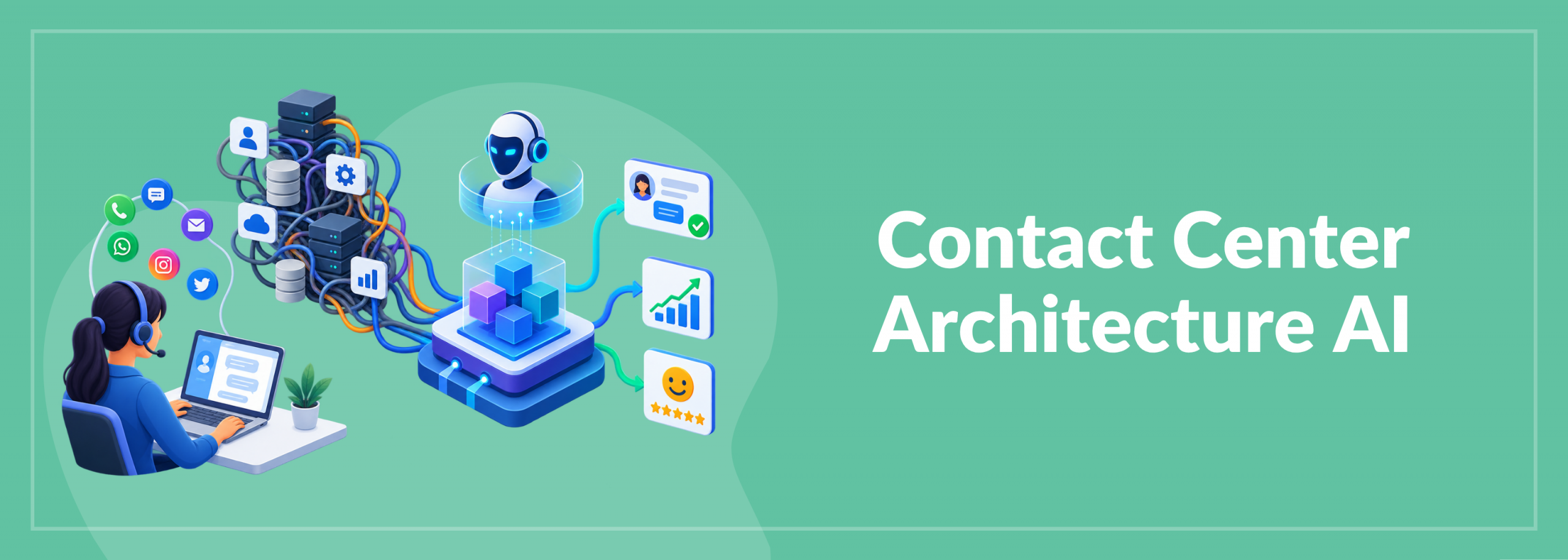
Your Contact Center Doesn’t Have an AI Problem. It Has an Architecture Problem

Is your AI strategy actually being blocked by the technology you already own?
Here’s the uncomfortable truth: most contact centers don’t have an AI problem. They have an architecture problem, and it’s been building quietly for years.
Think about how your stack actually got here. You added a CRM and then a telephony platform. Then workforce management tools, an analytics suite, a chatbot, a knowledge base, an automation platform, and now, AI.
Every single one of those purchases probably made sense at the time. Nobody sat in a room and decided to build something fragmented on purpose.
But AI has now arrived in an environment where customer information, interaction history, and workflows are scattered across a dozen different systems that were never really designed to talk to each other. And that’s the problem nobody wants to name directly, because it’s not as simple as “buy the AI tool.”
Your Stack Didn’t Become Complex Overnight
It’s worth pausing here, because it’s easy to slip into blaming IT teams for this, and that’s not fair or accurate.
Systems got purchased at different times, by different teams, with different priorities and different budgets. New channels got added as customer behavior changed, because customers started expecting chat, messaging apps, and self-service portals. Point solutions solved real, immediate problems. Integrations got built, one at a time, to stitch the gaps back together.
None of that was reckless. It was reasonable, incremental decision-making, repeated for a decade or more.
The result isn’t necessarily a bad technology stack. It’s a technology stack designed for a different era, one where the assumption was that a human being would sit in the middle of it all and make the connections the systems themselves couldn’t make.
Your People Have Been Holding the Stack Together
This is probably the most interesting part of the whole story, and it’s the part that’s easy to miss because it’s invisible in most technology conversations.
Your agents know where to look. Your supervisors know which system holds which piece of information. Your specialists know exactly who to call when something falls outside the standard process. Your most experienced employees have quietly built workarounds that never appear in any process document, but that keep the whole thing functioning day to day.
In other words, your people have become the integration layer. Not officially, not on any org chart, but in practice, that is exactly what’s happening every time someone toggles between five open tabs to answer one customer question.
Now bring AI into that picture. AI cannot lean on tribal knowledge. It cannot remember that “Priya in billing always checks the old system for anything before 2022.” It cannot manually switch between five applications the way a seasoned agent does without thinking. If AI doesn’t have access to connected, consistent context, its intelligence ends up as fragmented as the systems it sits on top of.
Customers Don’t See Your Stack. They Experience Its Consequences
Step back from the architecture diagram for a moment and look at this from the customer’s side of the conversation.
A customer chats with a bot. The bot can’t resolve it, so they call in. They get transferred to an agent. The agent asks many of the same questions the bot just asked. The agent has to search across multiple systems to piece together what’s already happened. The issue turns out to need a different team entirely, so it gets handed off again, and the context gets lost again.
The customer has no idea six different platforms are running behind that experience, and honestly, they shouldn’t have to know. They don’t care how many systems you run. They just reach one simple, entirely fair conclusion: “Why do I have to explain this again?”
That’s the exact moment your technology architecture stops being an internal IT concern and becomes a customer experience problem, sitting right there in the middle of the interaction.
Adding More AI May Actually Make the Problem Worse
Here’s where it gets genuinely counterintuitive, and it’s probably the most important section of this whole piece.
The instinct right now, almost everywhere, is: we need AI, so let’s go add an AI tool. But if every AI application you deploy is plugged into a different dataset, a different knowledge source, a different workflow, you don’t get one smarter contact center. You get several AI systems producing different answers to the same question.
Agents receive incomplete or contradictory recommendations. Automation that only works inside its own silo and stops the moment it hits a boundary. Customer context that disappears the instant it moves from one AI application to another. More integrations to maintain. More governance complexity to manage.
More AI does not automatically create more intelligence. Sometimes, it simply creates more fragmented intelligence, scattered across more places than before.
Before You Ask What AI to Buy, Ask What AI Can Actually See
This is where the conversation gets genuinely useful, because it shifts the question from “which AI tool should we buy next” to “what is AI actually able to see and act on today.”
Five questions worth sitting with as a leadership team:
- Can your AI access a truly unified view of the customer, or just a partial one?
- Can context move with the customer across channels and across interactions, or does it reset every time they switch?
- Are your customer data and knowledge sources consistent across systems, or does each one have its own version of the truth?
- Can AI trigger workflows across systems, or only within the one it happens to live inside?
- Do different teams operate off different versions of customer information without realizing it? And honestly, how much of your current customer journey still depends on a person manually connecting the dots between systems that should already be talking to each other?
Those answers tell you more about your AI readiness than any vendor demo will.
AI Needs a Connected Foundation
None of this means ripping out everything you own and replacing it with one single platform. That’s not realistic, and frankly it’s not the point.
The goal is that context is connected, data is accessible, workflows can move across systems instead of stopping dead at their edges, knowledge stays consistent no matter which system someone or something is pulling it from, and AI operates with a genuinely broader understanding of the customer journey rather than a narrow slice of it.
An AI-first contact center isn’t the one with the most AI tools bolted on. It’s the one where intelligence can move across the entire customer journey without constantly hitting a wall.
The Real Question Isn’t “What Should We Add?”
For years, we measured technology progress by what we added. Another channel, application, automation tool, or another AI capability layered on top of the last one.
AI is forcing a different question now: what needs to be connected before intelligence can actually scale?
Because the biggest barrier to your AI strategy probably isn’t the AI you haven’t bought yet. It’s the stack you’ve already built, one reasonable decision at a time, and never quite gone back to connect.