Eight Tabs, One Angry Customer, and a Room Full of Buzzwords

I read a lot of industry write-ups. Lately, they all say the same thing: the contact center shouldn’t be a lonely agent desktop anymore. It should be a “fabric.” Everything woven together, channels and data and AI and agents, all humming along in one connected system.
Honestly, I don’t disagree with the diagnosis. I just want to talk about what actually happens on the floor.
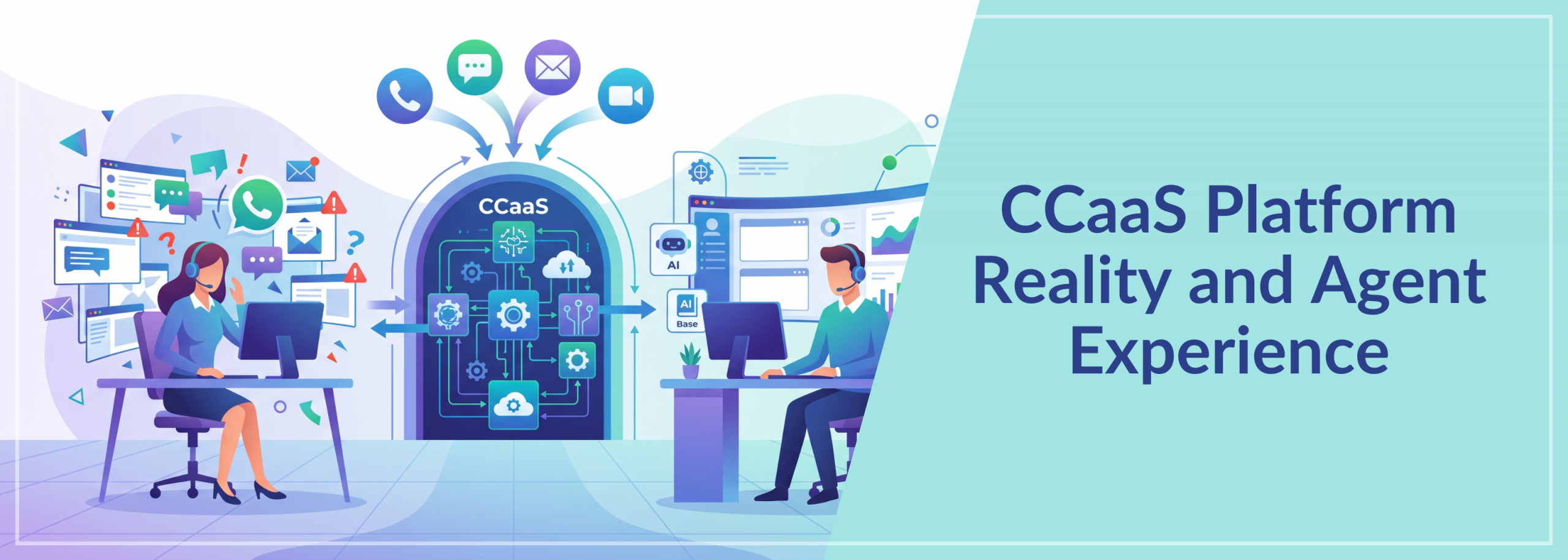
Because here’s the picture that never makes it onto the keynote slide. An agent is on a call with a customer who’s already irritated. She’s got a CRM open in one tab, the dialer in another, a knowledge base in a third, a compliance checklist somewhere, WhatsApp on the side, and a spreadsheet nobody will admit to using. Seven, eight windows. The customer asks one simple question, and she’s clicking around like she’s defusing a bomb.
That’s the real problem. Everyone’s named it correctly. The disagreement is about the fix.
More Platform Isn’t Always Less Chaos
The popular answer right now is to buy the big all-in-one thing. One giant stack that promises to connect every channel, plug into a couple hundred other tools, and orchestrate the whole journey end to end. Sounds great in a demo.
But I’ve been doing this in India since 2016, back when “put your contact center in the cloud” was a sentence that made people nervous. A bigger platform with more integrations doesn’t automatically make life simpler for the person in the headset. Often it just moves the mess around. Now you have two hundred integrations to maintain, a services bill that never quite ends, and an agent who still has eight tabs open, except now they’re “unified,” whatever that’s supposed to mean.
Stitching things together is not the same as making them simple. That’s the part I keep coming back to.
Nobody on a Call Cares What You Call Your AI
The other thing every write-up does now is stack up the AI vocabulary. Voice AI. Conversational AI. Generative AI. Agentic AI. Say it fast enough, and it starts to sound like a strategy.
Here’s my honest take: the person on the other end of the line does not care. They don’t know the difference between the labels, and they shouldn’t have to. They called because their EMI didn’t go through, their policy lapsed, or a payment they made isn’t showing up. The only questions that matter to them are whether it got sorted and whether they had to repeat themselves four times to get there.
So, I try not to get too excited about the terminology. I get excited about the boring wins. AI that fills in the call notes so the agent doesn’t have to type a summary at 11 pm. AI that catches the intent early and sends the person to someone who can actually help. AI that quietly updates the system so that the next agent doesn’t start from zero. That gives the agent their attention back, and attention is basically the whole job.
The theater is the part I’d happily leave behind. You know the kind. A bot that greets you warmly and then loops you right back to the menu you were trying to escape.
The Journey Doesn’t Happen in One Channel
Here’s another word I now hear at every event: orchestration. Journey orchestration, for the full version. And like most of these words, there’s a genuine idea buried under the jargon.
A customer’s journey almost never sits in one place. Someone messages you on WhatsApp on Monday, calls on Tuesday, gets an email that only half makes sense, and calls again on Wednesday, properly fed up. That’s one journey, spread across four touchpoints and three days. And the failure mode most businesses are quietly living with is going dark in between. The call floor isn’t aware of the WhatsApp thread. The email system never heard about the call. So, the customer explains themselves from scratch every time, and trusts you a little less with each retelling.
That’s what orchestration is actually meant to fix. Not the tidy flowchart with the neat little arrows, but the unglamorous job of making the context follow the customer from Monday’s message to Wednesday’s call, so whoever picks up already knows the story.
And here’s the part nobody enjoys hearing: orchestration is mostly a data problem in a nicer outfit. If your customer data is scattered and dirty, it just automates the confusion and ships it faster. You can’t route a journey you can’t see. So, before I get excited about any orchestration engine, I want to know whether the plumbing underneath it is clean, because that’s where it quietly works or quietly falls apart.
The Handoff Is Where It All Lives or Dies
If the whole journey is the trip, the handoff from machine to human is the single riskiest step in it. It’s the one moment where all that orchestration either pays off or falls flat on its face.
Get it wrong, and you’ve built the most sophisticated way in the world to annoy someone. The bot collects a pile of information, then drops the customer into a queue where the agent can’t see any of it, so they tell the whole story again from the top. Now they’re angrier than when they started, and they’ve quietly decided your “AI” is a gimmick.
Get it right, and it’s a different experience entirely. The agent picks up mid-conversation already knowing who this is, what they wanted, and what’s already been tried, so the customer never feels the seam between the machine and the person. And no, AI doesn’t replace the agent here. When someone’s calling about their money or their health, a human who can read the room still matters. AI’s job is to clear the clutter so that humans can be present.
The Unglamorous Slide Nobody Claps For
Here’s something that never gets a standing ovation at a conference: governance.
But if you’re going to let AI take actions on its own, pull up customer records, make a decision, move a case forward, then somebody has to be able to answer some basic questions. Why did it do that? What did it see? Who is accountable when it gets something wrong at two in the morning while nobody is watching?
In India, this isn’t a philosophical debate. We operate inside real rules. Telecom regulations, consent frameworks, the DLT layer, industry-specific compliance in banking and healthcare. Auditability here isn’t a luxury; it’s what keeps you in business. So, when we talk to a customer about automation, we talk about the escalation path and the audit trail in the same breath as the shiny features. It’s the reason our clients sleep at night.
What We Actually Believe
I’ll be straight about where ClearTouch sits in all of this. We’re not trying to sell you the biggest fabric on the market and then wave goodbye from the parking lot.
We run a managed cloud platform, and “managed” is the word that does the work in that sentence. We handhold. We sit with the customer, learn how they actually operate, tune the platform to their reality, and stay in the room long after go-live. A lot of what we deliver is unglamorous: clean data, sensible routing, the compliance guardrails, the things that don’t photograph well for a brochure.
That comes from our roots. We carried a two-decade contact-center legacy from our parent, TCN, into an Indian market with its own rhythm and its own rulebook, and spent years learning both at once. Voice analytics, list management, and the cloud backbone don’t exist to look clever. It exists so the agent has fewer tabs and the customer has fewer reasons to hang up.
So, when I read that the contact center is becoming an “interaction fabric,” I nod along and then ask the only question I think really counts. Did it make things simpler for the person on the call? Or did we just add another beautiful layer to the same old pile?
That’s the test. Everything else is a slide.