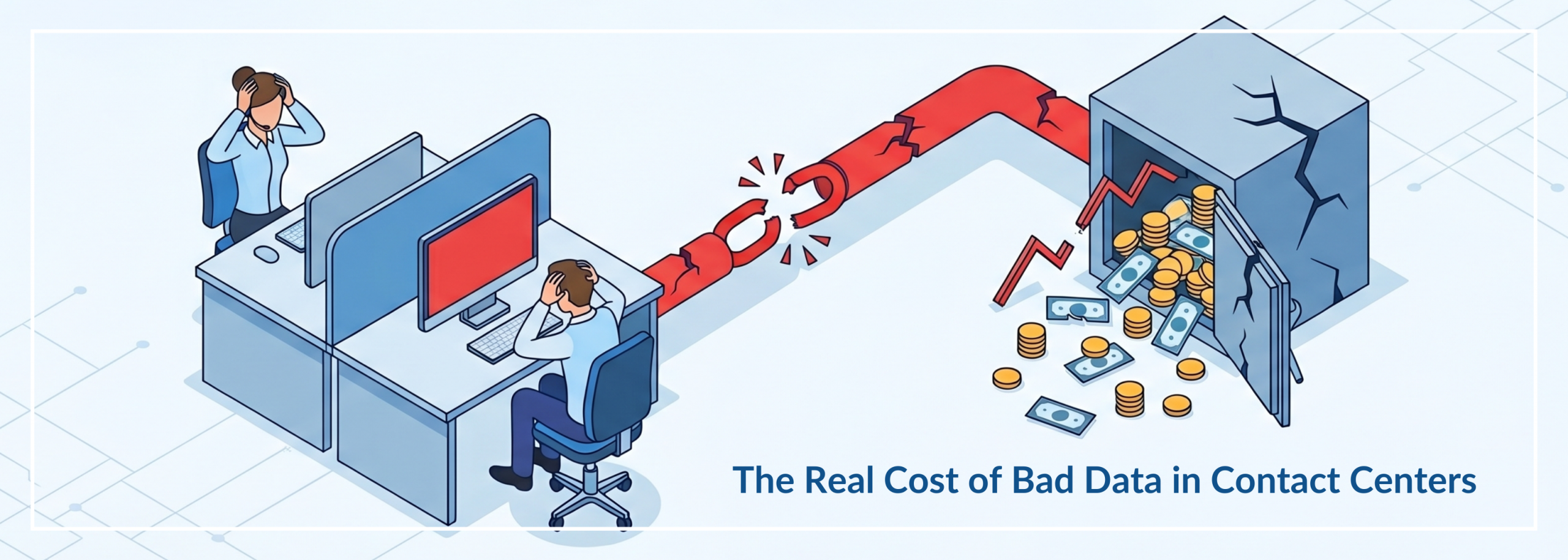
The Real Cost of Bad Data in Contact Centers (And How to Fix It in 2026)

I’ve walked into a lot of contact centers over the years. Different industries, different sizes, different technology stacks.
But there’s one thing I encounter almost everywhere, a quiet, expensive problem that rarely makes it onto the transformation roadmap.
Bad data.
Not the dramatic kind of bad data, like a system crash or a corrupted database that sets off alarms. The insidious kind.
The kind where the data looks fine on the surface, gets passed between systems without anyone questioning it, and then quietly breaks every decision that depends on it, like routing, AI, personalization, and ultimately, the customer experience. This is where even advanced call center data analytics software fails, not because of capability, but because of poor underlying data quality.
Let me give you a picture of what this actually looks like in practice.
A customer calls in about a billing issue. They’ve already contacted the company twice, once through the app and once over chat. Both interactions were logged, but in different systems that don’t talk to each other in real time. When the agent picks up, their screen shows a customer profile last updated 4 hours ago. The chat interaction isn’t visible. The app interaction shows a status of “resolved” even though the customer never confirmed it was. The agent starts from scratch. The customer, who has already explained the problem twice, explains it a third time.
That’s not a training problem. That’s a data problem.
What Bad Data Actually Means in a Contact Center
When I use the term bad data, I’m not just talking about typos or wrong phone numbers. In a contact center context, bad data has four faces, and each one does its own damage.
1. latency.
Data that exists somewhere in the system but hasn’t propagated in time to be useful. A payment made twenty minutes ago is still showing as outstanding. A case status updated in the CRM that hasn’t reached the agent desktop. In most contact centers, real-time is a polite fiction. The data is anywhere from minutes to hours behind the actual customer reality. This delay makes analyzing call center data unreliable and often misleading.
2. Identity Gaps.
The same customer exists as three different records, one from the web portal, one from the IVR, and one from a branch visit five years ago. No one has matched them. So, when the AI tries to predict intent, it’s working from a partial picture. When the routing engine tries to match the customer to the right agent, it’s guessing.
3. Duplicate and Conflicting Records.
I’ve seen contact centers where 15 to 20 percent of their customer database contains duplicates. That doesn’t sound catastrophic until you realize that every duplicate is a conversation where the agent is looking at the wrong history, making the wrong offer, or escalating something that was already resolved. Without proper call center data management, identity resolution becomes guesswork instead of precision.
4. Customer Profile.
And the final one that quietly drives the most cost, is fragmented customer profiles.
In many so-called omnichannel contact center environments, voice, chat, email, social, and app interactions each write to their own data store without a unified layer connecting them, the customer journey becomes invisible to the people trying to serve it. Every channel thinks it’s the first interaction.
What Does This Cost You?
Let me put this in terms that show up in a business case.
Every time an agent has to spend two minutes reconstructing context that should have been on their screen, that’s two minutes added to AHT (Average Handle Time). Multiply that across a contact center handling ten thousand calls a day, and you’re looking at hundreds of hours of avoidable handle time, every single day.
Related Article: How to measure Call Center Average Handle Time ?
Repeat contacts are even more expensive. When a customer calls back because the first interaction was resolved based on outdated data, such as a refund that wasn’t processed, a case that was marked closed prematurely, that’s a full interaction cost with zero value added.
In one implementation I worked on, we traced nearly 18% of repeat calls back to data synchronization failures rather than process failures. The process was right. The data feeding it was wrong.
And then there’s AI. This is the one that worries me most as we move deeper into 2026.
Organizations are deploying AI-powered dialer, routing, intent detection, and next-best-action engines, and feeding them fragmented, stale, identity-mismatched data. The AI isn’t failing because the model is bad. It’s failing because the inputs are broken. Garbage in, confidently delivered garbage out.Even the best call center data analytics software cannot compensate for fundamentally broken data inputs.
The Fix: Start at the Foundation
Here’s what I’ve seen work, and it isn’t glamorous. It doesn’t start with an AI platform or an omnichannel solution. It starts with taking the data layer seriously.
The organizations that are genuinely making progress have done three things deliberately. First, they’ve built a unified customer profile, a single, continuously updated record that consolidates identity across every channel and system. Not a data warehouse you query overnight. A live profile that every system reads from and writes to.
Second, they’ve implemented real-time data synchronization across channels. When a chat interaction closes, it appears on the agent’s desktop within 30 seconds. When a payment posts, the IVR knows before the customer calls. This isn’t novel technology in 2026, but it requires the organizational will to prioritize it over the next shiny feature.
Third, they’ve introduced AI-driven data validation at the point of entry, catching duplicates, flagging identity mismatches, and prompting for resolution before bad data enters the system and compounds. Prevention is dramatically cheaper than correction at scale.
Clean Data Is Not a Technical Nicety
Here’s what I want to leave you with. Every CX leader I speak to wants better AI outcomes, lower AHT, fewer repeat contacts, and higher first-call resolution. Those are all downstream results. The upstream cause, the one thing that either enables or undermines all of them, is data quality.
Clean, unified, real-time data isn’t a feature on a vendor’s checklist. It’s the foundation on which every other investment you make in your contact center either stands or collapses.
If your CX transformation roadmap doesn’t have a data strategy at the top, you’re not transforming. You’re decorating.
Start there. Fix it at the system level. Everything else gets easier once the foundation holds.
Frequently Asked Questions
Bad data in a contact center isn’t just incorrect information; it includes delayed records, duplicate customer profiles, identity mismatches across channels, and fragmented interaction histories. It matters because every routing decision, AI recommendation, and agent action is only as good as the data driving it.
When agents lack a complete, real-time view of the customer, they spend the first few minutes of every interaction reconstructing context, such as reviewing incomplete notes, asking questions the customer has already answered, and navigating mismatched records. That reconstruction time is pure avoidable cost.
AI models in contact centers, whether for routing, intent detection, or next-best-action, are only as reliable as the data they’re trained and fed on. Fragmented profiles and stale records don’t just reduce accuracy; they create confident, wrong decisions at scale, which is far more damaging than no AI at all.
A unified customer profile is a single, continuously updated record that consolidates a customer’s identity, history, and interactions across all channels, such as voice, chat, email, app, and more. Unlike a static CRM record, it’s a live data layer that every system reads from and writes to in real time, eliminating the fragmentation that causes repeat contacts and poor personalization.
At the top. Most organizations treat data hygiene as a back-office cleanup task and prioritize new technology instead. But every investment in AI, omnichannel, or automation sits on top of your data foundation. If that foundation is broken, the returns on everything above it are diminished or lost entirely.