Four Clicks and a Strategy: What Better Customer Experience Really Means

Many years ago, I met a senior developer at a large IT services company. Making conversation, I asked her what she did at the office all day.
She said she was working for a retail customer, helping them improve their checkout process.
Curious, I asked what that meant in practice. I was expecting to hear about a new payment system or a loyalty app.
Her answer was much smaller than that. At the moment, she said, a cashier had to make nine mouse clicks to finish every checkout. Her team was trying to get that down to five.
I remember thinking: does saving four clicks really make that much difference?
It did. Each counter handled about 600 checkouts a day. Four fewer clicks per checkout meant 2,400 fewer clicks per counter, per day. Multiply that by every counter in every store, and you’re looking at thousands of hours a year. That’s time cashiers could spend looking up at the customer instead of down at the screen. You will have shorter lines, fewer mistakes, and less tired staff at the end of a shift.
That conversation has stayed with me, and I keep coming back to it in my work at ClearTouch, where we help organizations run their contact centers in the cloud. It came back to me again recently when I read a sharp piece on CustomerThink by Gerardo Dada, titled Why a Better Customer Experience Is Sometimes the Wrong Strategy.
At first glance, his article and my checkout story seem to point in opposite directions. I’ve come to think they’re two halves of the same idea.
Better is Not a Strategy
Dada’s argument is simple and a little uncomfortable for people like me who sell CX technology. “Better,” he says, is a compliment, not a direction. If every company in a category chases the same improvements, the whole category gets better, but nobody stands out. Optimization raises the floor. It rarely builds a moat.
He uses examples everyone knows. Costco has a narrow selection, bulk packs, a warehouse feel, and lines. By conventional CX standards, that’s a lot of friction. But it’s friction that signals value, and Costco’s customers love it. IKEA makes you find your own way through the store and build your own furniture. That effort is part of how IKEA keeps its prices low. A luxury hotel, on the other hand, would be foolish to remove human attention in the name of efficiency, because guests pay for personal attention.
His point is that some friction is strategic. It supports what the company promises. Other friction is just bad: the password reset that never works, the support line that goes nowhere. The job isn’t to make everything smoother. It’s to know which experiences should be excellent and which can simply be adequate.
I agree with him. And I think this is where the nine clicks come in.
The Friction Nobody Chose
Those nine clicks weren’t strategic friction. No retailer ever sat in a boardroom and decided cashiers should click nine times so customers would feel something. The clicks just built up over time: a system added here, a screen added there, a workaround that became standard practice.
That’s bad friction. Customers don’t see it directly, but they feel it in the line, in the rushed cashier, and in the moment the cashier looks at a screen instead of them.
I see the contact center version of this every week.
An agent picks up a call. The customer has already typed their account number into the IVR, but the agent can’t see it, so they ask for it again. The agent opens the CRM in one window, the ticketing tool in another, and the order system in a third. They copy details from one screen to another. After the call, they spend another minute on wrap-up codes and notes.
None of it is dramatic. It’s a few seconds here and a few clicks there. But run the numbers the way that developer did.
Say an agent handles 50 calls a day and loses 20 seconds per call switching screens, re-asking questions, and entering the same data twice. That’s more than 16 minutes a day per agent. For a 200-seat contact center, it’s over 55 hours of agent time every single day, spent on work that helps nobody.
And customers feel every one of those seconds. They hear it in the pause while the agent searches. They feel it when they’re asked to repeat themselves. They notice when the agent is too busy with the screens to actually listen.
Removing Bad Friction is How You Pay for Good Friction
Here’s what I’ve come to believe, with Dada’s article and that checkout counter both in mind.
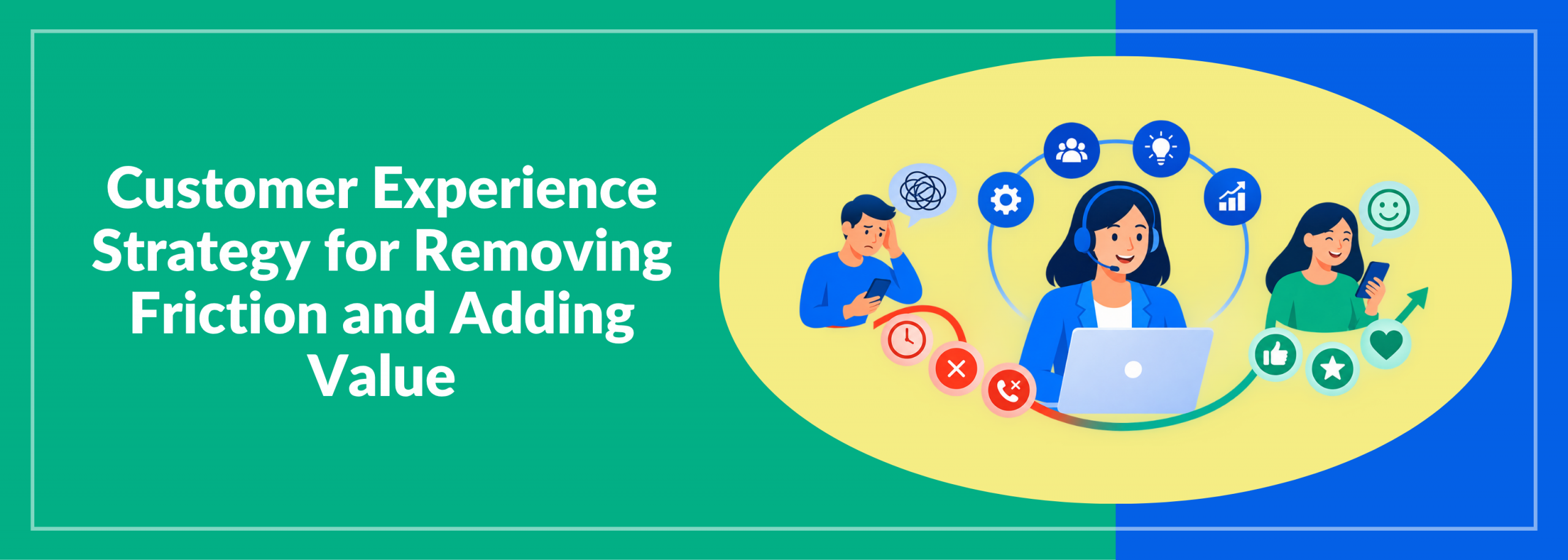
Removing bad friction isn’t the strategy. It’s what pays for the strategy.
Every second you get back from pointless clicks and repeated questions is a second you can spend where your business actually wants to stand out. If you’re the Costco of your industry, that may mean resolving simple requests quickly and cheaply, then moving on. If you’re the luxury hotel, it means giving agents the time and context to have an unhurried, personal conversation with a customer who expects one.
The mistake is treating every interaction the same way. Some companies automate everything, including conversations that deserve a person. Others put a person on every contact, including ones customers would rather handle themselves in thirty seconds. Both are chasing “better” without asking better for whom, and better at what.
So, when we work with organizations at ClearTouch, I try to start with two questions before we talk about features at all.
First: What Should Your Customers Feel is Different About Dealing With You?
Speed? Expertise? Warmth? Being remembered? The answer decides where you invest your agents’ time and attention.
Second: Where is the Friction That Nobody Chose?
Repeated questions, screen switching, calls that bounce between departments, and data your agents already have but can’t see. That friction is what you remove, without guilt, so you can afford to be excellent where it counts.
A cloud contact center platform helps with both. Bringing customer context onto one screen(Customer Journey Orchestration), routing each call to the right person the first time, and giving customers a real self-service option for simple tasks all remove the friction nobody chose. Analytics show you where that friction is hiding. But the platform can’t decide for you what your experience should stand for. That decision is strategic, and it belongs to you.
Four Clicks, Looked at Again
When that developer told me about cutting nine clicks to five, my first reaction was that it sounded trivial. It took me years to see why it wasn’t.
She wasn’t making checkout “better” in some general sense. She was taking away friction that served no purpose, so the retailer could put its people’s attention where it mattered: on the customer standing at the counter.
That’s the balance Gerardo Dada is pointing to, and it’s the balance I try to help our customers find. Don’t try to make everything better. Decide what should be distinctive about your experience. Then cut every pointless click, repeated question, and dead-end transfer that gets in the way.
Sometimes the most strategic thing you can do for your customer experience is get rid of four clicks.
And sometimes it’s knowing which clicks to keep.