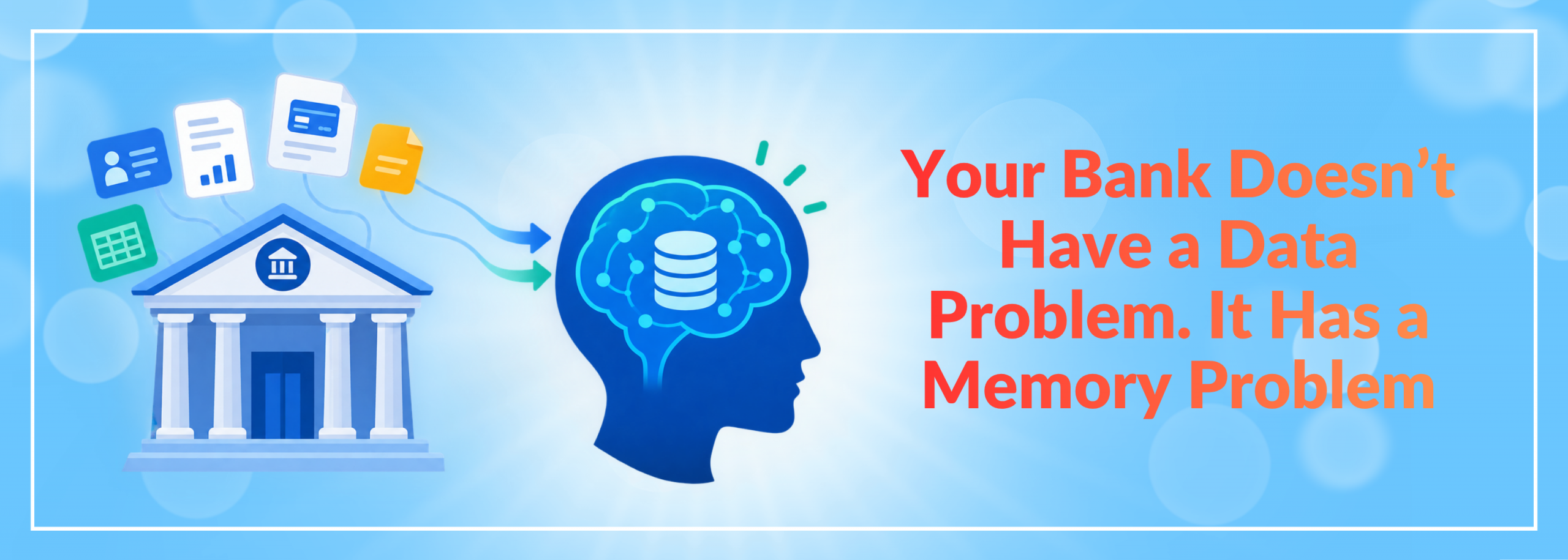
Your Bank Doesn’t Have a Data Problem. It Has a Memory Problem

I’ve lost count of how many times I’ve sat across from someone, like a client, a friend, once even my own father, watching them re-explain their entire financial situation to a bank employee for the second or third time in a week.
They’d already done it on the app. They’d already done it on a call. And now, standing at a branch counter for what was probably the most consequential financial decision of their year, they were doing it again, from scratch, to someone holding a mouse and a mildly apologetic expression.
Everyone in banking calls this an omnichannel problem. I don’t think that’s quite right. I think it’s a storytelling problem wearing a technology costume.
Data Isn’t the Same as a Story
Here’s the distinction I keep coming back to in my own work with client-facing teams, banking included: there’s a difference between a bank having a single view of the customer and a bank being able to tell that customer’s story back to them. Most institutions have spent the last five years solving the first one. Core banking data, app activity, call transcripts, branch visit logs, all of it lands in one place, visible on one screen. That’s real progress, and it wasn’t cheap.
But data sitting on a screen isn’t a story. It’s an inventory. And I think this is where a lot of very expensive omnichannel investment quietly stops delivering the experience it promised.
Picture the relationship manager who pulls up a customer’s file before a meeting. The screen shows: three app logins researching business loans, one abandoned call to the contact centre, two emails opened but not replied to. All the plot points are there. But nobody has written the plot. So the RM opens with, “So, how can I help you today?,” the exact question the system was supposed to make unnecessary. The data made the handoff possible. It didn’t make it happen. That gap between possible and happened is where trust quietly leaks out of a banking relationship, one polite re-introduction at a time.
Where the Story Actually Breaks
I’d go further and say the failure isn’t uniform; it shows up in at least three distinct ways, and each needs a different fix.
The first is the one everyone’s already fixing: the silent handoff, where no information travels with the customer at all. That’s a plumbing problem, and to be fair, a lot of banks are closing it.
The second is subtler and, I’d argue, more common now: the silent data dump. The information is all there, technically available to the person in front of the customer, but nobody has translated it into something a human can act on in the first ninety seconds of a conversation. A transaction log is not a briefing. Give a banker a stack of raw history, and you’ve handed them research, not readiness. This is the gap that better integration alone will never close, because it’s not a systems failure; it’s a synthesis failure.
The third, and the one I think gets the least attention, is the empathy gap. Even a well-synthesized summary tells you what a customer did. It rarely tells you why it mattered to them. A customer researching a mortgage refinance three times in one week isn’t just engaged; they might be anxious about a rate window closing, or quietly comparing offers because a life event forced the decision.
Systems capture behavior. They very rarely capture the emotional stakes behind it. And branches, in particular, have become the place where those high-stakes, high-emotion conversations happen, like estate planning, a business owner’s first commercial loan, a family working through what happens to an account after a bereavement. These are exactly the moments where a customer most needs to feel known, not merely recognized by a system. It’s also exactly where a generic “how can I help you today” lands worst.
What I’d Fix First
If I were advising a bank on this tomorrow, I wouldn’t start with another integration project. I’d start with the ninety seconds before a human opens their mouth.
First, stop measuring success by whether data was available and start measuring whether the story was actually picked up. Before any client-facing conversation at the branch, call, or otherwise, the employee should have a two-line narrative brief, not a transaction log: what the customer has been exploring, what stage they’re likely at, and one sensible way to open the conversation that proves continuity. If your CRM can’t produce that sentence automatically, it’s a database, not a customer intelligence system, whatever the vendor calls it.
Second, train frontline staff to close the loop out loud, deliberately, every time. “Last time we spoke, you were weighing two options on the business account. Has anything changed since?” That single sentence does more for trust than any amount of backend integration, because it’s the customer’s own evidence that they weren’t forgotten. Right now, most banks treat continuity as something the technology should quietly produce as a byproduct. I think it needs to be a scripted, trained, coached behavior, the same way a good salesperson is trained to remember a name.
Third, reward continuity as its own outcome, separate from resolution speed or satisfaction scores. A conversation can be fast, polite, and technically resolved, and still fail the customer if it started from zero. Ask, specifically: did the next person in the chain pick up the thread, or did they restart it? That’s a measurable, coachable behavior, and almost nobody measures it directly today.
Conclusion
Branches survived the digital banking wave not because customers stopped wanting convenience, but because certain decisions still feel too important to make without a human in the room. That’s a vote of confidence in people, not screens. It would be a strange outcome if, having earned that trust, banks handed those same people beautifully integrated dashboards and nothing else: no coaching, no narrative discipline, no expectation that they actually use what’s in front of them to make the customer feel remembered.
The technology to stop the amnesia already exists in most banks I’ve seen. What’s missing, more often than not, is somebody teaching the person at the desk how to use it to tell one continuous story instead of collecting three broken ones. Fix that, and the omnichannel investment finally pays for itself, not as better plumbing, but as a bank that remembers who you are.