The Return That Taught Me What Customer Experience Actually Means

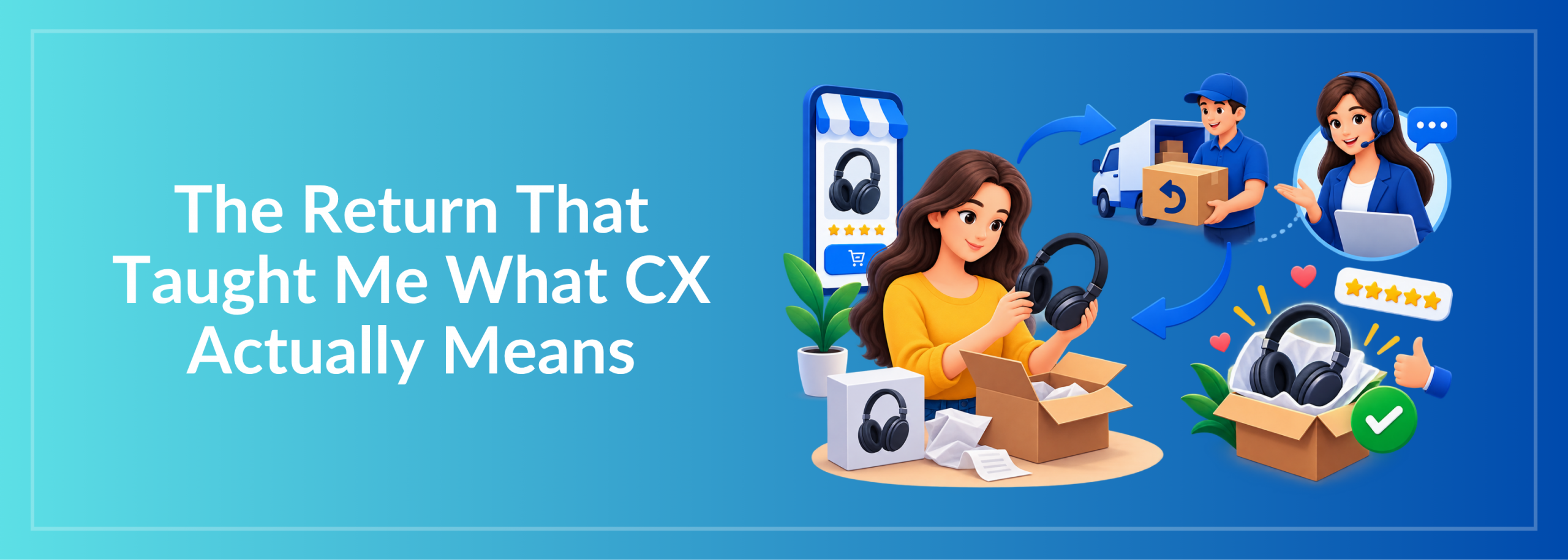
I returned a pair of headphones last month, and the experience was super-fast. The return took four minutes, start to finish, and I spent the rest of the afternoon wondering why so few companies manage to pull that off.
Here’s what happened. I opened the app, tapped the order, tapped return, and it already knew why I might be returning it, such as defective, wrong size, or changed my mind, because apparently enough people before me had returned that exact item for that exact reason.
I picked one, a label appeared, a pickup got scheduled, and twenty seconds later a message landed telling me my refund was already queued, not pending review, not “please allow 5 to 7 business days for a representative to evaluate your claim. I didn’t repeat my order number to anyone. I didn’t explain myself twice. Nobody asked me to hold.
I was wondering, because it’s rare enough to be memorable, and I started comparing it to every miserable customer service call I’ve ever been on, such as the airline hold music, the “let me transfer you,” the agent who clearly can’t see anything I did five minutes ago with a different agent.
The Hard Truth
I understand the hard truth: the good experience wasn’t an accident, and the bad ones weren’t accidents either. Somebody built both of them. One company decided friction was the enemy and engineered it out, step by step. The other company, probably without meaning to, built a maze and then hired people to apologize for it.
That’s where I think we get it wrong when we talk about customer experience.
We treat it like a personality trait, like some companies are just nicer than others, warmer, more customer-obsessed, whatever the LinkedIn post of the week calls it. But goodwill isn’t a strategy. You can’t scale being nice.
What you can scale is a system, and the companies winning on experience right now have stopped trying to make customers feel good and started trying to make the entire path require less effort. Fewer steps, explanations, and moments where the customer has to do the company’s job of remembering who they are.
Trust Is at Work
And underneath that, I think something even more foundational is at work: trust. Not the kind of trust you build with a tagline or a warm email signature, the kind you build by doing the same thing the same way, every single time, especially when something goes wrong.
I trusted that return process instantly, not because the app was pretty, but because it behaved exactly as advertised, with no surprises tucked into the fine print. Trust, it turns out, isn’t a feeling a brand gives you. It’s a predictable interaction. And once a company breaks that pattern, you don’t just lose that one transaction; you lose the whole account of trust you’d been building. For instance, when a refund that was supposed to be automatic suddenly needs manager approval, that breaks trust.
Part of why this matters more now than it did five years ago is that our expectations got recalibrated without our permission. I don’t think about it consciously, but somewhere between same-day delivery, real-time flight tracking, and apps that just know what I want to reorder, my patience for friction quietly evaporated.
I used to accept “we’ll call you back within 48 hours” as a normal sentence. Now it sounds like a company telling me it doesn’t respect my time. Nobody sent a memo announcing this shift. It just happened, until waiting started to feel like a design flaw instead of a fact of life.
I noticed the same shift in myself with self-service. A few years ago, I wanted a human on the phone for almost everything. Now I actively avoid the phone call if there’s a decent self-service option, because I’ve learned it’s usually faster and doesn’t require me to explain my problem to a stranger from scratch. That only works, though, when the self-service tools are actually built well enough to trust. However, half-finished chatbots and dead-end FAQ pages just push me back to the phone anyway, more annoyed than when I started.
Are You Bolting an AI Chatbot?
This brings me to the part of this I find most interesting, and also the part everybody seems to be getting backwards: AI. Every company I talk to right now wants to bolt a chatbot onto their support line and call it transformation. And I get the appeal of fewer human agents, faster resolution, and lower costs on paper. But I’ve started to think of AI less like a fix and more like a mirror. It doesn’t repair a broken process. It just reflects that process back at you, faster and at scale, mistakes included.
If your return policy already means five different things depending on which agent you ask, a chatbot won’t clean that up; it’ll just deliver five different confident-sounding wrong answers instead of one confused human being. If your knowledge base has been stale since 2023, the bot won’t know that. It’ll still answer with total conviction. You don’t get a more coherent company by pointing AI at an incoherent one.
Mental Checklist for AI Rollout
So now, whenever I hear a company announce an AI rollout, I run through a short mental checklist before I believe it’ll actually work.
Would every person on the support team give me the same answer to the same question, or does it depend on who picks up? Is the information that answer’s built on actually current, or is someone quietly out of date and nobody’s noticed yet? Can the systems behind the scenes actually be trusted, or is there a decent chance the AI is going to fill in gaps with a guess dressed up as a fact? If it does get something wrong, is there an obvious person whose job it is to notice, own it, and fix it, or does the error just drift? And maybe most importantly, do I, as the customer, know I’m talking to a machine, and can I reach an actual human quickly if I need one?
Companies that can answer all of that honestly are usually the ones whose AI experiments actually help. The ones that can’t are usually the ones training a bot to be confidently wrong faster than a person ever could.
Ease Isn’t a Bonus Feature
I think about that return a lot now, honestly more than a 1500-rupee pair of headphones deserves. But it stuck with me because it proved something I hadn’t fully believed before: Ease isn’t a bonus feature layered on top of a good product; it’s the product, or at least a huge part of what people actually remember.
Nobody walks away from a company and says, “Well, their mission statement really moved me.” They remember whether it was easy. They remember whether someone owned the problem when it went sideways. They remember whether the next interaction felt like the last one, or like starting over from zero.
That’s the whole game, I think. Did you make it easy, keep your word, and make me want to come back without thinking twice?