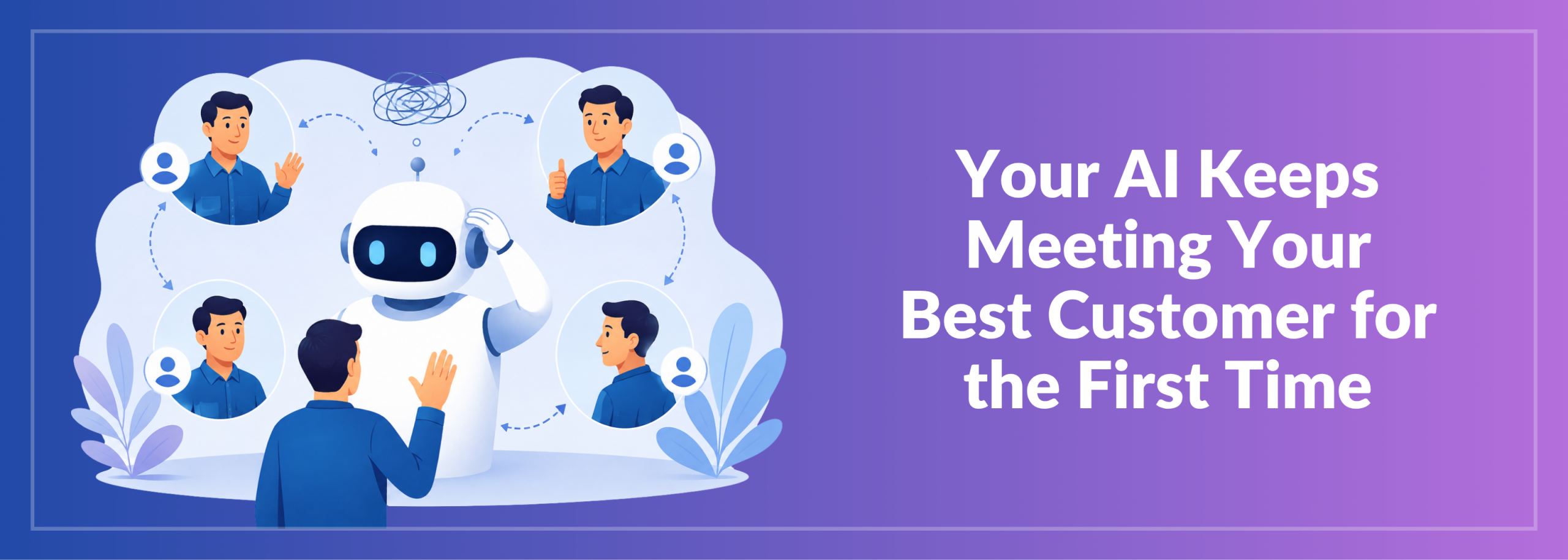
Your AI Keeps Meeting Your Best Customer for the First Time

Picture the demo that got your AI project funded. The model was sharp. It summarized, predicted, personalized, and made everyone in the room nod. Then it went live, and something curious happened. The personalization recommended a blender to someone who bought one last week. The churn model flagged your most loyal customer as a flight risk. The support bot apologized for a problem it couldn’t quite see. The “we miss you” email landed the morning after the customer came back and spent money.
So, everyone did the natural thing. They blamed the AI.
Here’s the uncomfortable truth: the AI is probably fine. It’s doing exactly what a smart system does when you hand it a confusing picture. The problem isn’t intelligence. It’s that your AI is trying to serve a customer it can’t actually see clearly, because that customer is scattered across a dozen systems, wearing a different name badge in each one.
You Don’t Have a Data Problem. You Have a “Which Data Is This Person?” Problem
Most enterprises assume the issue is that they don’t have enough customer data. It’s almost never that. You have mountains of it. The catch is that it’s shattered into pieces and stored in places that don’t talk to each other.
The same human being shows up as jane.doe@gmail.com in your ecommerce platform, as loyalty member #88213 in your rewards app, and as an anonymous browsing session in your support tool. Her purchases live in one place. Her clicks live in another. Her consent preferences live somewhere a lawyer picked. To you, that’s obviously one person. To an AI model, that’s three different strangers who happen to like the same brand.
And the fix everyone reaches for, “let’s pour it all into one warehouse,” doesn’t actually solve it. Piling every fragment into a single lake gives you a bigger pile. It doesn’t tell you that these three fragments are the same Jane. Storing everything is not the same as understanding anyone.
What Fragmentation Actually Costs You
This is where it stops being an abstract data-hygiene issue and starts costing real money and real trust.
Your churn model flags Jane as inactive because half of her order history is associated with an email she stopped using in 2022. Your recommendation engine pitches her something she already owns because it never connected her browsing to her buying. Your service agent greets her like a stranger because the last three conversations are stored in a system this one can’t access. Every one of these is a tiny broken promise. And each one quietly teaches Jane that you don’t really know her.
Now here’s the part that should worry you. AI doesn’t fix a shaky foundation. It scales it. Automate on top of a fragmented view, and you don’t get smarter decisions. You get the same wrong decision, delivered faster, to more people, across more channels, all at once. Confidence goes up while accuracy stays broken.
Where This Really Shows Up: The Customer’s Journey
Let me bring in the piece that ties all of this together, because most of these failures don’t happen in a spreadsheet. They happen in the middle of a customer’s journey, in real time, where she can feel them.
Customer journey orchestration is the layer that determines what should happen next for a person in the moment across every channel she touches. She browses on mobile, gets an email, opens the app, then calls support. Orchestration is what’s supposed to make all of that feel like one continuous conversation instead of four disconnected ones. It picks the next message, the next offer, the right hand-off from a bot to a human. Done well, the experience feels like the brand actually remembers her.
But orchestration is only ever as smart as its sense of who it’s orchestrating for. This is the whole ballgame. Give a world-class orchestration engine a fragmented view of Jane, and it will choreograph a beautiful journey for the wrong person. Or worse, it will run three separate journeys for the three strangers it thinks she is, and none of them will connect. She has to re-introduce herself at every step. She’s asked to repeat what she just told the chatbot. She gets dropped in the gap between the website and the email. That’s not a journey. It’s a string of first dates, and she’s the only one who remembers the previous ones.
So, orchestration is where disconnected data stops being a backend problem and becomes something your customer experiences directly. It’s the moment the crack shows.
What Actually Fixes It
The good news is that this is solvable, and you already own most of what you need. The signals exist. They just need to be connected, trusted, and made available in the moment.
Start with identity resolution, the work of deciding which records belong to the same human. Match deterministically where you have hard identifiers, use machine learning to bridge the fuzzy gaps, and let the identity graph keep learning as people change phones, emails, and habits. This is what turns three strangers back into one Jane.
But identity alone isn’t the finish line. Your orchestration engine and your models need more than a name. They need a trusted context layer that brings identity together with behavior, transactions, consent, and intent, in one place every system can reach. One version of the customer, not four contradictory ones.
Then make it real-time, because a journey happens now, not overnight. If Jane’s profile updates tomorrow morning, your orchestration is always a step behind the person actually standing in front of you. The cart she abandoned at 9 pm shouldn’t trigger a nudge that fires at 9 am the next day, long after the moment passed.
And keep it shared and governed. When every system draws from the same source of truth, Jane gets one coherent story wherever she shows up, and you can still explain and control how her data is used. Unified context is the fuel. Orchestration is the engine. You need both running, or the car doesn’t move.
The Real Competition Isn’t About Who Has the Better Model
Foundation models are becoming a commodity. In a couple of years, everyone will have access to roughly the same raw intelligence, at roughly the same price. So, the edge won’t come from having a cleverer model than the company down the street.
It’ll come from actually knowing your customer well enough to act on it while it still matters. The winners in enterprise AI won’t out-compute anyone. They’ll out-understand them. Fix the fragmentation, connect the context, and orchestration stops being a slide in a deck and starts feeling, to the one person who actually matters, like you finally remembered who she is.
That’s the whole game. Not a smarter machine. A machine that knows who it’s talking to.