Answering Machine Detection in Contact Centers: How AMD Works, Accuracy and Best Practices

If you’ve ever run an outbound floor, you know the sound. An agent leans in, ready to pitch, and gets: “Hi, you’ve reached Priya, I can’t take your call right now…” Multiply that by a few hundred agents and a few thousand dials an hour, and you’re paying people to listen to recordings.
That’s the problem answering machine detection was built to solve.
Let me walk through how it actually works, why accuracy is trickier than vendors like to admit, and what I’d measure if I were running a campaign tomorrow.
So, what is AMD, really?
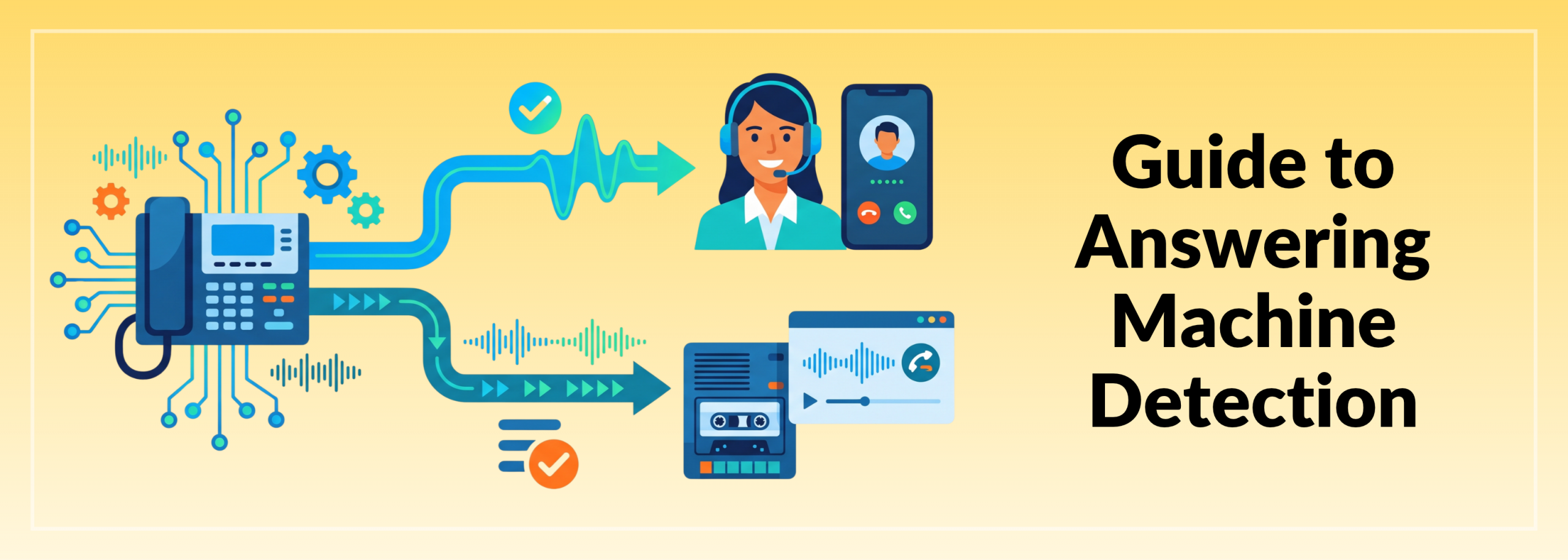
Answering machine detection (AMD) is the part of your dialer that listens to the first second or two after a call connects and decides one thing: did a human pick up, or a machine?
If it’s a human, the call goes to an agent. If it’s a machine, the dialer does something else: hangs up, drops a pre-recorded voicemail, or schedules a retry. The agent never hears it.
How AMD tells a person from a machine
Here’s the thing most people don’t realize: AMD isn’t listening to what is said. At least, traditional AMD isn’t. It’s listening to the shape of the audio.
Think about how you answer your phone. You say “Hello?” Maybe “Hello, this is Arjun.” Then you stop and wait. Short burst of sound, then silence.
Now think about a voicemail greeting. “Hi, you’ve reached Arjun Mehta at Sunrise Finance. I’m away from my desk at the moment, but please leave your name and number, and I’ll get back to you as soon as I can.” Long, continuous speech, no pause for a reply, and then often a beep.
AMD works off exactly those differences:
- Length of the first utterance. A short greeting points to a human; a long one points to a machine.
- Silence after the greeting. Humans pause and wait for you. Recordings keep going.
- Speech rhythm. Live speech is uneven. Recorded greetings tend to be smoother and more scripted.
- The beep. A tone at the end is a dead giveaway.
The system has to make that call in a fraction of a second, because every moment it spends thinking is a moment of silence on the line for a real customer. And that’s where the trade-offs start.
Traditional AMD vs AI-powered AMD
Traditional AMD runs on fixed rules. If the greeting runs longer than X milliseconds, call it a machine. If there’s a beep, call it a machine.
It worked reasonably well when most voicemails were old answering machines. It struggles now. People record short greetings that sound like a live “hello”. Some people answer with a long “Good morning, Sharma residence, who’s calling?” and get hung up on. And then came mobile call screening: Apple’s Live Voicemail, Google’s Call Screen, and a growing list of carrier and third-party tools. Those aren’t humans, and they aren’t voicemail. Rule-based AMD simply wasn’t designed for them.
AI-powered AMD takes a different route. Instead of a handful of rules, it uses machine-learning models trained on huge volumes of real calls, and it keeps learning as greetings and screening tools change.
Take ClearTouch’s own SmartAMD as an example. Rather than one classifier, it runs several specialized models in parallel. One makes the core human-vs-machine call in under a second. Others work out which kind of machine it is: a voicemail greeting, a full mailbox, or a specific screening service. Each outcome gets handled differently. When a screening assistant answers, for instance, SmartAMD can play a short message saying who’s calling and why, wait for the person to accept, and then bridge them to an agent.
It’s also deliberately weighted towards recognizing humans. That matters more than it sounds, as you’ll see in a minute.
On a deployment of more than 1.6 million calls, TCN (ClearTouch’s parent) reported a 13.28% rise in agent utilization and a right-party conversation rate that went from 7.68% to 8.70% (TCN, June 2026).
Why accuracy is harder than it looks
Every AMD vendor has a headline accuracy number. I’d take all of them with a pinch of salt, because accuracy depends heavily on your lists, your region, and your customers. These are the things that throw detection off most often:
- Greeting length. The rule-based approach assumes humans are brief. Plenty aren’t. A business line answered with a full company greeting looks like a recording. A one-word voicemail (“Leave a message”) looks like a person.
- Background noise. Traffic, a TV, a busy office or a crying baby fills the silence AMD relies on. The system hears continuous sound and can decide it’s a machine.
- Accents and speech patterns. Speech pace and rhythm vary hugely across regions and languages. A model trained mostly on one kind of speaker will misread others. For any contact centre dialling across India, or across countries, this is a real factor.
- Voicemail variety. Carrier default greetings, custom recordings, greetings with music, full mailboxes, network messages like “the number you are calling is switched off”, and now screening assistants. Each one sounds different.
The point is: don’t trust an accuracy figure you haven’t tested on your own traffic.
What good AMD does for an outbound floor
When AMD is working well, you feel it on the floor before you see it in the reports.
Agents spend their day in conversations. In most outbound campaigns, a big share of connected calls never reach a live person. Without AMD, agents absorb every one of them. With it, the dialer filters those out and agents go from one real conversation to the next.
You get more live connections. This is where AI-based detection earns its keep. A system weighted towards recognising humans hangs up on fewer real people. Each of those recovered calls is a right-party contact you’d otherwise have paid to dial and then thrown away.
Campaigns run more efficiently. Machine-answered calls aren’t wasted either. The dialer can drop a voicemail automatically, schedule a retry at a better time, or flag a bad number. Over a few weeks, your lists get cleaner, your retry strategy gets smarter, and your cost per contact comes down.
Best practices, and the four numbers I’d watch
AMD is never right 100% of the time. It makes two kinds of mistakes, and they cost you very differently.
A false positive is when AMD decides a real person is a machine and hangs up or plays a voicemail at them. That’s a lost customer, a confused prospect, and often a complaint. In collections or sales, it’s the most expensive mistake you can make.
A false negative is when AMD decides a machine is a person and sends it to an agent. Annoying, and a few seconds wasted, but the agent simply moves on.
Once you see it that way, the tuning question becomes obvious: err on the side of humans. A few extra voicemails reaching agents is a much smaller price than hanging up on live customers.
Here are the four metrics I’d put on the dashboard:
- Detection accuracy: the share of calls AMD classified correctly. Check it by listening to a sample of recordings every week, not just trusting the system’s own report.
- False-positive rate: humans wrongly marked as machines. This is the one to obsess over.
- False-negative rate: machines wrongly sent to agents. Keep it in check, but don’t strangle it at the cost of number two.
- Live-answer rate: the share of dials that end in a real conversation with an agent. This is the number that actually pays the bills.
A few practical habits help too:
- Test before you trust. Run AMD on and off across a sample of the same list and compare live-answer rates.
- Watch the silence. The time between “hello” and an agent speaking should be as short as possible. Long pauses make people hang up, and many regulators limit abandoned or silent calls.
- Tune by campaign. A B2B list full of office lines behaves very differently from a consumer mobile list. One setting won’t fit both.
- Plan for screening tools. If a big chunk of your list is on smartphones, make sure your AMD can tell a screening assistant from a voicemail and handle each one properly.
- Re-check regularly. Phones, carriers, and greetings keep changing. What worked last quarter may not work now.
Get these basics right, and AMD stops being a black box. It becomes one of the most dependable ways to get more out of every hour your agents spend on the phone.
Frequently Asked Questions
Answering machine detection (AMD) is a dialer feature that determines whether an outbound call was answered by a live person or by a machine, such as voicemail. Calls answered by people go to agents. Machine-answered calls are handled automatically, for example by dropping a voicemail or scheduling a retry.
AMD analyses the first second or two of audio after a call connects. Traditional AMD looks at patterns such as greeting length, pauses, and beep tones: humans usually say something short and wait, while recordings speak continuously. AI-powered AMD uses machine-learning models trained on large volumes of real calls to make the decision more accurately.
In a call center, AMD is the technology that keeps agents from spending time on voicemails, answering machines, and call-screening services. It sits inside the outbound dialer and passes only live, human-answered calls to agents, which raises productivity and the number of real conversations per hour.
It depends on the technology and your call traffic. Rule-based AMD is easily thrown off by long human greetings, short voicemail greetings, background noise, accents, and mobile screening tools. AI-powered AMD generally performs better because it learns from real calls. The only reliable accuracy figure is the one you measure on your own campaigns, especially your false-positive rate.
The terms are often used interchangeably. Strictly, AMD decides whether a human or a machine answered, while voicemail detection focuses on recognizing a voicemail greeting, often to find the beep so a pre-recorded message can be left at the right moment. Modern systems do both, and also identify mobile call-screening assistants.
A predictive dialer places more calls than there are available agents, betting that many won’t be answered by a person. AMD screens each answered call in real time. Human answers are routed straight to the next free agent, and machine answers are handled automatically. Good AMD has to decide fast, so the customer doesn’t hear a long silence before an agent comes on the line.
Yes. AI-powered AMD replaces fixed rules with machine-learning models that recognize a far wider range of greetings and screening tools, and keep improving as they process more calls. Solutions like ClearTouch’s SmartAMD also favour detecting humans, which reduces the costly mistake of hanging up on live customers.