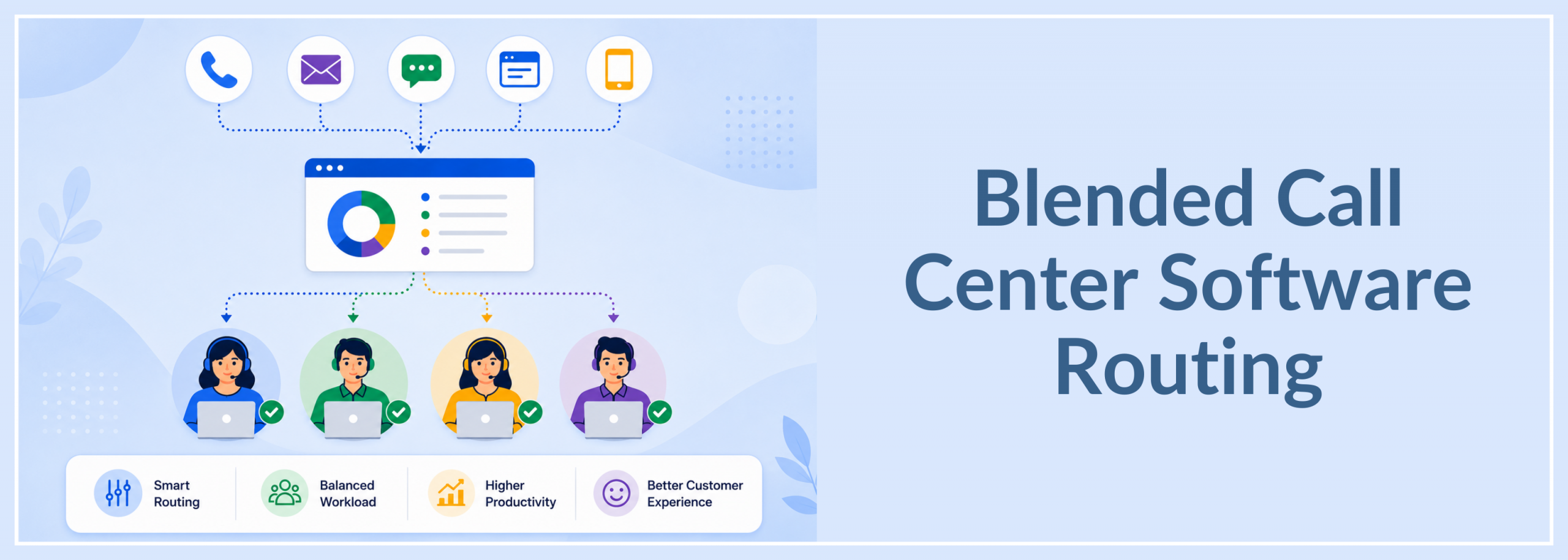
How Blended Call Center Software Distributes Queries Without Overloading Agents

I’ve sat in enough contact center war rooms to know what overload actually looks like. It’s not dramatic. It’s quiet. One cluster of agents is buried under a backlog they can’t clear, customers on hold getting angrier by the minute, while elsewhere on the same floor or platform, capacity sits unused. Nobody planned for it to work that way. It just does, because the system underneath wasn’t built to prevent it.
This is the real problem with inbound call centers, and it doesn’t go away just because you’ve invested in dialer software. I’ve seen teams spend serious money on technology and still end up with the same uneven distribution they had before. Two agents handling twelve simultaneous chats. A billing queue with a 40-minute wait. A technical support queue with three agents and nobody in it. The software is running. The agents are working. And the operation is still a mess.
The reason is simpler than most vendors will tell you. Routing a query to an available agent and routing it to the right available agent based on real-time workload, skill, and priority are two completely different things. Most traditional setups do the former. Blended systems, when properly built and configured, do the latter.
What Is A Blended Call Center System?
The word gets used loosely, so let me be specific about what I mean when I use it.
A blended call center system is not just a platform that handles both inbound and outbound calls. That’s the basic definition, and it undersells what the architecture actually does. A properly blended system combines AI-driven query identification, dynamic routing logic, and human agent management into something that behaves more like a live dispatch operation than a traditional queue.
The AI component reads the incoming query, whether it’s a call, a chat, an email, or a social message, and classifies it before it reaches a human. What type of query is it? What’s the customer’s history? Has this issue been raised before? Is it urgent? Does it require a specialist? That classification happens in seconds, and it changes everything about where the query goes next.
The routing logic then uses that classification to match it against a live picture of agent availability, not just who’s logged in. Who’s actually free, who’s mid-interaction but nearly done, who has the right skills, and who has capacity without being idle? It’s a continuous calculation, not a static assignment.
The human layer, the agents, sits at the end of that process, receiving queries that have already been sorted, prioritized, and matched to them specifically in theory. In practice, it only works that way if the configuration is honest about what the operation actually looks like, not what someone hoped it would look like when they designed the workflow.
How A Query Actually Moves Through The System
Here’s what this looks like in real life.
A customer calls about a billing dispute. The IVR picks up, and within the first interaction, a spoken response, a keypress, sometimes just a caller ID matched against account history, the system already knows this is a billing query from an account that’s had two previous contacts on the same issue. That context travels with the call.
It doesn’t go into a generic queue. It goes into a priority billing queue, flagged as a repeat contact, which in most well-configured systems means it has a shorter wait time before escalation.
The blended routing engine looks at which billing-trained agents are available. Not just available, but available and not already managing a high-complexity interaction on another channel.
Because blended systems handle multiple contact channels simultaneously, an agent who looks free on voice might already be running two active chats. The system knows that. A traditional queue doesn’t.
The call lands with an agent who already has the billing skills, current capacity, and context on their screen before they pick up. The customer doesn’t repeat themselves. The agent doesn’t start from zero.
That’s the version that works. Getting there requires genuinely dynamic load balancing, not just round-robin with a priority flag attached.
The Features That Actually Matter
I want to be honest here. Many blended systems sell features that sound more sophisticated than they are in practice. So let me focus on the ones that make a real difference to query distribution.
Real-time load balancing is the one I’d start with. This is the system’s ability to see agent workload across all active channels simultaneously and adjust routing decisions based on that view, continuously, not in batch updates. When it works, no single agent cluster gets buried while others coast. When it doesn’t, you’re back to uneven distribution with a more expensive platform generating it.
Priority routing matters most during volume spikes. When query volume jumps, such as during end-of-month billing cycles, outages, or product launches, the system needs to deprioritize low-urgency contacts and protect capacity for high-urgency ones automatically. Without this, high-volume periods flatten everything into a single undifferentiated backlog, and the operation loses control over its own outcomes.
Dynamic queues are less talked about but practically important. These are queues that adjust their own parameters based on real-time conditions, such as wait time thresholds, escalation triggers, and overflow routing, rather than running fixed rules that made sense when they were configured but don’t reflect what’s actually happening on a Tuesday afternoon in a volume spike.
I’ve seen operations where the queue logic hadn’t been touched in two years and was actively making distribution worse because the business had changed around it.
Skill based routing sounds obvious, but the implementation is where it falls apart in most setups. Skills need to be maintained, updated, and honestly assessed. An agent trained on a product that was discontinued six months ago shouldn’t still be in that routing pool. An agent who’s developed expertise on a complex query type should be reflected in the system. When the skills data is stale, routing decisions are stale, and the blended system starts producing the same outcomes as the one it replaced.
What The Contrast Actually Looks Like
Without a properly configured blended system, this is what an inbound contact center typically produces: uneven agent workload, peak-hour backlogs that take hours to clear, repeat contacts from customers who got routed to the wrong place the first time, and burnout in the agent clusters that consistently absorb the overflow.
The agents aren’t the problem. The distribution is.
With properly blended routing, the workload spreads. Priority contacts move faster. Agents work at sustainable capacity rather than lurching between swamped and idle. And the operation develops something it rarely has otherwise, a real-time view of what’s happening across all channels simultaneously, which makes it possible to actually manage the floor rather than react to it.
I’ve seen the same team, same headcount, same contact volume, produce completely different outcomes when the underlying distribution logic changed. The difference wasn’t effort. It was architecture.
If you’re running an inbound contact center and the overload problem is persistent, if it shows up in every volume spike regardless of what you’ve tried, it’s worth asking whether your current system is actually routing intelligently or just routing fast. They’re not the same thing, and the gap between them is usually where the backlog lives.
The technology to close that gap exists, and it’s not new. The harder part, in my customer experience, is being honest about whether your current configuration is actually using it.
Frequently Asked Questions
Traditional dialers route to whoever is available, but available just means logged in and not on a call. It ignores whether that agent is already managing three chats at their limit. Blended systems don’t just route fast, they route to the right person based on skill, real-time workload, and contact priority. That distinction is usually where backlogs live.
The AI layer first classifies the query based on factors such as contact type, account history, and urgency before any routing occurs. The engine then matches it to the best available agent based on skills, current workload across all channels, and live floor state. That calculation runs continuously, not once. Workload spreads in proportion to actual capacity rather than piling into the same clusters every time volume rises.
Three things: accurate skills data, honest queue configuration, and real-time visibility across every active channel. Most underperforming blended deployments trace back to one of these being stale or incomplete. A sophisticated system, given bad inputs, produces the same outcomes as the one it replaced.
Track AHT, First Contact Resolution, and agent utilization, but watch the variance, not just the averages. Narrowing AHT variance means queries are landing with the right agents. Improving FCR means classification is working. And evenness of utilization across the team is the clearest sign that distribution is actually doing its job.
Yes, and cross-channel visibility is the whole point. An agent on two active chats isn’t available for a complex call, but a voice-only system doesn’t know that. When the routing engine sees the total workload across all channels, capacity is used honestly. That’s why omnichannel operations see the biggest gains from blended routing.