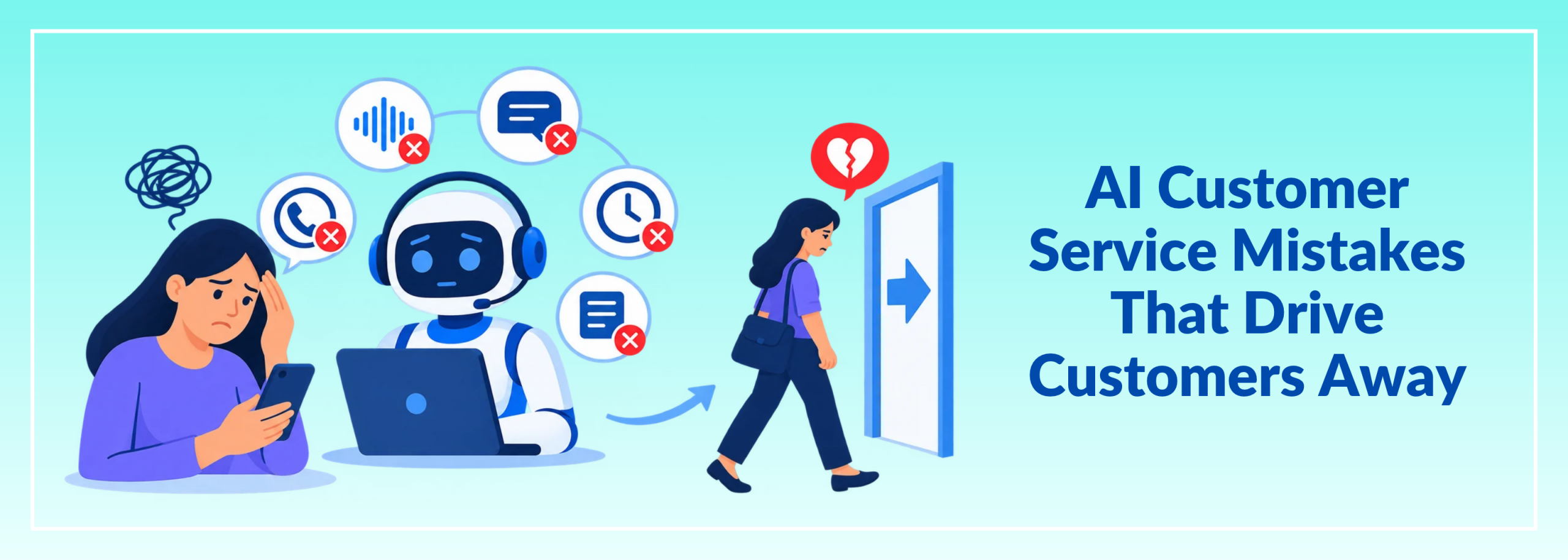
When AI Costs You Customers: 6 Ways It Goes Wrong

Every company seems to be in a race right now. Put a chatbot on the website, add a voice bot to the IVR, automate the queue, cut the cost per contact. It’s an easy business case to write. AI doesn’t take breaks, doesn’t call in sick, and can answer a thousand people at once.
But there’s a line in that business case that rarely gets written down: what happens to the customers who leave?
A recent survey commissioned by US wireless carrier Consumer Cellular puts some numbers on it. The company asked 482 people aged 50 and over, a mix of its own customers and people with other carriers, how they feel about AI in customer service. The answers aren’t anti-AI. They’re anti-bad AI. And they’re pretty blunt about what bad AI costs: 62% of customers said a frustrating bot experience makes them less likely to stay, and 47% had switched, or seriously considered switching, because of one.
Nearly half. That’s not a CX metric. That’s a revenue line.
So where exactly does AI go wrong? Reading through the findings, six patterns stand out. If your contact center is rolling out automation, it’s worth checking you’re not building any of them.
#1 The Loop With No Exit
You know this one. You type “talk to an agent.” The bot offers you three help articles. You type “AGENT.” It asks if you’d like to check your balance. Somewhere around the fourth attempt, you start looking up the competition.
This is the single biggest deal-breaker in the survey. 97% of customers and 94% of prospects said there should always be an option to reach a human, and 87% of customers would consider leaving over an automated loop that won’t let them out.
The fix isn’t removing the bot. It’s making the exit obvious. A clear “talk to a person” path, at any point, turns a trap into a convenience.
#2 The Bot That Answers But Doesn’t Solve
A chatbot can be polite, fast, and grammatically perfect, and still be useless. It replies to everything and resolves nothing.
The numbers here are uncomfortable. Around three in five respondents said a chatbot resolves their issue less than 40% of the time. And 38% of customers and 44% of prospects said bots fix their problem less than 10% of the time.
If you measure your bot by containment (how many people it kept away from an agent), it can look like a success while customers are quietly giving up. A customer who abandons the chat isn’t contained. They’re just gone.
#3 Optimizing for Speed Nobody Asked For
Much of the AI pitch is about speed: instant replies, shorter handle times, fewer seconds in queue. Customers don’t seem to share that priority.
Asked what matters most, only 4% of customers and 3% of prospects picked speed. Resolution won by a mile (43% and 53%), followed by reaching a real person (43% and 32%).
That flips the usual logic. Consumer Cellular itself runs calls 11.6% longer than the telecom benchmark, and still reports first-contact resolution of around 86%. A fast answer that doesn’t fix the problem means a second contact, a third, and eventually a cancellation. A slightly slower one that solves it is cheaper in the end.
#4 The Handoff That Starts From Zero
Say the bot does pass you to a human. Then the agent says, “Can I have your account number and a brief description of the issue?” Everything you just typed is gone.
The survey doesn’t measure this directly. But it shows customers want two things above all: resolution and a person. A cold handoff fails at both. It wastes the time you spent with the bot, and it makes the human feel like another hoop.
Good automation carries context forward across the customer journey. The agent should see the conversation so far, who the customer is, and what they’ve already tried before saying hello. That’s the difference between an escalation and a restart.
#5 Automating the Conversations That Matter Most
Not every contact is equal. Resetting a password is a fine job for a bot. A disputed charge, a canceled loan, a bereavement, a service outage before a big day are not.
Those high-stakes moments are exactly where frustration turns into churn. Remember: 62% of customers said a bad bot experience makes them less likely to stay, and nearly half had acted on it. Customers forgive a bot for a simple question it can’t answer. They’re much less forgiving when it stands between them and a problem that’s costing them money or sleep.
The smart approach is to route by intent and emotion, not just volume. Let AI handle the routine, and get the sensitive stuff to a person fast.
#6 Replacing Agents Instead of Equipping Them
Here’s the surprising finding. Customers mostly don’t mind if a bot sounds robotic. Only 9% of customers and 10% of prospects would consider leaving over a bot that solved the problem but felt “cold and robotic.”
So, personality isn’t the issue. Effectiveness is. And the most effective use of AI in the survey isn’t customer-facing at all. Consumer Cellular uses AI to summarise calls, so agents can focus on the caller instead of taking notes. It also uses AI to review far more calls for coaching than managers ever could by hand.
That’s AI working behind the agent, not in front of the customer. Gartner’s 2026 research points the same way: half of customers say GenAI makes service easier, but 87% say companies using it must still offer a human. As Consumer Cellular’s CEO Ed Evans put it: “AI isn’t the problem. Bad customer service is.”
So, Should You Slow Down on AI?
No. But you should change what you’re racing towards.
The survey doesn’t say customers hate automation. It says they hate being trapped, being ignored, and having to start over. Each of those six failures comes from the same mistake: treating AI as a way to keep customers away from people, rather than a way to get them to the right answer faster.
A Quick Gut-Check for Any AI Rollout in Your Contact Center:
- Can a customer reach a human in one step, from anywhere?
- Are you measuring resolution, or just deflection?
- Does the agent see the full conversation when a bot hands over?
- Are your most sensitive conversations going to people first?
- Is AI making your agents better, or just making them fewer?
Get those right, and AI does what it promised: lower costs and happier customers. Get them wrong, and the savings show up on one spreadsheet while the losses show up on another.
The customers in this survey were clear. They’ll happily talk to a machine. They just won’t stay with a company that won’t let them talk to anyone else.