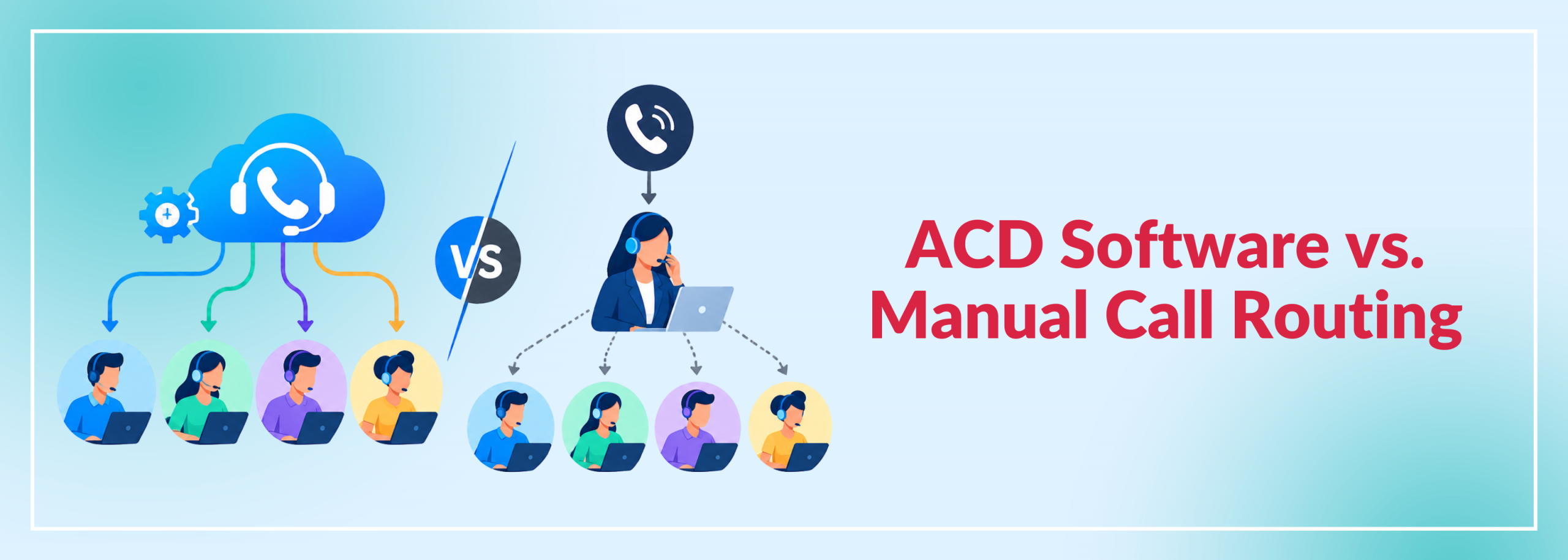
ACD Software vs. Manual Call Routing: Which Is Better for Modern Contact Centers?

If you’ve ever called a company and waited while someone figured out who should take your call, you’ve felt manual routing in action. If you’ve called and landed on the right agent within seconds without saying much more than your reason for calling, an ACD system was probably working in the background.
Automatic call distribution, or ACD, is the technology that decides where an inbound call goes the moment it hits the queue, using rules like agent skill, availability, or priority instead of a person making that call in real time. Manual routing is the older approach: a receptionist, team lead, or basic phone tree passes calls along based on judgment or a short menu, with a human somewhere in the loop deciding the next step.
Manual routing usually looks like this: a call comes in, it hits a front desk or a shared line, and someone checks who’s free before transferring it. Small teams get by on this for years, as long as call volume stays low and everyone knows who does what. The moment volume climbs or the team grows past a handful of people, the cracks show. Calls sit on hold while someone tracks down the right agent, transfers land on whoever’s already swamped, and callers repeat themselves to two or three people before reaching someone who can actually help.
ACD Flips That Sequence Around
The system sits between the phone network and your agents and applies routing rules the instant a call arrives, before any human touches it. It can route based on the number dialed, the caller’s location, choices made in an IVR menu, or data pulled from a CRM the second a phone number is recognized, checking who’s logged in, who’s idle, who has the right skill tag, and who’s been waiting longest, then making the match in a fraction of a second. None of that requires a supervisor standing by or a receptionist juggling three lines at once, and it runs the same way at 9am and at midnight.
That’s the Real Difference Between the Two
Manual routing depends on a person’s attention and memory. ACD depends on rules that don’t degrade under pressure. Speed is where this shows up first. A sharp receptionist might route a call in under a minute on a quiet morning, but that number climbs fast once three lines ring at once, while ACD routes in milliseconds regardless of volume because it isn’t waiting on anyone to notice the call.
Queue management follows the same pattern. Manual queues are often just an unordered pile, first-come-first-served with a mental list somebody’s trying to keep straight in their head, while ACD systems hold a caller’s place, tell them roughly where they stand, offer a callback instead of hold music, and rebalance the queue the moment an agent logs off. Wait times drop not because agents suddenly work faster, but because no call sits forgotten in a queue nobody’s actively watching.
Skills-based routing is where manual systems really start to strain. A human router can remember that Priya handles billing disputes and Tom speaks Spanish, but that mental map falls apart once you’re tracking a dozen skills across forty agents. ACD holds all of it as data, skill tags, language, certification level, even how an account is flagged, and matches on several at once. Priority routing works the same way: a high-value customer or an urgent open ticket jumps ahead in line automatically, something that’s almost impossible to enforce consistently by hand without playing favorites.
Workload Distribution Benefits Too
Manual routing tends to send calls to whoever is easiest to reach, so the same two or three agents get hammered while others sit idle. ACD spreads calls based on actual availability and, in better systems, on how close each agent is to a fair share of calls for the day.
All of this adds up to a different experience on the customer’s end.
First call resolution, one of the more honest measures of how a contact center is really doing, tends to rise with ACD simply because callers land with someone qualified to help the first time instead of getting bounced around while their patience runs out. Every transfer is a chance for context to get lost and for the customer to repeat themselves again, so cut down on unnecessary transfers and resolution rates tend to follow.
Reporting is Another Place the Gap Widens
Manual routing leaves you guessing. You might know total call volume from the phone bill, but not average wait time, abandonment rate, or which agent is quietly overloaded, not without someone logging it by hand. ACD systems track that by default: talk time, hold time, abandonment, first call resolution, agent load, queue length by hour, which is what lets a manager fix a problem instead of reacting to complaints after the fact. Scaling a manual process usually means hiring more people to do the same manual work, so costs climb in a straight line with headcount. ACD scales differently. Once the system and rules are set up, adding agents or call volume doesn’t mean rebuilding the routing logic from scratch, and a bigger share of the cost sits in software rather than in bodies answering phones.
Integration Matters
None of this works well in isolation, which is why integration matters almost as much as the routing logic itself. Most ACD platforms plug into IVR systems so a caller’s menu selections carry into the routing decision instead of getting asked to repeat themselves, and connect to CRM software so account history appears the instant a call connects, before the agent even says hello. Tie that into a broader contact center platform covering chat, email, and voice, and you end up with one queue and one set of rules instead of three disconnected systems each routing on their own.
A Practical Conclusion
None of this means manual routing is obsolete everywhere. A two-person office fielding twenty calls a day doesn’t need software deciding who picks up the phone, and some small teams genuinely know their callers by name and route better through that relationship than any algorithm could manage. If your call volume is low, your team is small, and everyone already knows their role, the cost and setup work of an ACD system might solve a problem you don’t actually have yet.
If you’re past that point and evaluating ACD software now, the practical checklist is shorter than most vendor pitches make it sound. Check whether it supports the routing types you actually need, skills-based, priority, and time-based at minimum, and confirm it integrates cleanly with the CRM and IVR you already run, since rebuilding your whole stack around one routing tool rarely pays off.
Look at the reporting dashboard directly instead of trusting a sales deck, since that’s what your supervisors will live in every day. And ask how it handles growth, what happens to setup and pricing if your agent count doubles next year, because a system that only works well at your current size isn’t solving the scalability problem you’re buying it for.
Manual routing isn’t a mistake so much as a method with a ceiling. It works fine right up until call volume, team size, or customer expectations outgrow what one person can track in their head. ACD software exists for that moment, when routing decisions need to happen faster and more consistently than any individual can manage, backed by data that shows what’s actually happening in your queue instead of leaving you to guess.
For most contact centers handling real volume in 2026, that moment has probably already arrived.
Frequently Asked Questions
ACD sits between the phone network and your agents and applies routing rules the instant a call arrives, before anyone touches it. It checks data from the IVR or CRM, matches that against agent skill, availability, and queue position, and connects the call automatically, all in a fraction of a second.
The main ones are faster routing, shorter wait times, and calls landing with the right agent the first time instead of getting transferred around. It also gives managers real reporting on wait times, abandonment, and agent workload, and it scales without forcing you to rebuild your process every time the team grows.
It holds a caller’s place in an organized queue instead of an unordered pile, can offer a callback instead of hold music, and rebalances automatically if an agent logs off. Callers aren’t waiting on someone to notice them; the system is already tracking their spot.
Yes, that’s one of its core jobs. It tracks who’s logged in, who’s idle, and who’s been sitting the longest without a call, then spreads volume so calls don’t keep landing on the same two or three agents while others wait.
Most modern ACD platforms do. The integration pulls up a caller’s account history the moment the call connects, so the agent knows who’s calling and why before saying hello, instead of asking the customer to explain everything from scratch.
It can be, but it isn’t automatic. A very small team with low call volume that already knows its callers by name may not need it yet. Once volume or team size grows past what one person can track in their head, ACD starts paying for itself.