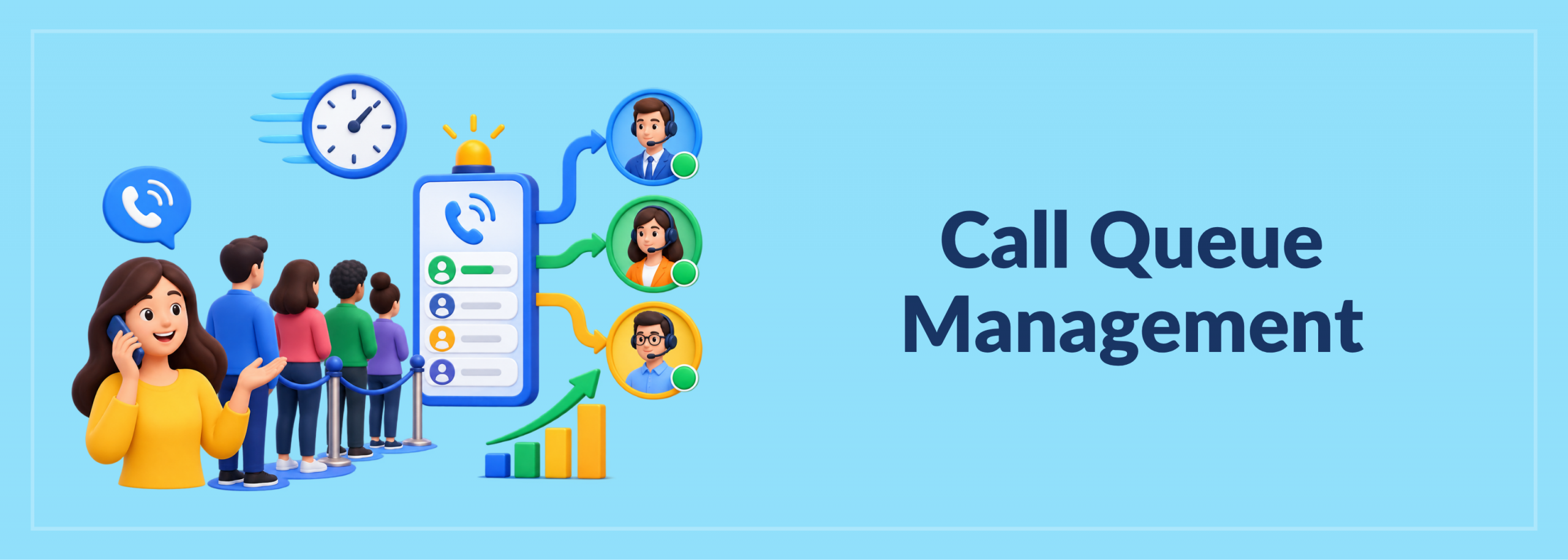
Call Queuing Explained: How Contact Centers Reduce Wait Times and Abandoned Calls

I’ve spent a lot of time looking at contact center operations, and if there’s one piece of technology that quietly decides whether a customer has a good day or a bad one, it’s the call queue. Most people never think about it; they just notice whether they waited two minutes or twenty. Behind that wait is a whole system of decisions, and understanding it is the first step to fixing it.
What is Call Queuing?
At its simplest, call queuing holds incoming calls in a virtual line when not enough agents are available to answer them immediately. Instead of a busy signal or a dropped connection, the caller hears hold music, a message, or an estimated wait time while the system works out who should take the call and when.
That sounds basic, but a modern call queuing system does a lot more than “first in, first out.” It’s constantly weighing priority, skill match, agent availability, and business rules for every call sitting in it. That balancing act is call queue management, in practice: trading off who matters most right now against who’s actually free, so the wait doesn’t feel arbitrary when it happens.
How Call Queuing Works in a Contact Center?
Here’s roughly what happens the moment a customer calls in. The call hits your phone system, gets identified (often through caller ID or an IVR selection), and gets evaluated against your routing rules. If an agent is free and qualified, the call goes straight through. If not, it lands in a queue.
From there, the call center queue holds the call and keeps re-checking conditions: has an agent become free, has priority changed, has the wait crossed a threshold that should trigger a callback offer. Get this wrong, and callers notice within seconds. Get it right, and most of them never think about it at all, which, honestly, is the whole point.
Key Components of a Call Queue
The queue itself is tied to a specific team, skill, or department. Routing logic defines the rules for where each call goes and in what order. And the underlying call queue software, or queue management system, executes those rules in real time.
You also need visibility tools, dashboards that show supervisors how many calls are waiting and how many agents are free, plus the caller-facing side of things: hold messaging, wait announcements, and callback options that give customers some sense of control while they wait instead of dead silence.
Types of Call Queuing Strategies
Not every queue should work the same way, though many end up defaulting to the simplest option anyway.
The most common is linear, or first-in, first-out, where calls are answered strictly in arrival order. Simple and fair, but it ignores urgency and agent skill entirely.
Round-robin distributes calls evenly across agents to balance workload. Simultaneous ringing sends a waiting call to every free agent at once and connects it to whoever picks up first, which cuts wait time but can turn the floor into chaos if you’re not careful.
Then there’s skills-based and priority queuing, which I’ll get into next, since that’s usually where the real gains are hiding.
Most contact centers run a blend of these rather than picking just one, tuned to their call volume, team structure, and what matters most to their customers.
How ACD Manages Call Queues
None of this happens manually. It’s managed by your Automatic Call Distribution system, or ACD, the engine sitting underneath your call queuing system.
ACD is the technology that executes call routing decisions. It checks every incoming call against your configured rules and decides where it goes and when. If you’ve ever wondered how a contact center routes a billing question to the billing team and a technical issue to a specialist without a human redirecting every single call, that’s ACD doing its job quietly in the background.
A good ACD setup also handles the harder edge cases: what happens when every agent is busy, when a queue exceeds its target wait time, and how overflow gets handled between teams. The strength of that configuration has a direct effect on both agent workload and customer experience, more than most people give it credit for.
Queue Priority and Skills-Based Routing
This is where queuing stops being just a line and starts doing real work.
Queue priority lets you say “this call matters more right now,” whether that’s a high-value customer, a service outage, or someone who’s already been transferred twice, moving certain calls ahead based on criteria you define.
Skills-based routing takes it further, matching calls to the agent best equipped to handle them. A customer with a complex technical issue gets routed to someone who knows the product instead of whoever’s free. Fewer transfers, shorter handle times, and better first-call resolution tend to follow, mostly because the right person is answering the question the first time instead of the third.
How Call Queuing Impacts Wait Time and Abandoned Calls
Here’s what matters to the business: average wait time and abandoned calls are two of the clearest signals of whether your queuing setup is working.
When queues run long, customers get frustrated, and many simply hang up before reaching an agent. Every abandoned call is someone who needed help and didn’t get it, which can mean a lost sale or, worse, an unresolved issue that comes back around later, angrier the second time.
Smart queuing pushes back on both. Priority and skills-based routing shorten the effective wait for the calls that need it most. Overflow rules keep any one queue from becoming a bottleneck for everyone behind it. And giving customers visibility into how long they’ll wait, instead of silence, reduces abandonment even when the wait itself hasn’t gotten any shorter, because uncertainty is usually what makes people give up, not the wait.
Best Practices to Optimize Call Queues
A few habits separate contact centers with healthy queues from those that are constantly firefighting. Staff to your real call patterns, not just the average, since spikes are where queues fall apart. Give honest wait time announcements instead of optimistic ones that erode trust the first time they’re wrong. Review your routing rules on a real schedule instead of treating them as a one-time setup you configure and forget. Use skills-based routing on purpose rather than defaulting to whoever’s free, and build overflow paths between teams so one busy queue doesn’t sit backed up while another team has nothing to do.
None of this is complicated. The hard part is doing it consistently, and revisiting it as the contact center grows and call patterns shift underneath you.
Using Callback and Virtual Queues to Improve CX
If there’s one change I’d point to for its impact on customer satisfaction, it’s offering a callback instead of making someone sit on hold.
A virtual queue lets a customer keep their place in line without staying on the phone. They hang up, go about their day, and get called back near their turn. That alone tends to cut abandoned calls, since the customer isn’t burning patience listening to hold music, and it smooths out staffing needs during volume spikes because you’re no longer racing a caller’s patience in real time.
Callback pairs especially well with priority queuing, offered selectively during peak periods or automatically once a wait crosses a set threshold, so customers get a choice instead of a mandate.
Key Call Queue Metrics to Monitor
You can’t fix what you’re not watching, and a handful of numbers tell you most of what you need to know about queue health.
Average wait time is obvious, but pair it with longest wait time, since averages hide the worst outliers. Abandoned call rate tells you how many customers gave up, and it’s often the earliest warning sign something’s wrong. Service level, the percentage of calls answered within your target time, tells you whether you’re meeting the standard you set for yourself. Occupancy and agent utilization show whether staffing matches volume, and first-call resolution, while not strictly a queue metric, tracks closely with routing quality.
Look at these together rather than any single number. That lets you diagnose a problem instead of reacting to complaints after the fact.
How AI and Automation are Changing Call Queuing in 2026
Queuing has gotten noticeably smarter over the past couple of years, and 2026 looks like the point where that stops being cutting-edge and just becomes how things work.
Predictive routing now uses historical data to estimate which available agent is most likely to actually resolve a call, not just who’s free next. Sentiment analysis picks up on frustration or urgency in a caller’s voice and adjusts queue priority on the fly, so someone who’s clearly upset doesn’t sit behind routine calls. AI voice agents are also handling a growing share of simple requests, like appointment changes, before they ever reach a human queue, which takes real pressure off wait times during peak periods.
None of this replaces the fundamentals above; it sits on top of them. A weak ACD setup with AI bolted on is still a weak setup. But when the basics are solid, these tools genuinely make queues faster and less miserable to sit in.
Common Call Queuing Challenges and How to Solve Them
Long queues during peak hours are usually a forecasting problem more than a technology one, fixed by staffing to real demand and using overflow and callback as a release valve. Inconsistent routing, where similar calls get wildly different treatment, usually means the rules haven’t been reviewed in a while, or there’s too much manual override happening on the floor. Tightening the logic fixes this faster than people expect.
High abandonment despite reasonable average wait times usually comes down to poor communication. Customers who don’t know how long they’ll wait assume the worst and hang up, so clear announcements and callback options fix this directly. And agent burnout from constant overflow is really just chronic understaffing wearing a different hat, one that’s been masked because the queue kept absorbing the pressure instead of the schedule.
Conclusion
Call queuing looks simple from the outside: a line, a wait, an answer, but it’s one of the more sophisticated systems running behind the scenes in any contact center. Getting it right means thinking about ACD, routing logic, priority, and skill, not just the technology moving calls from one point to another.
The contact centers that consistently keep wait times low and abandonment down aren’t the ones with the fanciest tools. They’re the ones that treat queue management as an ongoing job, revisiting it as call patterns change, instead of configuring it once and leaving it alone.
Frequently Asked Questions
When every agent is busy, the queuing system holds the caller in a virtual line and keeps re-checking who’s free, how urgent the call is, and what rules apply. The ACD does this work in the background and connects the call the moment a suitable agent opens up.
Start with staffing that actually matches your real call patterns, not just averages. From there, skills-based routing gets calls to the right agent faster, overflow rules keep one busy queue from backing up the rest, and callback options ease pressure during peak hours.
Usually it’s a staffing mismatch, not enough people on for the volume you’re getting. Outdated routing rules and too few agents qualified for certain skills make it worse, and an unforecasted spike tends to expose it all at once.
A lot of it comes down to communication. Customers who know roughly how long they’ll wait are far more patient than ones sitting in silence. Add priority routing for urgent calls and a callback option, and abandonment tends to drop even before the actual wait gets any shorter.
Track average wait time alongside longest wait time, since averages hide the worst cases, plus abandoned call rate, service level, and agent occupancy. First-call resolution is worth watching too, since it usually reflects how well your routing is working.