Your Employees Are Your First Customers. So Why Are You Measuring Them the Same Way?

I’ve been thinking a lot lately about a phrase that’s become almost reflexive in business conversations: Employees are our internal customers.
The logic is clean. If your people aren’t bought in, if their day-to-day experience is frustrating or hollow, that eventually leaks into how they treat the people who actually pay you. The research backs it up, the boardroom nods along, and the LinkedIn posts practically write themselves.
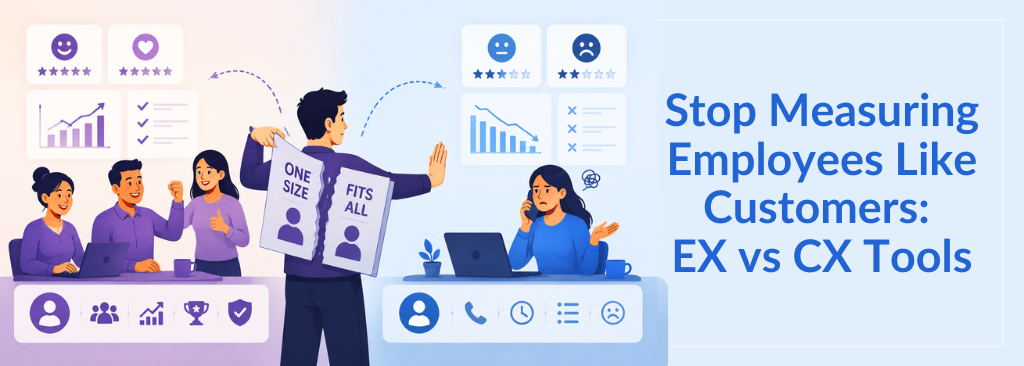
But here’s where I keep getting stuck. If we all agree that employee experience matters just as much as customer experience, why do so many organizations try to measure and manage them with the exact same tools?
I’ve watched this play out more than once.
A company invests heavily in a CX platform, the results are decent, and someone in the leadership team has the bright idea: “Why don’t we just use this for our employee surveys too? Same vendor, same dashboard, one bill.”
It feels efficient and smart until you start looking at what you’re actually getting out of it.
The Connection Is Real. The Tooling Shouldn’t Be Identical
I want to be clear about something: I’m not arguing that EX and CX should live in separate universes. They shouldn’t. There’s plenty of evidence that when people feel good about where they work, they bring more energy and care to the customers they serve. And that shows up in the financials. Companies that take employee experience seriously, not just running a survey, but genuinely building the conditions for people to do great work, tend to outperform their peers on revenue and profitability by a meaningful margin.
So yes, putting equal weight on both EX and CX is the right call. But equal weight doesn’t mean identical treatment. And it definitely doesn’t mean cramming one into a system that was purpose-built for the other.
Here’s why I think that keeps going wrong.
Customers Browse. Employees Inhabit
A customer touches your brand in isolated moments. They make a purchase, open a support ticket, and maybe leave a rating. That relationship is optional, and it revolves around specific transactions. CX measurement is built around that reality. The questions are designed to gauge satisfaction at a point in time and predict whether someone will open their wallet again.
But employees don’t dip in and out. They’re embedded in your organization every day, such as dealing with leadership decisions, navigating internal politics, and absorbing how things actually get done versus how the company says they get done. The relationship between an employee and an employer is sustained, layered, and shaped by power dynamics that simply don’t exist between a brand and its buyers.
When you point a CX survey at that relationship, you pick up how someone feels on a Tuesday afternoon. You don’t pick up what’s actually helping or holding them back over the long run. And that second thing is what actually matters if you care about performance.
People Won’t Talk if They Don’t Feel Safe
This is the one that really gets me. A customer can post a scathing review from their couch and never worry about it. The power sits with them. Employees are in a completely different position.
Every time someone fills out a workplace survey, there’s a quiet risk assessment happening in the background: “Can this be traced back to me? What happens if my manager reads this? Is it actually worth being honest?” CX feedback tools aren’t designed to address any of that. They assume the person giving feedback has nothing at stake. In an employment relationship, that’s almost never true.
I’ve seen setups where a manager’s bonus was partly tied to their team’s survey scores. Sit with that for a moment. The person whose behavior you’re trying to evaluate has a direct financial reason to influence the results. In environments like that, clean-looking data doesn’t mean things are fine. It often means people have decided it’s not worth the risk to tell you what’s actually going on. And some of the biggest culture scandals in recent memory involved companies that looked perfectly healthy from the outside and had exactly this problem. The numbers were stable. The truth was buried.
Asking Without Acting Is a Fast Way to Lose Trust
Here’s another place where CX logic falls apart when you apply it to employees. A customer who fills out a post-purchase survey doesn’t sit around wondering whether their feedback made a difference. They’ve already moved on.
Employees haven’t moved on. They’re still there the next morning. When they invest time in sharing honest feedback, and then nothing visibly changes, with no results shared, no priorities communicated, and no tangible follow-up, they draw a reasonable conclusion: this was performative.
Next time around, fewer people bother. The ones who do participate give safer, blander answers. The data hollows out over time, and you end up making decisions based on increasingly unreliable information without even realizing it.
The companies I’ve seen get this right treat a survey as the opening move in a longer conversation, not a data collection exercise. They push insights to managers quickly and in a format that’s actually usable. They close the loop publicly. They build accountability into the process so that “we heard you” isn’t just a slide in a town hall deck. That kind of follow-through infrastructure isn’t something you get out of the box with a CX tool. It requires something specifically designed for how workplaces operate.
You’re Measuring the Wrong thing Entirely
Maybe the most fundamental issue is that CX and EX are trying to answer different questions. CX wants to know whether someone will come back and buy more. EX should be asking whether someone has what they need to actually do their job well.
That means understanding whether people know what’s expected of them. Whether they trust the decisions being made above them. Whether they have the right skills and resources. Whether they feel like they belong to something and aren’t just filling a role. These are deep, structural questions about how work gets done inside an organization.
They require different survey designs, different analytical models, and different benchmarks than anything in a CX toolkit. When you try to get at these through customer-style metrics, you end up tracking a number that moves around but doesn’t tell you much about what to actually fix.
So, What’s the Move?
I’m not saying rip out your CX platform or fire your vendor. I’m saying, recognize that employee experience is its own discipline. It has its own measurement needs, its own sensitivities around trust and power, and its own path from insight to action. Use CX tools for CX. Find or build something that’s actually fit for purpose for your people.
Let the two inform each other absolutely. But stop treating them as interchangeable.
Your employees are your first customers, and they deserve a system that was actually designed to listen to them.