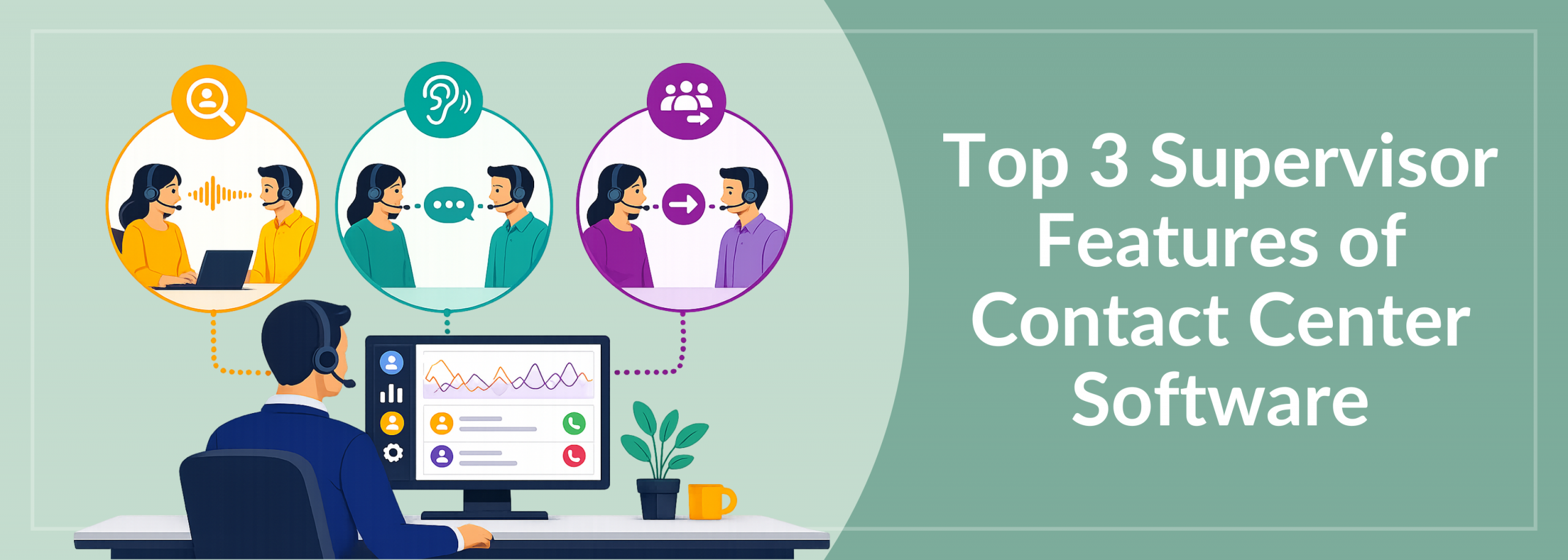
Call Monitor, Call Whisper & Call Barge: Top 3 Supervisor Features of Contact Center Software

There’s a call happening right now on your contact center floor that’s going badly.
The customer called in frustrated. The agent, maybe a newer hire, maybe just having a rough day, took the bait. The tone shifted. The customer is starting to repeat themselves, which is never a good sign. And the agent is defaulting to scripted responses, which is making it worse.
Nobody is intervening. Because the supervisor is in a meeting, or reviewing yesterday’s recordings, or simply can’t see it happening in real time.
That call is probably going to end badly. The customer will hang up more frustrated than when they called. The agent will file it under “difficult customer” and move on. And the business will lose someone it didn’t have to lose.
This happens every day on floors that either lack modern call center monitoring software or have it but don’t use it properly. When looking at how to improve call center agent performance, organizations often look at training manuals and hiring profiles. But the quickest path to better outcomes isn’t a new onboarding deck—it’s active, real-time intervention. Fixing this requires letting go of one very deeply ingrained operational habit first.
The QA Delay: Why Grading Last Week’s Calls Doesn’t Help Today’s Customers
Most quality assurance in contact centers works like a post-mortem: calls are recorded, a tiny random sample gets pulled, a supervisor or QA analyst listens through them a few days later, scores them against a legacy rubric, and feeds the results back to the agent in a weekly or fortnightly coaching session.
There is absolute value in that process. Pattern-spotting over time, identifying systemic training gaps, and tracking high-level performance trends require reviewing historical data. It is a core pillar of long-term agent performance management.
But here’s the problem with making it your primary QA mechanism: by the time you’ve identified that an agent consistently struggles with de-escalation, you’ve already let dozens of frustrated customers walk out the door. The feedback loop is broken. You’re coaching for yesterday’s calls while today’s calls pile up unmonitored.
The other thing nobody says enough: agents know when they’re being reviewed asynchronously. They know the QA sample is maybe ten percent of their calls. So, the accountability is real but partial, and everyone knows it.
Real-time supervision closes that gap, not as a surveillance mechanism, but as a coaching and rescue tool. The three features that make this possible are live monitoring, whisper coaching, and call barging. Used together, they change what a supervisor can actually do during a shift.
Feature 1: Silent Live Monitoring (Call Monitoring)
Real-time call monitoring lets a supervisor listen to a live conversation without the agent or the customer ever knowing they are there. There is no notification audio chirp, no lag on the line, and no interruption. Just a direct, raw feed into the interaction.
This sounds simple. It is simple. But the operational impact is bigger than most people give it credit for.
The most obvious use is real-time quality checking rather than retrospective checking. A supervisor can drop into five calls in a single hour, get an immediate read on how the floor is performing, and catch problems while there’s still time to address them. Compare that to reviewing five recorded calls at the end of the week, by which point the moment has long passed.
But there’s a subtler benefit that doesn’t get discussed enough: it changes agent behavior on the floor. Not because supervisors are listening to every call; they’re not, and agents know that too. But because they might be. The awareness that any call could be monitored live tends to raise the baseline more than post-hoc QA scores ever do. It’s not about fear. It’s about presence.
For supervisors managing large teams across multiple queues, live monitoring also gives you a legitimate floor read without having to physically walk the room. You can be in a one-on-one, step out for two minutes, check in on a flagged call, and get back. That kind of visibility used to require physical presence. Now it doesn’t.
The practical advice: don’t use live monitoring only when you already suspect a problem. Build it into a daily routine. Drop in on calls from strong performers too, not just the agents you’re worried about. You’ll catch things you didn’t expect, and you’ll have a much more accurate picture of what’s actually happening versus what your QA scores are telling you.
Feature 2: Whisper Coaching (Call Whisper)
If monitoring gives you eyes and ears, the whisper coaching feature gives you a voice.
The supervisor can speak directly to the agent during a live call. The customer hears nothing. The agent hears the supervisor’s voice in their ear, gets the guidance they need, and can course-correct without the customer ever knowing the interaction nearly went sideways.
Think about what that means in practice.
An agent quotes an incorrect refund policy. Before the customer has a chance to push back, the supervisor is already in the agent’s ear: “That’s not right; it’s thirty days, not fourteen. Correct it now.” The agent catches it. The customer gets accurate information. Nobody knows anything went wrong.
Or an agent is letting a conversation escalate emotionally, matching the customer’s frustration rather than absorbing it. The supervisor doesn’t have to watch it spiral. They can intervene immediately: “Lower your tone. Acknowledge what they’re feeling before you offer a solution.” The agent recalibrates. The call comes back from the edge.
This is real-time coaching in the most literal sense. Not feedback delivered a week after the fact in a meeting room, but guidance landing exactly when it’s needed, in the moment the agent can actually use it.
There’s a skill to doing this well, and it’s worth training supervisors on it properly. The instinct when you hear something going wrong is to jump in with a correction. But an agent who suddenly hears a voice in their ear while managing a difficult customer can lose their thread if the instruction isn’t calm and specific. Short, clear, actionable. “Offer to escalate.” “Ask them what resolution they’re looking for.” “Stop talking and let them finish.” That’s the language that works under pressure.
Done well, whisper coaching accelerates agent development faster than any classroom session. Learning happens at the point of difficulty, anchored in a real situation. Agents remember it.
Feature 3: Call Barging
Call barging is the escalation option. The supervisor joins the call as an active participant, where the customer can hear them, the agent can hear them, and everyone is now on the same call.
This is not a tool you reach for lightly. Barging into a call mid-conversation is disruptive by definition. The customer suddenly hears a new voice. The agent has effectively been taken off the wheel. Used carelessly, it can make a difficult situation worse rather than better, and it signals to the agent that you didn’t trust them to handle it.
But there are situations where it’s exactly the right call.
A customer is threatening to close a significant account, and the agent doesn’t have the authority to offer what’s needed to retain them. A call has become so hostile that the agent needs to be extracted. There’s been a serious miscommunication, wrong information given, wrong commitment made, that needs a senior voice to correct. These are moments where waiting for the call to end and following up later costs you a customer you could have saved.
The keys to barging well: announce yourself clearly and calmly when you join (“Hi, this is name, I’m the supervisor here, I’ve been brought in to help”), take ownership of the situation without throwing the agent under the bus, and have a clear plan for what resolution looks like before you join. Barging in without knowing what you’re going to offer is worse than not barging at all.
After any barge, debrief with the agent privately. Not as a criticism session, but as a coaching one. What happened, why it escalated, what could have been done differently earlier. That’s where the learning sticks.
The Unified System: Moving From Firefighting to Proactive Coaching
These three features work as a system, not as independent options.
Monitoring gives you visibility. It’s how you know a call needs attention.
Whisper is your first intervention. It is low-disruption, invisible to the customer, often enough to turn things around.
Barging is the last resort when a whisper isn’t enough or the situation has already escalated beyond what the agent can manage alone.
Most at-risk calls should never reach the barge stage. If your supervisors are actively monitoring and using whisper coaching effectively, they’re catching the signs early enough to redirect a call before it becomes a crisis. Frequent barging is a signal that the earlier intervention points aren’t working, either the monitoring isn’t happening, the whisper coaching isn’t landing, or agents aren’t being developed quickly enough to handle the call types they’re facing.
The floor this creates is higher than what post-hoc QA can build on its own. Not because the recordings don’t matter, but because they’re always retrospective. The customer on today’s call doesn’t benefit from feedback delivered next Tuesday.
What This Requires From Supervisors
None of this works if supervisors are spending their shifts in back-to-back meetings, buried in administrative tasks, or managing escalations reactively. Live supervision requires time on the floor, where the job is watching and coaching, not firefighting.
That’s as much a management and resourcing question as a technology one. The tools exist. The question is whether supervisors are set up to use them.
The calls that go badly without intervention don’t always generate complaints. Sometimes the customer just goes quiet, switches to a competitor, and never comes back. That’s the damage that doesn’t show up in your QA scores.
The tools to prevent it are already there. The question is whether someone’s watching.
Frequently Asked Questions
Whisper coaching is a supervisor feature that lets a manager speak directly to an agent during a live call without the customer hearing. The supervisor can correct mistakes, suggest responses, or guide tone in real time, all without interrupting the conversation or alerting the customer. It’s one of the fastest ways to develop agents on the job because the feedback lands exactly when it’s needed.
Call barging lets a supervisor join a live call as an active participant, so both the agent and the customer can hear them. It’s used when a situation has escalated beyond what the agent can handle alone, such as a major account threatening to leave, a serious miscommunication, or a call that’s become too hostile for the agent to manage. It’s a last resort, not a first response, and works best when the supervisor joins with a clear resolution in mind.
The three core real-time supervision features are silent live monitoring, whisper coaching, and call barging. Silent monitoring lets supervisors listen to live calls without interrupting. Whisper coaching lets them speak to the agent privately during the call. Call barging lets them step in as an active participant when needed. Together, they enable supervisors to catch problems, coach in the moment, and intervene before a call is lost.
Call monitoring is passive, where the supervisor listens to a live call without anyone knowing. Call barging occurs when the supervisor joins the call and becomes part of the conversation. Monitoring is used for quality checks and to catch early warning signs. Barging is reserved for situations that have already escalated and need direct supervisor involvement to resolve.
Recorded call reviews capture patterns over time, which is valuable for training and QA. But by the time a supervisor identifies a problem in last week’s recordings, the affected customers are already gone. Real-time monitoring lets supervisors spot a struggling call while it’s still happening, and use whisper coaching or barging to turn it around before the customer hangs up frustrated.
Call barging is a call center feature that allows a supervisor or manager to join a live call between an agent and a customer without prior notice. The supervisor can listen to the conversation, speak to the agent or customer, or take over the call entirely when needed.
Call whispering is a call center feature that enables supervisors to provide real-time guidance to agents during a live call without the customer hearing the supervisor. The agent hears the supervisor’s instructions discreetly while continuing the conversation with the customer.
The key difference is visibility to the customer:
– Call barging allows the supervisor to join and speak on the call, and the customer may hear the supervisor
– Call whispering allows supervisors to coach agents silently without the customer’s knowledge
Call centers use call barging to:
– Provide real-time coaching and training
– Handle escalations or difficult customer situations
– Ensure compliance with scripts and regulations
– Maintain service quality standards
– Support agents during high-risk or high-value calls
Call barging is implemented through call center software or cloud telephony platforms. Supervisors monitor live calls via a dashboard and can join an ongoing call, creating a three- way connection between the supervisor, agent, and customer.
The benefits of call barging include:
– Faster skill development for agents
– Better handling of complex customer situations
– Improved compliance and quality assurance
– Reduced escalation time
– Higher customer satisfaction
Common use cases of call whispering include:
– On-the-job training for new agents
– Discreet coaching during live calls
– Handling sensitive customer information
– Assisting agents with objections or complex queries
– Supporting crisis or emergencies
Call whispering offers:
– Discreet supervisor support
– Increased agent confidence
– Better call quality
– Minimal disruption to customer conversations
– Faster learning without public correction
Call barging is widely used in call centers, but organizations must ensure compliance with local regulations and company policies, including call-monitoring disclosures when required. Transparency, training, and proper governance are essential to using these features responsibly.
By providing real-time support to agents, both features ensure:
– Faster issue resolution
– More confident and accurate responses
– Better handling of difficult situations
– Consistent service quality