Warm Transfer vs. Cold Transfer in Contact Centers: When to Use Each (And How to Do It Right)

We’ve all been on the wrong end of a bad transfer.
You call in, sit through the hold music, finally reach a human, explain your whole situation, and then hear the words that drain the energy right out of you: “Let me transfer you to the right team.” Click. New hold music.
New agent. “Hi, how can I help you today?” And off you go, telling the entire story from the top.
By the third retelling, most people aren’t even angry anymore. They’re just done.
That one moment does more quiet damage to customer loyalty than almost anything else a contact center does. Study after study on customer effort lands on the same culprit: having to repeat yourself. A transfer is supposed to move the customer closer to a resolution. Done badly, it does the opposite. It tells them nobody was really listening, and that the systems behind the curtain don’t talk to each other.
But here’s the part that gets missed. Not all transfers are created equal. The gap between a call transfer and call forwarding that frustrates and one that feels effortless usually comes down to a single choice: warm or cold.
Cold Transfer vs. Warm Transfer: What They Actually Mean
What is Cold Transfer?
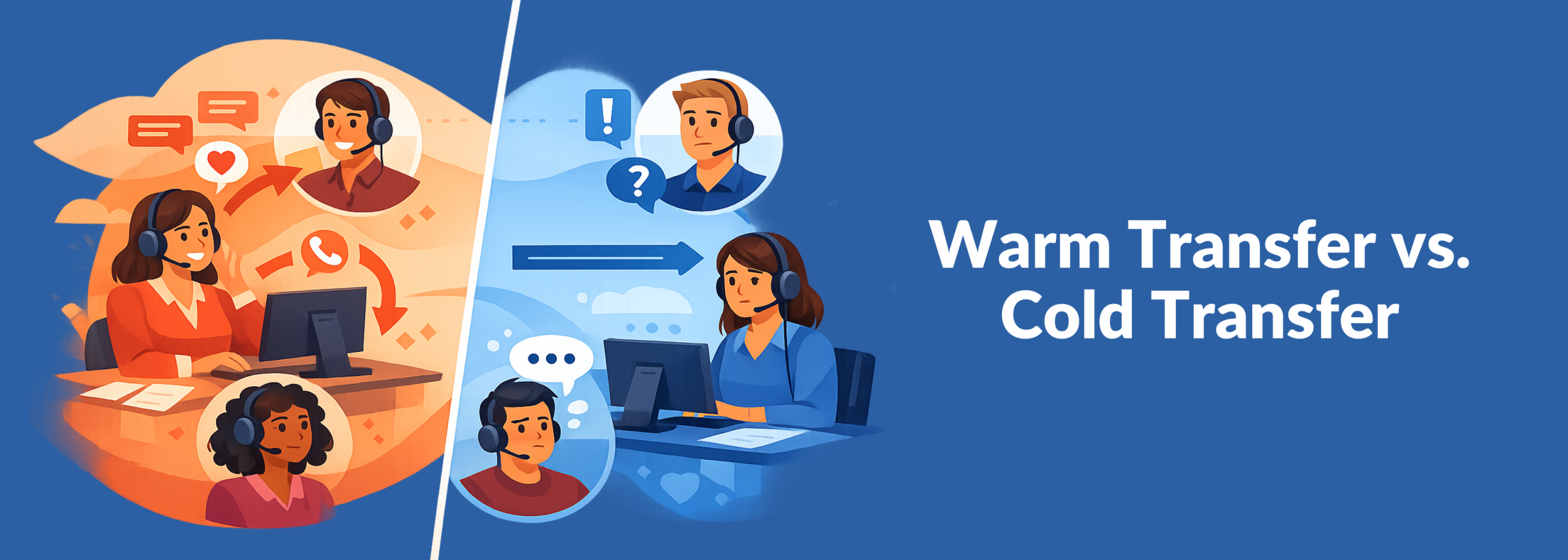
A cold transfer (also called a blind transfer) is exactly what it sounds like. The agent transfers the call to another agent or department and drops off immediately, without speaking to whoever answers. No introduction, no briefing, no context. The customer lands on the line with a new person who has no idea who they are or why they’re calling. It’s quick for the agent, but the customer usually pays for that speed by having to start over.
What is Warm Transfer?
A warm transfer (also called an attended transfer) works differently. Before handing the call over, the first agent connects with the receiving agent, quickly explains the situation, and only then brings the customer into the conversation. Sometimes they’ll stay on the line for a moment to make the introduction. The context travels with the customer, so the handoff feels like a relay instead of a cold restart.
Same goal, very different experience. One passes the person along. The other passes the person and their story.
The Trade-Offs: Pros, Cons, and the Metrics That Move
Neither approach is automatically better. They pull on different levers, and each has a real cost.
Cold transfers are fast and cheap on agent time. They keep the first agent’s handle time down, free them up for the next call, and work perfectly well when the routing is obvious. The downside is everything the customer loses on the way: context, continuity, and often their patience. Use a cold transfer on a complicated or emotional issue, and you’ll watch your satisfaction scores slide.
Warm transfers protect the experience. Because context carries over, customers rarely repeat themselves, issues are solved on the first attempt more often, and people hang up feeling looked after. The cost sits on the operations side. Warm transfers take longer, briefly tie up two agents at once, and can add hold time if the receiving agent isn’t immediately available.
Here’s how the two stack up on the numbers contact center leaders actually watch:
Warm Transfer vs Cold Transfer
| Cold transfer | Warm transfer | |
| Speed of handoff | Fast | Slower (briefing takes time) |
| Average handle time (AHT) | Lower per transfer | Higher per transfer |
| First call resolution (FCR) | Often lower | Usually higher |
| CSAT/customer effort | Risk of frustration | Smoother, more satisfying |
| Agent effort | Minimal | Higher (two agents involved) |
| Best fit | Simple, obvious routing | Complex, sensitive, or high-value issues |
The trap is optimizing for the wrong number. Cold transfers look fantastic if AHT is the only thing you stare at. But a low AHT that comes from punting customers around and generating callbacks and repeat calls is a false economy. You saved 30 seconds on this call and manufactured three more calls next week.
When to Use a Cold Transfer
Cold transfers earn their place when the handoff is straightforward, and the receiving agent doesn’t need a backstory. Reach for one when:
- The request is simple and self-explanatory, like a customer who picked the wrong IVR option and just needs to land in the right queue.
- Any agent in the destination team can handle it equally well, so there’s no specific person to brief.
- The context is minimal, or your system surfaces it automatically for the next agent (more on that shortly).
- Speed and volume matter more than a personal handoff, as with high-volume, low-complexity routing.
The one rule to live by: only cold-transfer when you’re confident the customer won’t have to start from scratch. If they will, you’ve just created the exact frustration everyone complains about.
When to Use a Warm Transfer
Warm transfers are worth the extra minute whenever the stakes, the complexity, or the emotion are high. Choose one when:
- The issue is complicated or has a long history, and re-explaining it would be painful and easy to get wrong.
- You’re escalating to a supervisor or a specialist who needs the full picture before they engage.
- The customer is upset, canceling, disputing a charge, or otherwise in a sensitive moment where being passed off coldly would make things worse.
- It’s a high-value customer or a live sales opportunity, where losing momentum could cost the relationship or the deal.
Best practice on the warm side is simple: keep the briefing short and genuinely useful, confirm the receiving agent is actually ready, and introduce the customer by name so the handoff feels human. A rambling, disorganized warm transfer can be nearly as annoying as a cold one.
How Modern Cloud Contact Centers Make Transfers Painless
Here’s the good news. The warm-versus-cold choice used to be a hard trade-off, but modern cloud contact center platforms have blurred the line. You can now get most of the warmth of an attended transfer without paying the full-time penalty, because the technology carries the context for you.
A few capabilities do the heavy lifting:
Context travels with the call. Instead of relying on one agent to brief another out loud, the platform automatically passes the interaction history along: what the customer selected in the IVR software, notes from the current conversation, previous tickets, and even intent and sentiment signals. The receiving agent inherits the story rather than asking for it.
Real-time screen pops. The moment a transferred call connects, the next agent’s screen fills with the customer’s profile, recent interactions, and the reason for the call. They know who they’re talking to before they say hello, so even a technically “cold” transfer stops feeling cold.
CRM data syncing. When the contact center is wired into your CRM or helpdesk, everything stays in sync through the handoff. Calls get logged automatically, notes are written back in real time, and the next agent sees the same up-to-date record. Nobody works from a stale or partial view of the customer.
Intelligent routing that prevents transfers in the first place. The best transfer is the one that never has to happen. Skill-, language-, and priority-based routing get the customer to the right agent on the first attempt, which quietly shrinks your transfer rate and everything that rides along with it.
Put these together, and the old trade-off starts to dissolve. Transfers get faster and smoother, AHT stays under control, and FCR and CSAT climb because customers finally stop repeating themselves.
The Bottom Line
Warm and cold transfers aren’t good and evil. They’re tools, and the craft is matching the tool to the moment. Cold transfers win on speed for simple, obvious routing. Warm transfers win on experience for anything complex, sensitive, or valuable. Train your agents to feel the difference, and you’re already ahead of most contact centers.
The real leap, though, comes from the platform underneath them. When context follows the customer automatically, the whole debate softens, because even your fastest transfers can carry the warmth of an attended one.
That’s exactly what ClearTouch’s Intelligent Routing and Cloud Contact Center Platform is built to do: route every customer to the right agent the first time, carry full context on every handoff with real-time screen pops and CRM syncing, and turn transfers from a moment of friction into a moment of trust. If your transfers still require customers to repeat themselves, it’s worth seeing what a smarter platform can do.
Frequently Asked Questions
In a cold (blind) transfer, the agent routes the call to another agent or team and disconnects immediately without any briefing, so the customer usually has to re-explain their issue. In a warm (attended) transfer, the first agent speaks with the receiving agent and shares context before handing over, so the customer’s story carries with them. The core difference is whether the context travels with the customer or gets left behind.
Yes, a warm transfer typically raises AHT on that individual call, because the briefing between agents takes extra time and can involve two agents at once. But it often reduces overall effort across the customer’s journey by improving first-call resolution and reducing repeat calls. Look only at per-call AHT, and warm transfers seem expensive; look at the whole relationship, and they frequently pay for themselves.
The most reliable way is to let the technology carry the context instead of depending on agents to relay it verbally. Modern cloud contact centers pass interaction history, IVR selections, and notes along with the call, trigger real-time screen pops so the next agent instantly sees the customer’s profile and issue, and sync everything with the CRM so records stay current. Together, these make sure the receiving agent already knows the story before the conversation begins.
Cold transfers make sense when the handoff is simple, and the receiving agent doesn’t need background information: correcting an IVR misroute, sending a customer to a general queue where any agent can help, or handling high-volume, low-complexity requests where speed matters most. The key condition is that the customer shouldn’t have to repeat themselves, either because the request is self-explanatory or because your platform surfaces the context automatically.