We Gave AI to Our Customer Service Teams. Here’s Why Some of Them Are More Burned Out Than Ever

Let me paint you a picture.
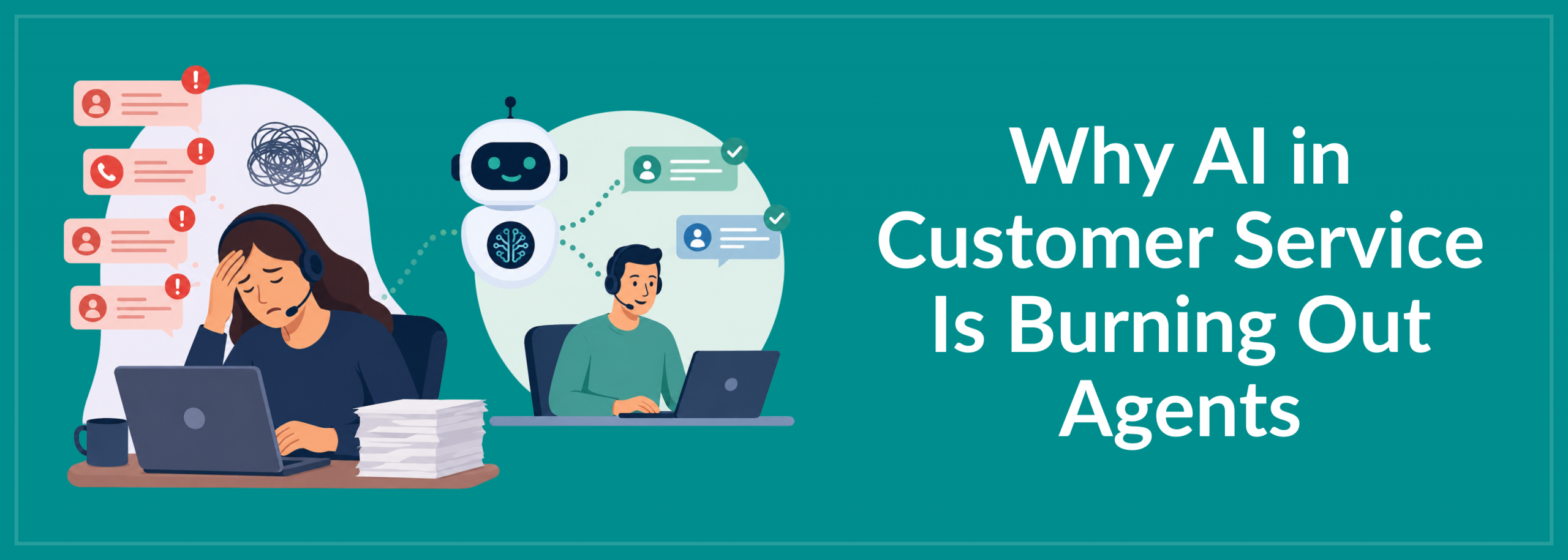
It’s 2:47 PM on a Tuesday. Priya, a customer service agent at a mid-sized telecom company, is wrapping up her 34th call of the day. Not her 34th easy call, but her 34th hard call. A billing dispute that spiraled into a sob story about job loss. Before that, a customer who’d already spoken to a chatbot three times and was absolutely furious by the time he reached a human. Before that, someone had threatened to file a complaint with the regulator.
Meanwhile, on her screen, an AI assistant is blinking suggestions at her. It’s recommending she “acknowledge the customer’s concern” and “offer a resolution pathway.” She knows that. She’s been doing this for six years. What she needs is for the tool to just find the account without making her toggle between four different systems to piece together why this customer’s plan was migrated incorrectly in the first place.
By 3 PM, Priya is exhausted in a way that’s different from any burnout she’s felt before. And here’s the irony: it started getting worse after the company deployed AI.
Why Is AI Causing Customer Service Burnout?
AI causes customer service burnout by automating routine queries, leaving human agents to handle a continuous stream of complex, emotionally charged edge cases. Without a break from high-stress interactions, and burdened by fragmented data systems, agents experience severe cognitive overload.
The Great Complexity Shift Nobody Warned Us About
Here’s the thing about AI in customer service that the sales decks don’t show you: when you automate the easy stuff, you don’t make agents’ jobs easier. You make their jobs harder.
Think about it. When a chatbot handles “Where’s my order?” and “How do I reset my password?”, those queries never reach a human. Great! Except what does reach a human is everything the bot couldn’t handle, such as the edge cases, the emotionally charged situations, the problems that need judgment, nuance, and sometimes a bit of creative rule-bending.
How Does AI Change The Role Of A Customer Service Agent?
AI shifts the role of a customer service agent from simple execution to complex judgment. Because chatbots now handle basic questions, human agents must act as dedicated problem-solvers for highly nuanced, escalated issues that require deep empathy and creative thinking.
Request Demo: Live Chat Outsourcing Services
Jonathan Schmidt, a senior analyst at Gartner, describes this shift plainly: agent roles have moved from execution to judgment. Every call now requires a human decision, not a scripted response. And that’s genuinely demanding work.
Tim McDougall from Deloitte‘s contact center practice puts it even more starkly. In some contact centers today, agents are getting “edge case after edge case after edge case,” one complicated, emotionally exhausting interaction after another, with no breathing room in between. No easy wins. No “sure, let me just look that up for you” to reset the nervous system between the difficult conversations.
It’s the customer service equivalent of asking a surgeon to do nothing but the most complicated procedures, back-to-back, all day, with no routine check-ups in between to break the rhythm.
Too Much Information, But Not Enough Context
Now add another layer to Priya’s afternoon: data.
She has access to a lot of it. Customer history, AI-generated summaries, scripts, recommendations, compliance notes. But having access to information and having useful information are two very different things.
Imagine you’re trying to bake a cake, and someone hands you 200 recipe books, an ingredient list from a different cake, and a note that says, “make it good.”
That’s what fragmented data looks like in a contact center. Agents are switching between multiple legacy systems, systems that were built at different times, by different vendors, that don’t talk to each other properly, to stitch together a complete picture of a single customer’s situation.
Nate Brown, co-founder of CX Accelerator, has a blunt take on how this happened: “The customer service worker got the shaft and had to sort through all this data and all these systems.” Companies built disconnected applications over the years, and agents became the human glue holding it all together.
Here’s the part that should give every CX leader pause: many organizations are now doing the exact same thing with AI. They’re layering new tools on top of siloed systems, adding yet another interface to navigate, another set of prompts to evaluate, another recommendation to accept or override, all while the customer on the line is getting more impatient by the second.
As Jeannie Walters, CEO of Experience Investigators, notes, AI can be genuinely powerful when data is consolidated and well-structured. But when it isn’t? Agents end up searching across multiple places while simultaneously learning and supervising the new tools. The cognitive load doesn’t go down. It goes up.
When The Agent Breaks, So Does The Experience
Here’s what this overload actually looks like from the customer’s side.
You’ve spent 20 minutes with a chatbot that couldn’t help you. You’ve been on hold for another 15. By the time a human picks up, you’re already frustrated. And the agent who greets you? They’re on their 28th difficult call. They’re not checking out, they’re trying, but they’re tired in a way that’s hard to hide.
Walters describes what happens next: overloaded agents fall back on scripts. The interaction becomes transactional. The warmth that was supposed to be the whole point of human service, such as empathy, reading between the lines, and making someone feel genuinely heard, starts to erode.
Brown frames it from the customer’s perspective: “If the service agent feels helpless because the tools are broken, the data is not there, or there’s just too much going on, it’s too hard, and the customer is going to feel helpless.” That feeling transfers. Customers pick it up. They leave the call unsatisfied, and sometimes they don’t come back.
The financial consequences are real on both sides. Gartner research has found that technology environments with lots of guidance but limited context are associated with higher turnover intent, meaning agents are more likely to quit. And replacing an experienced agent can cost tens of thousands of dollars. You lose not just a body but years of institutional knowledge about how to navigate complexity.
So, What Does Fixing This Actually Look Like When Choosing A Contact Center Solution To Reduce Agent Cognitive Load?
Contact centers solution can reduce agent cognitive load by unifying fragmented data streams and deploying AI that provides direct context rather than just scripted suggestions. Additionally, implementing smart call routing that alternates difficult interactions with easier ones gives agents a necessary mental reset.
The answer isn’t to roll back AI. It’s to deploy it differently.
Schmidt’s framing is useful here: AI should reduce cognitive load by pairing relevant context with actual guidance.
The answer isn’t to roll back AI. It’s to deploy it differently.
Schmidt’s framing is useful here: AI should reduce cognitive load by pairing relevant context with actual guidance. Right now, too many implementations do the second part without the first. They surface recommendations without explaining why those recommendations apply to this specific customer, right now, in this interaction. That means agents spend mental energy evaluating whether the AI suggestion even makes sense, which is the opposite of help.
Some companies are exploring smarter call routing, giving agents an easier call after an emotionally draining one, as a kind of mental reset. It’s a simple idea, honestly. It mirrors how good managers naturally protect their teams. But it’s surprisingly hard to operationalize at scale.
Brown goes even further, arguing that the problem is philosophical, not just operational. Customer service cannot be treated as a role to be boxed in and automated around. The people doing this work need to be part of shaping how the work changes, not just handed new tools and told to adapt.
The Priya at the start of this piece is fictional, but she represents something very real. She’s in thousands of contact centers right now. And the question isn’t whether AI belongs in her workflow. It’s whether the leaders deploying that AI have thought carefully enough about what they’re actually asking her to do.
As Walters put it: “There are no easy calls anymore.”
The question is: have we made it easier for the humans who still have to make them?