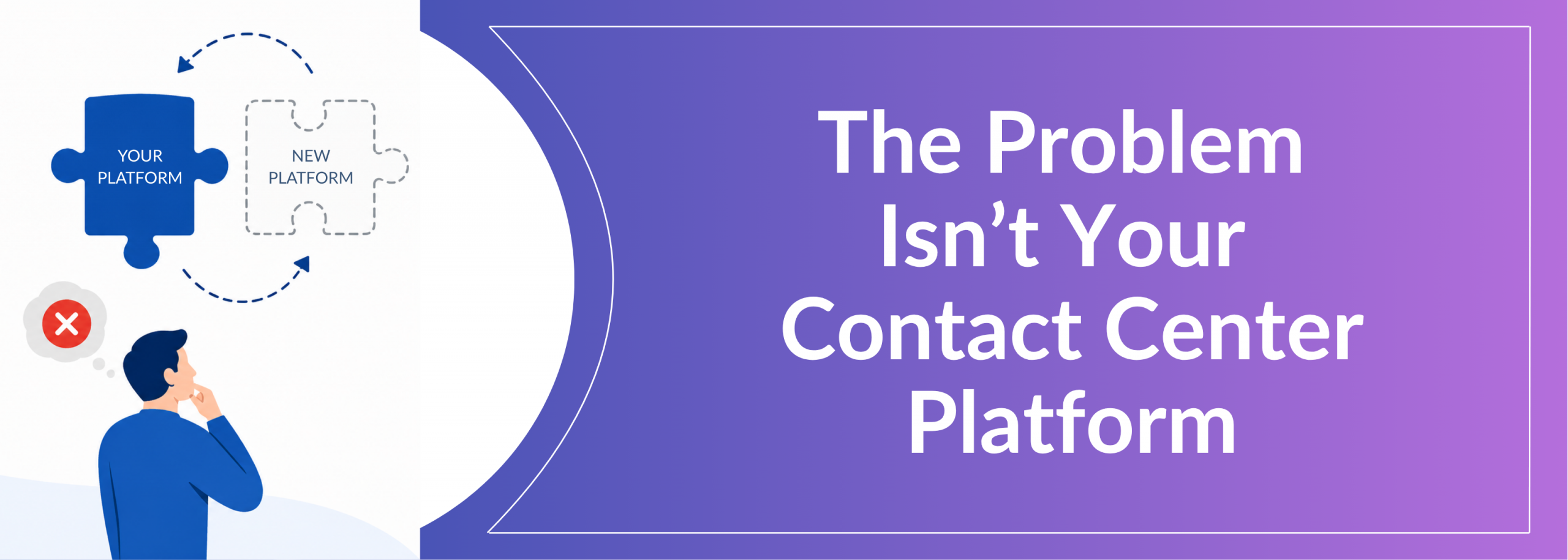
Your Contact Center Platform Isn’t The Problem. Replacing It Won’t Help Either

I want to tell you about a customer who just wanted more data on their phone plan.
They called in. The agent was polite and had the new platform, the one the telco spent 18 months implementing and a big chunk of their transformation budget on. The interaction was smooth. Upgrade confirmed in under four minutes, and the customer hung up happy.
72 hours later, their plan hadn’t changed.
They called back, but angrier this time. It was answered by another agent on the same platform, and the interaction was smooth. Escalation raised. Ticket created. Another 24 hours.
Now here’s the thing. The platform worked exactly as it was designed to. The agent did everything right. The problem had nothing to do with either of them.
It was what sat behind them, a billing system from the late 1990s, a prepaid platform that got bolted on in the early 2000s, a product catalog layer that appeared when bundles became a thing, a middleware stack that grew one acquired product at a time, and a manual reconciliation team whose entire job was to fix the mismatches between all of the above.
The modern contact center platform could take the request. It just couldn’t do anything about what happened after.
Does Upgrading a Contact Center Platform Improve Customer Experience?
No, upgrading a contact center platform alone will not fix customer experience. A new platform only improves how customer requests are captured. If the backend relies on outdated legacy systems, middleware silos, and manual data reconciliation, customer fulfillment will still be delayed, regardless of the new platform.
That’s the story I keep coming back to whenever I hear a company talk about fixing the customer experience by overhauling the contact center.
The Part Nobody Puts In The Business Case
Let me walk you through how that telco got there, because it didn’t happen overnight.
When prepaid launched, the billing system couldn’t support it natively. So, they set up a separate prepaid platform. Different database, different logic, different team. It solved the problem in front of them. It also created the first crack: two systems that would never fully agree on what was true about a customer.
When bundled products came along, mobile, broadband, and TV on one bill, the billing system couldn’t handle it cleanly. So a product catalog layer went on top. The billing system still ran the charges. The catalog now decided what products existed. Another crack.
Add-ons came next. Data boosters, roaming packs, device insurance. Most arrived through acquisitions. Building them into the core was going to take months nobody wanted to spend. So middleware grew up around them instead, stitching everything together. More cracks.
By the time 5G launched, connecting new network-slicing provisioning to the existing middleware was an 18-month project. The call was made to set it up separately and connect it at the edges. And the reconciliation team, the people manually matching CRM records against billing records every 48 hours, just got a new queue.
Here’s what I want you to notice about all of that. Every single one of those decisions made sense at the time. The people who made them weren’t being reckless. They were under pressure, working with what they had to solve the problem at hand. Nobody sat down and decided to build a mess. The mess built itself, one reasonable decision at a time.
That’s what makes it so hard to fix. And so easy to keep adding to.
So Why Does The Contact Center Always Take The Hit?
Because it’s the most visible place to point when things go wrong.
Customers feel it there. CSAT scores come from there. Handle time is measurable. Agents are trackable. And there’s never a shortage of vendors with a compelling platform and a deck full of numbers that make the business case look clean.
Handle time will drop. First contact resolution will improve. CSAT will recover.
What the deck doesn’t show is the system the contact center is sitting on top of. And that’s where it all unravels.
The agent’s screen might be faster. The routing might be smarter. But when an upgrade confirmation disappears into a middleware gap because two systems haven’t been properly reconciled since the product catalog was added fifteen years ago, the new platform has nothing to offer. It logs the interaction as resolved. The customer’s plan doesn’t change. And nobody in the contact center knows why.
The agent experiences it as a mystery. The customer experiences it as a broken promise. And the business experiences it as a repeat contact, an escalation, a complaint, and sometimes a lost customer. None of this shows up in the contact center metrics that justified the platform investment in the first place.
And Then The AI Layer Arrives
I want to spend a moment here because this is where I see many companies right now.
The contact center platform didn’t fix the underlying problem. So the AI deployment comes in, and I understand why the pressure to move on to AI is real, and it inherits exactly the same issues. The same incomplete data and the same broken handoffs. Then downstream state mismatches. Just running faster, and with even less visibility into where things are actually going wrong.
The chatbot resolves the queries that didn’t need a human anyway and escalates the hard ones to an agent with a shinier screen and the same broken view of customer state. The self-service portal handles simple cases and funnels complex ones, the ones with real downstream dependencies, straight into a contact center that now handles a higher proportion of difficult problems. The new CRM gives agents a “unified” customer view that pulls data from six systems, three of which update in real time and three of which batch overnight.
None of these are stupid decisions. They all deliver something. But they’re all treating the contact center as the thing to fix, when it’s just where the consequences of everything else show up.
What Causes Bad Customer Experience in Contact Centers?
Poor customer experience is rarely caused by the contact center platform itself. Instead, the root causes usually include:
Applying expensive tech upgrades to symptoms rather than systemic causes.
Outdated legacy billing and prepaid platforms.
Disconnected middleware stacks and product catalogs.
Broken data flows between departments.
Reliance on manual reconciliation teams to fix system mismatches.
This isn’t a technology problem at its core. It’s a sequencing problem.
The instinct is always to start with the most visible part of the pain. The contact center is loud. Customers are complaining there. Metrics are declining there. So that’s where the investment goes.
But the pain doesn’t start there. It starts in the middle, in the processes, data flows, and integration seams that sit between what a customer asks for and what the business actually delivers. That’s where the real work is. Tracing a customer request from the moment it’s made to the moment it’s fulfilled, and finding every point where a human step, a reconciliation batch, or a manual exception exists. Those are the seams. And those are the ones that need to be closed.
That telco’s customers aren’t waiting 72 hours because the agents are slow or the platform is old. They’re waiting because four systems that were never designed to work together are being manually reconciled by a team that exists solely to paper over the gaps between them. A new platform doesn’t touch that. The only thing that touches it is deciding that the tangle itself is the actual project.
Here’s where I land on this.
Most transformation programs don’t fail because the technology was wrong. They fail because the technology is applied to the symptom while the cause quietly compounds beneath it.
If your customers are having a bad experience, your contact center is where you’re hearing about it. It’s probably not where it’s coming from. And until you’re willing to go looking for the real source, which is almost always messier, less visible, and harder to build a business case around, you’ll keep investing in better ways to absorb the consequences of a problem you haven’t actually touched.
The platform isn’t the answer. But it’s a very expensive way to find that out.