Everything About Direct Inward Dialing (DID) : The Ultimate Guide

Direct Inward Dialing (DID) is a telecommunication service that allows organizations to assign individual phone numbers to specific extensions or users within their phone system. Unlike traditional phone lines, where a single number is used to reach multiple extensions, DID enables direct access to individual extensions through unique phone numbers.
This is where Direct Inward Dialing (DID) comes in.
Whether you are running a fast-growing startup or managing a high-volume enterprise contact center, DID numbers are the secret to streamlining communications, improving customer satisfaction, and reducing operational costs. In this guide, we will cover everything you need to know about Direct Inward Dialing, how it works, and how your business can leverage it for better connectivity.
What is Direct Inward Dialing (DID)?
DID is a powerful feature offered by telecommunications providers that allocates multiple phone numbers—often called direct-dial numbers or virtual extensions—to a single trunk line. Each of these unique phone numbers can then be assigned to different extensions, departments, or individual users within an organization’s phone system.
This architecture enables external callers to reach a specific person or department directly. By routing calls straight to the destination, customers can connect instantly without navigating through a manual switchboard receptionist, waiting on hold, or dealing with an automated menu system.
Do You Need DID? – Real-World Scenarios
Determining whether your organization needs Direct Inward Dialing (DID) involves considering various factors, including your business size, team structure, and daily communication requirements.
Let’s explore five real-world scenarios where implementing DID numbers can make a massive difference in your day-to-day operations:
Small Businesses With Limited Staff
Imagine you are running a small consulting firm with a handful of employees. Without DID, all incoming calls are directed to a single main line number. This quickly leads to operational bottlenecks, long hold times, and missed business opportunities when multiple clients call at once.
By implementing Direct Inward Dialing, you can assign unique virtual phone numbers to each team member, enabling clients to reach them directly.
For example:
your sales manager can have a dedicated DID number for prospects interested in consultations, while your project manager can have a separate number for ongoing project-related inquiries. This personalized approach improves customer service and streamlines communication from day one.
Growing Businesses With Multiple Departments
Let’s consider a growing tech startup with multiple departments, including sales, customer support, and product development.
As the company expands, managing inbound calls becomes increasingly challenging, with callers often getting lost in a maze of menu options. By deploying DID, the startup can assign dedicated phone numbers to each department, simplifying the calling process for customers.
For instance, clients seeking technical assistance can dial the support department’s DID number directly, bypassing the need for lengthy phone trees. This results in faster resolution times, higher customer satisfaction, and improved efficiency.
Remote Workforce in Distributed Organizations
Picture a global marketing agency with a distributed workforce spanning different time zones and locations.
With team members working remotely from various parts of the world, coordinating communication becomes a logistical nightmare.
By leveraging DID, the agency can provide remote employees with virtual extensions and direct phone numbers, regardless of physical location.
This ensures seamless connectivity and enables clients to reach their designated account managers or project leads without hassle. Whether it’s a client in New York or Tokyo, DID ensures that every call is routed to the right person, fostering stronger client relationships and enhancing collaboration across borders.
Customer-Facing Businesses With High Call Volumes
Consider a busy medical practice inundated with patient inquiries, appointment requests, and prescription refills.
Without DID, the receptionist is overwhelmed with incoming calls, leading to long wait times and frustrated patients.
By implementing DID, the practice can assign unique phone numbers to different departments, such as scheduling, billing, and prescription refills. Patients can dial the appropriate DID number directly, bypassing the receptionist and instantly reaching the relevant department.
This reduces call congestion, improves staff productivity, and enhances the patient experience.
Marketing Campaigns With Trackable Phone Numbers
Let’s explore a marketing agency launching a new advertising campaign for a client.
To measure the campaign’s effectiveness, the agency assigns unique DID numbers to each ad variant (e.g., print, digital, radio). As prospects respond to the ads by calling the designated numbers, the agency can track call volumes and conversion rates for each campaign element in real time.
This data allows the agency to refine its marketing strategies, allocate resources more effectively, and demonstrate ROI to the client. Without DID, tracking the campaign’s success would be challenging, if not impossible.
Implementing DID offers tangible benefits in each scenario, including improved customer service, streamlined communication, enhanced productivity, and greater accountability.
Whether you’re a small startup or a multinational corporation, DID can be a valuable tool for optimizing your communication workflows and delivering exceptional experiences to your customers and clients.
How Does Direct Inward Dialing Work?
The inner workings of DID rely on several key components working together behind the scenes to seamlessly link an external caller to an internal user. Whether your business uses traditional physical hardware or modern cloud-based systems, the core process involves the same foundational elements:
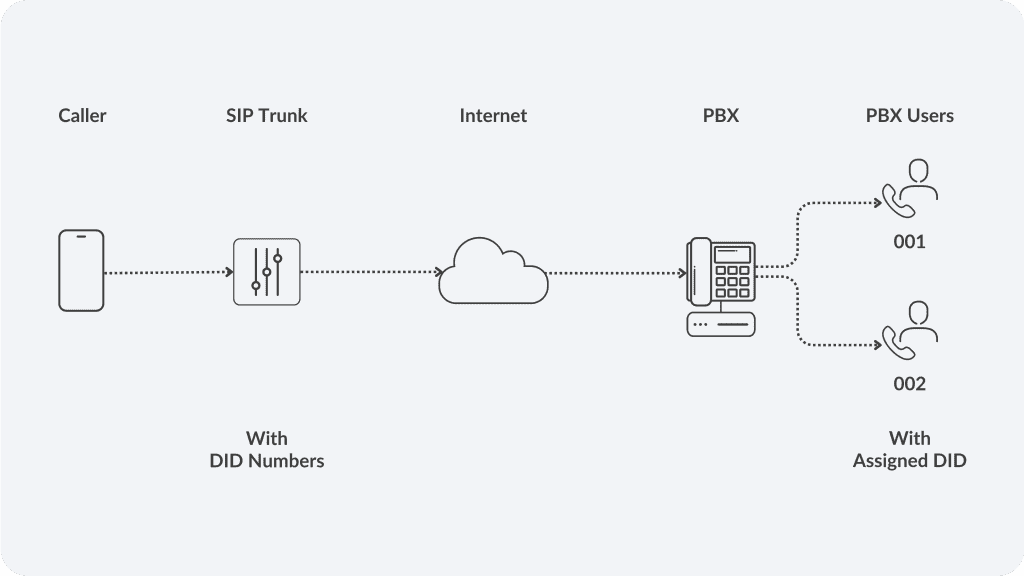
Telecommunications provider – Your organization’s telco or cloud provider allocates a range (or block) of phone numbers to your trunk line (such as a traditional PRI circuit or a modern virtual SIP trunk). The provider is responsible for routing incoming calls to those numbers based on the specific digits dialed.
PBX or phone system – A PBX is the central brain of your business communications. It can be a physical server located in your office or a hosted cloud phone system. The PBX manages all your incoming traffic and automatically routes calls to the appropriate extensions or users within your organization.
DID numbers – Each individual phone number within the provider’s allocated range is known as a DID number. These numbers are virtually mapped and assigned to specific extensions, departments, or individual user accounts within your phone system software.
Call routing –When an external caller dials a DID number, the call travels through the carrier network and is routed instantly to your organization’s PBX via the provider. The PBX reads the dialed digits, identifies the extension associated with that specific DID number, and forwards the call directly to the recipient’s endpoint—whether that is a desk phone, computer app, or mobile device.
By utilizing DID, organizations can efficiently manage high volumes of inbound traffic and ensure that every call is directed to the appropriate recipient immediately, eliminating unnecessary friction and operational delays.
7 Use Cases of Direct Inward Dialing
Direct Inward Dialing is highly versatile, offering massive advantages across various industries and organizational setups. Here is a deep dive into how modern businesses leverage DID to optimize operations and improve connectivity:
1. Customer Service Excellence
Call centers – Call centers can leverage DID to assign dedicated phone numbers to individual agents or teams handling specific customer inquiries or support issues.
This allows callers to reach the appropriate agent directly, reducing wait times and improving overall customer satisfaction.
Technical support – Companies providing technical support services can benefit from DID by assigning unique numbers to different tiers of support (e.g., level 1 and level 2).
This enables callers to reach the appropriate support level based on their issue complexity, leading to quicker resolutions and enhanced customer experience.
2. Sales Enablement
Sales teams – Sales departments can use DID to allocate direct phone numbers to sales representatives, enabling prospects and clients to reach them directly.
This personalized approach fosters more robust relationships between salespeople and clients, improves responsiveness, and increases sales conversion rates.
Lead generation campaigns – Businesses running lead generation campaigns can assign unique DID numbers to each marketing channel (e.g., website, social media, email) or campaign variant.
By tracking incoming calls to these numbers, marketers can measure the effectiveness of their campaigns, optimize marketing strategies, and allocate resources more efficiently.
3. Internal Communication and Collaboration
Interdepartmental communication – Large organizations with multiple departments can deploy DID to facilitate seamless team communication.
By assigning dedicated phone numbers to each department, employees can easily reach their colleagues for collaboration, information sharing, and project coordination.
Remote workforce – Companies with remote or distributed teams can use DID to provide remote employees with virtual extensions and direct phone numbers.
This ensures that remote workers remain accessible to clients, colleagues, and stakeholders, regardless of their physical location, fostering collaboration and productivity.
4. Professional Services
Legal firms – Law firms can utilize DID to streamline client communication and case management.
By assigning dedicated numbers to specific attorneys or legal departments, clients can reach their designated lawyer directly, enhancing attorney-client relationships and improving client satisfaction.
Healthcare providers – Healthcare practices can benefit from DID by assigning unique numbers to different medical specialties or departments (e.g., cardiology, pediatrics, billing).
Patients can then dial the appropriate DID number to schedule appointments, inquire about medical services, or seek assistance, resulting in more efficient patient care and improved patient outcomes.
5. Marketing and Advertising
Campaign tracking – Marketing agencies and advertisers can leverage DID to track the effectiveness of marketing campaigns and advertising initiatives.
By assigning unique phone numbers to each campaign element (e.g., print ads, digital banners, radio spots), marketers can measure call volumes, track conversions, and attribute leads to specific marketing channels, enabling data-driven decision-making and campaign optimization.
6. Event Management
Conference and event organizers – Event organizers can use DID to streamline attendee communication and event logistics. By assigning dedicated numbers for event inquiries, registration assistance, and on-site support, organizers can provide attendees with direct access to event staff, improving attendee experience and satisfaction.
7. Real Estate and Property Management
Real estate agents – Real estate professionals can benefit from DID by assigning unique numbers to individual listings or properties. Prospective buyers can dial the DID number associated with a particular listing to reach the listing agent directly, facilitating property inquiries, scheduling viewings, and expediting the sales process.
By harnessing the versatility of DID, organizations across various industries can optimize their communication workflows, enhance customer engagement, and drive business growth.
Whether improving customer service, enabling sales teams, fostering internal collaboration, or tracking marketing performance, DID offers endless possibilities for enhancing organizational efficiency and effectiveness.
How DID Optimize Communication in Outbound and Inbound Calling
Direct Inward Dialing plays a crucial role in optimizing both directions of your business communications, serving as a dual-purpose asset for your teams:
Outbound calling – DID allows organizations to display specific DID numbers as the outgoing caller ID when making outbound calls.
This helps in maintaining consistency and professionalism in communication, as well as facilitating callback requests from recipients.
Inbound calling – In inbound calling, DID enables organizations to route incoming calls directly to the appropriate recipients based on the dialed DID number.
This reduces call handling time, minimizes call transfers, and enhances the overall efficiency of call handling processes.
By leveraging DID in both outbound and inbound calling, organizations can optimize their communication workflows and deliver a seamless experience to callers and recipients alike.
Conclusion: Transform Your Business Communications
In today’s fast-paced business landscape, effective communication is key to success. Direct Inward Dialing (DID) empowers organizations to streamline communication processes, improve customer service, and enhance overall efficiency.
By providing direct access to individual extensions or departments, DID enables organizations to deliver personalized service to customers, facilitate smoother internal communication, and maintain a professional image.
Whether you’re a small startup or a large enterprise, implementing DID can revolutionize communication, boosting productivity and driving growth. So why wait? Unlock the power of DID and take your communication capabilities to new heights today!
Frequently Asked Questions
Direct Inward Dialing (DID) assigns unique, public-facing phone numbers to individual extensions within your company’s phone system. This allows outside callers to reach specific employees directly without going through a receptionist or auto-attendant. When a caller dials a DID number, your telecom provider routes the call through your trunk line directly to your PBX system, which instantly forwards it to the assigned user or device.
Yes, DID is significantly more cost-effective than traditional lines, often saving businesses 60% to 75% on monthly telecom expenses. While individual pricing varies by provider, standard market rates typically range:
Local DID Numbers: $3 to $8 monthly per number
Toll-Free DID Numbers: $5 to $15 monthly per number
International DID Numbers: $10 to $25 monthly per number
Unlike traditional phone systems where you must pay for a separate physical line for every single employee, DID allows you to share trunk capacity across all numbers. You only pay for the concurrent call capacity your business actually needs, rather than individual line rentals.
Regular business phone lines operate on a 1:1 ratio—one telephone number requires one physical phone line, and expanding means paying separate monthly fees for additional physical wiring. DID utilizes a 1:Many ratio. It provides multiple virtual phone numbers that share the same underlying trunk capacity. This setup offers vastly superior routing flexibility, easier digital number management, and effortless scalability compared to rigid, expensive legacy lines.
If your small business has 3 or more staff members who frequently handle direct client communication, you will see immediate benefits from implementing DID. It is highly recommended if you want to eliminate missed calls, bypass confusing menu trees, provide professional, dedicated caller IDs for outbound sales reps, or use unique trackable phone numbers for marketing campaigns.
DID setup typically takes 2-4 weeks, including number provisioning, system configuration, and number porting if needed. You’ll need a compatible PBX system (cloud or on-premise), adequate internet bandwidth (64-100 kbps per concurrent call), and IP phones or softphones for users. Most providers handle the technical setup, and you can often keep your existing phone numbers by porting them to the new DID service.