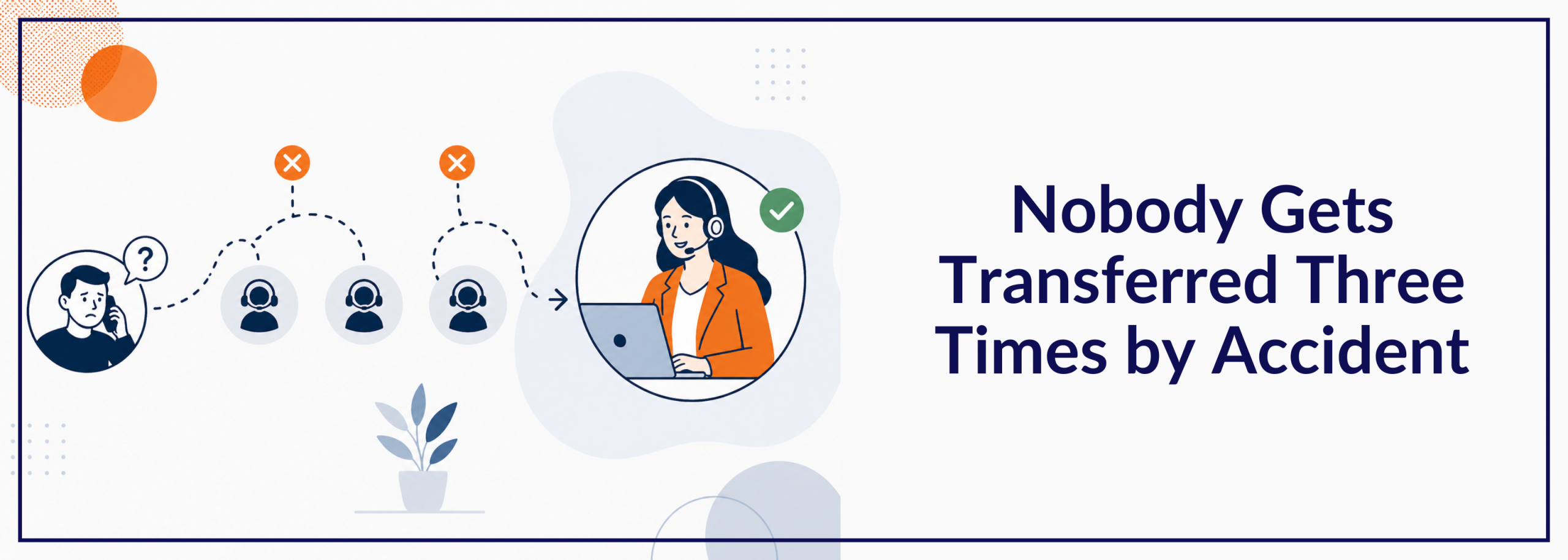
Nobody Gets Transferred Three Times by Accident – It’s a Call Routing Problem

The Real Problem: High Call Volume, Wrong Routing & Long Wait Times
A few years ago, I spent 22 minutes on a call with my internet provider trying to resolve a connection issue. Three days of dropping signals, and I’d finally had enough. I pressed 2 for technical support, waited, explained the problem to someone who listened patiently, and then said, “Hmm, this actually sounds like a billing issue.”
Transfer. I waited again.
I explained everything again. The billing agent told me it wasn’t a billing issue, probably provisioning, and transferred me again. The third person asked me to verify my account details for the third time.
I hung up. Not because the problem was unfixable. Because nobody had any idea where my call was supposed to go.
I think about that experience a lot when I work with contact centers. What I went through wasn’t bad luck or a particularly incompetent team. It was a routing problem. There was no system thinking about where my call should go before sending it somewhere. And that’s a remarkably common situation, even in operations that are otherwise well-run.
What’s Actually Breaking in Call Routing Systems
When contact center leaders tell me they have a “volume problem,” I usually push back a little. High volume alone isn’t the problem. The problem is high volume hitting a system with no logic behind it. Calls going to whoever happens to be free. Agents taking calls they’re not trained to handle. Customers repeating themselves across three conversations that should have been one.
Related Article : Should CFOs Be Concerned About Customer Experience?
The cost isn’t just customer frustration, though that’s real. It’s handle time going up because agents are improvising outside their competence. It’s escalations that are completely preventable. It’s the one agent who’s genuinely excellent at complex claims, spending her day answering password reset questions because nothing is sorting calls by what they actually need.
Auto Dialing that sorting is the job of Automatic Call Distribution (ACD). It’s the system that decides which call goes to which agent, based on rules rather than chance. Not who’s available, but who’s available and actually right for this call.
The Life of a Call: How Automatic Call Distribution Works
Here’s what happens when someone dials in, and the system is working properly.
The first thing they hit is an IVR Solution, the “press 1 for English, press 2 for billing” layer. I want to be clear about something here because I see this confused constantly: the IVR is not the ACD.
The IVR’s job is to collect information.
Related Article : How IVR works in a Cloud Contact Center?
What does the caller want?
What’s their account number?
What language do they prefer?
It’s asking questions. It isn’t making decisions.
Once the IVR has what it needs, the call moves into a queue. I used to describe queues to clients as invisible waiting rooms, except the people in them are ranked. Not everyone waits in the same line. A long-tenured customer with an urgent account issue sits closer to the front.
Someone asking a general question about a product feature sits further back. The ACD is managing this ranking in real time as new calls arrive and agents finish their current calls.
When an agent becomes free, the ACD doesn’t just send the next call.
It asks: Does this agent have the skills to handle this type of call?
Are they finishing a wrap-up?
Have they been idle long enough that fairness says they should take the next one?
All of that happens before the phone rings on their end. The customer hears a click. Someone picks up who is actually equipped to help them. That’s the goal, anyway. When it works, it’s invisible. When it doesn’t, you get my 22-minute internet call.
Inside the Routing Brain of Automatic Call Distribution
I’ve seen a few routing methods used in practice, often layered on top of each other.
Skill based routing is the one I believe in most. Every agent gets tagged with what they can actually handle, like technical support, escalations, a specific language, enterprise accounts, or whatever. When a call arrives with certain flags attached, only agents who match those tags are in the pool.
I was working with a telecom client once whose IVR had customers select “billing” or “technical” at the start of the call. Simple enough. But their ACD wasn’t using that input to route differently; every call still landed in a single general queue. We weren’t doing skill-based routing at all. We were doing theater.
Priority routing is about who gets served first, not who serves them. I think of it like airport boarding. Business class doesn’t need different gate agents; they just go first because the airline has decided that’s how value is acknowledged. Contact centers do the same: escalated complaints, high-value accounts, and time-sensitive cases get pulled ahead of routine inquiries. Done well, most customers don’t even notice. Done badly, it breeds resentment among the agents who end up carrying the load.
Agent Availability routing is the simplest version: the call goes to whoever has been free the longest. No skills weighting, no priority tiers. I’ve seen this work well in smaller operations where agents are generalists and call types don’t vary much. But the moment you start hiring specialists, this approach actively works against you.
Call Queue Management: The Waiting Room Nobody Talks About
Queues get underestimated. I think it’s because they’re invisible to most people; customers don’t see the line, they just experience the wait. But how a queue is managed determines a surprising amount of what that experience actually feels like.
The most impactful thing I’ve seen well-configured ACD do with queues is overflow management. If the technical support queue is building, say, 35 calls deep and climbing, the system can start routing overflow to a secondary group of agents, or trigger a callback option so customers don’t have to sit on hold. I worked with an insurance operation that reduced its abandonment rate by 30% in one quarter, almost entirely by fixing how their queues overflowed. They didn’t hire more people. They just stopped letting one queue drown while another sat underutilized.
The callback feature, by the way, is one of those things that seem small but make a disproportionate difference. The customer keeps their place in line. They hang up. They get a call back when an agent is free. Abandonment drops. Frustration drops. Call volume doesn’t change; you’re just no longer punishing people for calling you.
What Chaos Looks Like Without One
I visited a regional insurance company a few years ago that was growing quickly but hadn’t kept its infrastructure up to date. They were running a basic phone system that distributed calls round-robin, just whoever wasn’t on a call got the next one. No skills tagging, no priority logic, nothing.
They had one agent, whom I’ll call Priya, who was genuinely exceptional at handling complex claims. She’d been there eight years. She knew the edge cases, the exceptions, the internal escalation paths that nobody had written down. And she was spending most of her day on basic policy queries because the system had no way of knowing she shouldn’t be. Meanwhile, genuinely complex calls were landing on newer agents who were doing their best but simply didn’t have the depth to resolve them. Escalations were manual, transfers were constant, and the team was burning out because no one felt like they were doing the right work.
The problem wasn’t the people. The problem was that every call was identical to the system, regardless of what it actually needed.
Automatic Call Distribution Best Practices: What to Get Right
A few things I’ve seen break repeatedly, regardless of how well the system looked on paper on day one.
Skills tags go stale. Agents are trained on new products, take on new responsibilities, and change roles, but no one updates their ACD profile. Calls keep routing to the old classification. I’ve found this in almost every contact center I’ve audited. Someone needs to own that maintenance, with a calendar attached.
Queues need real-time visibility, not just weekly reports. A queue that looks fine in a Tuesday morning meeting can be a genuine mess by Tuesday afternoon. If the only way your supervisors know a queue is struggling is by walking the floor or waiting for complaints, you don’t actually have oversight.
IVR and ACD need to be audited together. I’ve seen situations where the IVR collects inputs that the ACD isn’t actually using to route calls, the customer presses 3 for technical support, and that information just sits there unused. The system feels intelligent because it asked a question. But it didn’t do anything with the answer. That gap is worth fixing before anything else.
My 22-minute call was fixable. Not with more staff, not with better-trained agents, not with a longer IVR menu. It was fixable with routing logic that understood what my call was before it was sent somewhere. ACD isn’t complicated in concept. It’s complicated in implementation, mostly because people rush it, under-configure it, and then forget to maintain it.
Get those three things right, and most of the chaos solves itself.
Frequently Asked Questions
They’re not. The IVR is the front door: it greets the caller, asks questions, and collects information such as account numbers or reasons for the call. The ACD is the decision-maker sitting behind it, using that information to route the call to the right agent. One collects. The other decides. You can have an IVR without a proper ACD, which is exactly when customers end up in the wrong place despite telling you what they need.
Ask yourself three things: Are customers getting transferred more than once per call? Are certain agents overwhelmed while others sit idle? Are specialists regularly fielding calls that don’t need their skills? If any of these is true, routing by chance is costing you. Small teams with generalist agents and low call variety can manage without it. Once you have volume, specialization, and variety of call types, you need the logic.
Fix the biggest problem first. If calls are landing with agents who can’t resolve them, start with skill-based routing. If high-value customers are waiting as long as first-time callers, add priority routing. Availability routing works as a baseline for generalist teams, but doesn’t scale once you have specialists. Most operations eventually layer all three, but get one working cleanly before adding the next. Configuring all three at once, without clean data, usually ends badly.
Mostly the latter, directly speaking. ACD doesn’t create capacity; it uses existing capacity better. What it does reduce is handle time: when calls reach the right agent the first time, there are no transfers, no repeated explanations, no holds while someone figures out where to send you. Shorter handle time effectively frees up capacity, and wait times tend to follow. It’s not a fix for an understaffed operation, though.
Configuring it once and walking away. Agents change roles, products launch, call types shift, and nobody updates the ACD. Six months later, the system is routing based on a reality that no longer exists. A close second is treating the IVR and ACD as separate projects. If the IVR is collecting information that the ACD isn’t using to route, the customer told you what they needed, and the system ignored them.