Human in the Loop AI: Why the Human Shouldn’t Be at the Edge

What Does Human in the Loop AI Really Mean?
We say it as a reassurance. Human-in-the-loop. I’ve said it more times than I can count, in decks, on calls, in the steady voice you use when a customer’s nervous and you want them to settle. And on one call last month, somewhere around the third time I said it, the phrase went soft and meaningless in my own mouth, the way any word does when you repeat it. Human. In. The. Loop. It sounded like a seatbelt. There’s a person in there somewhere, so don’t worry.
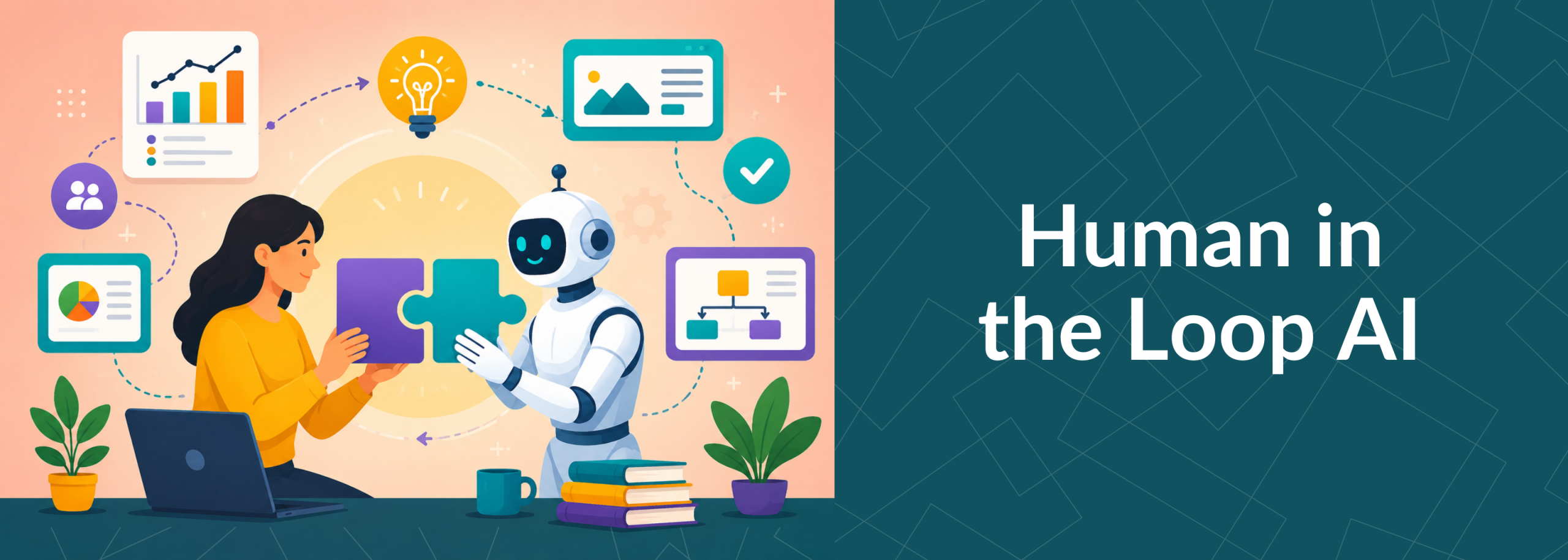
I’d built that slide. The little grey figure standing politely beside a glowing circle with arrows curling around it, slide eleven, the human in the loop, right there in our own deck. And driving home that night, I started wondering who I actually meant by it. Not “the human” in general. A real one. With a chair, a headset, a manager, a name. Where is that person sitting, and what does the loop feel like from inside it?
So, I went looking.
Who’s Actually in There?
First, the obvious one: the agent. Except the job isn’t the job it used to be. When the bot takes everything simple, like the balance checks, the where’s-my-order, the reset-my-password, it skims the cream off the top of the day. What’s left for humans is everything the machine couldn’t do. The tangled account. The bereavement. The customer who’s been bounced through four menus and arrives already furious, halfway through explaining a problem they’ve now had to repeat five times.
The bot keeps the calls that were always going to be easy. The human gets the one that was always going to be hard, and now gets 10 of those back-to-back. And here’s the part that gets me: we still measure them on the same average handle time. We handed them the heaviest calls in the building and kept the stopwatch running at the old speed.
Then there’s the human I almost never hear anyone mention. The one labeling the transcripts. Somewhere in the building, or more likely in a building on another continent, someone is reading yesterday’s bot conversations and tagging them. Good answer. Bad answer. Should have escalated. Missed the point entirely. That tagging is the loop. It’s the literal feedback the model learns from.
So, there’s a person quietly and patiently teaching the machine to do the very thing they’re being paid by the hour to correct. I don’t say that to be dramatic. I say it because nobody puts that person on slide eleven, and they are arguably the most “in the loop” of anyone in the whole operation.
There’s the conversation designer, too. The one who wrote what the bot says before any customer ever showed up. Every cheerful “I can help with that!” and every dead end where it says “Sorry, I didn’t quite get that,” a human chose those words, sat there imagining your bad day in advance, and tried to write for it. They’re in the loop before the loop even starts. We just don’t see them, because by the time you meet their work, it’s wearing a robot’s voice.
And I keep coming back to this one, there’s you. The customer. When you type “agent,” and then “AGENT,” and then “I want to speak to a real person,” you think you’re escaping the system.
You’re not.
You’re inside it, doing unpaid quality assurance. Your frustration is a data point. The moment you give up and flatten your question into the simple, keyword-friendly English the bot can actually parse, congratulations: you just trained it. You became, briefly, the human in the loop, and nobody thanked you or paid you, and you didn’t even get your problem solved.
I could keep going. The team leader watching a wall of dashboards, deciding the exact threshold at which a human gets pulled in. The fraud specialist, the system wakes up at 2 am. But somewhere on that train, I stopped counting the humans and started noticing the work being done quietly. Loop.
At the Edge, Not the Center
Because here’s what “in the loop” actually tells you, if you listen to it. It tells you where the human stands. Not at the center. At the edge. The loop is the system, the system is the thing, and the human is a station the process passes through when it needs checking; a backstop, a fail-safe, a quality gate. The machine is the noun. The person is the safety feature. That’s not me being cynical about the technology; that’s just what the preposition is telling you. In. The human is in the loop the way a fuse is in a circuit. Useful right up until someone works out how to design it out.
And someone designed it that way. That’s the human I went looking for and didn’t expect to find. The loop has an author. The author has a manager. The manager has a number to hit this quarter. The decision to place the human at the edge rather than the middle wasn’t made by the agent, the labeler, the designer, or you. It was made in a room, by a person, weighing a cost against a risk. That person is the most powerful human in the loop and the one furthest from the headset. They never appear in the diagram either, which is convenient, because the diagram is the thing they signed off on.
Centered on Which Human?
So, when I hear “human-centered AI” now, I find myself asking a small, slightly awkward question. Centered on which human? Because every one of them has a claim. The agent drowning in the hard calls. The labeler teaching their own replacement. The designer writing apologies in advance. The customer doing free QA. And the person in the room who decided where everyone else would stand.
Most of the time, if I’m honest, the answer is: centered on the last one. The budget sits in their room, not in ours, and “human-centered” becomes a label we paste over a decision that was really about cost. I don’t think that’s villainy. I think it’s just easier. Nobody sets out to build a cold system. They set out to hit a number, and the cold system is what’s left over when they do.
Flip the Preposition
But it doesn’t have to land there, and this is the part I actually believe. The whole thing turns on one little preposition, and the preposition is the wrong way round. We’ve built setups where the human is in the machine’s loop, pulled in when the machine gets stuck, clocked by the machine’s stopwatch, taught to feed the machine that’s being built to need them less.
Flip it.
Put the human in the center and ask the machine to sit in their loop instead. Let the technology be the thing that gets pulled in when the person needs it, on the person’s terms, judged by whether the person, the agent, and the customer all actually came out of it better than they went in.
That’s the test, and it isn’t a soft one. It’s harder to build, slower to ship, and it doesn’t demo nearly as cleanly on slide eleven. But it’s the whole difference between a human in the loop and a human at the heart of the thing.
And here’s the part I can’t dodge. I’m not pointing at someone else’s deck. I built that slide. My company (ClearTouch’s) makes the platform that runs the loop, which means the diagram is ours, and so is the quiet call about where the human stands in it. That’s why I wrote this down. If the human ends up at the edge, the technology didn’t put them there. Someone like me did. Which means someone like me can move them.