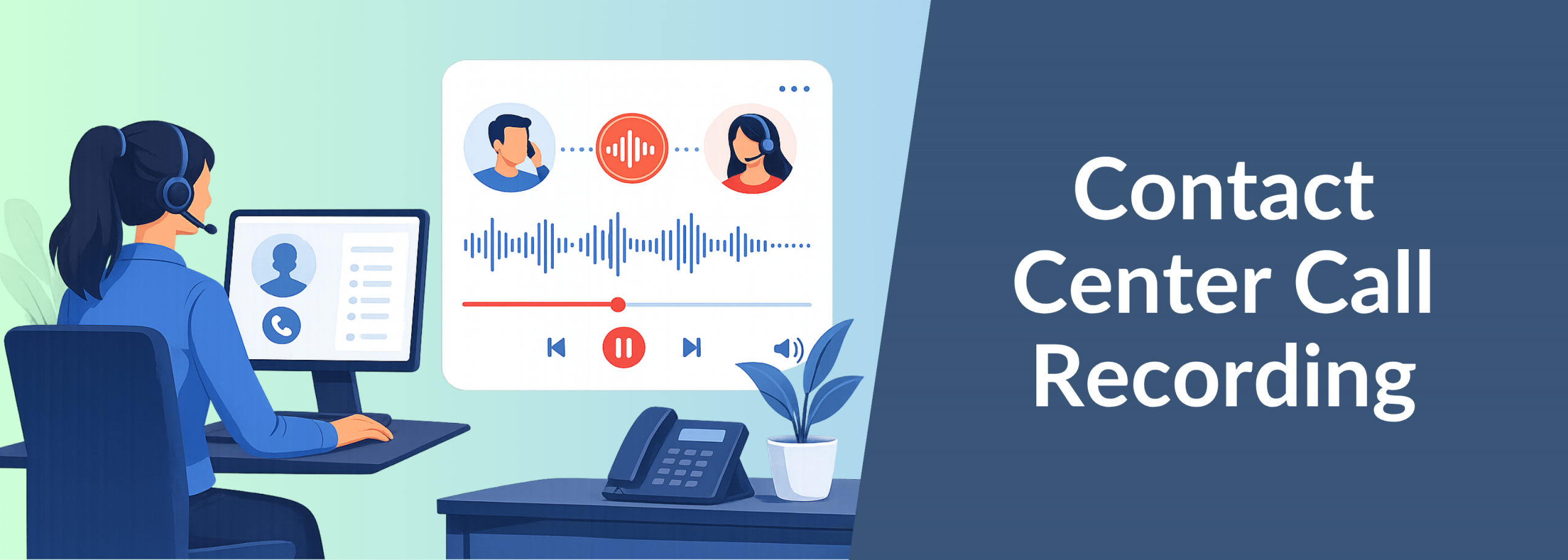
Contact Center Call Recording in 2026: More Than Just “This Call May Be Monitored”

“This call may be recorded for quality and training purposes.”
You’ve heard it ten thousand times. I’ve written some version of it into more systems than I can count. For most of my years doing this, the sentence was honest in a slightly bleak way. The call did get recorded.
It dropped into a folder as a flat audio file. And then it sat there, on a server in a back room, doing nothing for anyone until the day someone needed it and couldn’t find it.
The gap between that bland sentence and what the recording actually has to do now is enormous.
Why Traditional Call Recording Storage Is a Compliance Risk
Here’s the old setup, still running in plenty of contact centers. Calls land as WAV or MP3 files on a local server, named something useless like a timestamp and an extension.
Maybe there’s a RAID array, if someone was being careful. The files usually aren’t encrypted. Access is “whoever has the network share.” Retention is “we never delete anything, storage is cheap.” And the only time anyone opens the archive is when there’s a dispute, a complaint, or a regulator asking a pointed question, at which point some poor person spends two days scrubbing audio for ninety seconds that may or may not exist.
For a long time, that was good enough, because nobody was really looking. The recording existed to settle arguments and tick a quality box. It wasn’t treated as what it actually is: a giant pile of personal data, often including payment information, sitting in the least-protected corner of the business.
The Compliance Shift: Why the DPDP Act and PCI-DSS Make Legacy Recording Dangerous
Two things turned that pile from untidy into dangerous.
The first is the DPDP Act. India’s Digital Personal Data Protection Act and its 2025 Rules are no longer a draft you can wave away. The Rules are notified, the Data Protection Board is up and running, and the substantive obligations, such as security safeguards, retention limits, breach reporting, and the rights people hold over their own data, come into full force in 2027.
That sounds far off until you remember what a call recording actually is under this law. A person’s voice, their name, their account number, the problem they called about: that is personal data, and the Act says you keep it only as long as you need it, protect it properly, and delete it once the purpose is done. It also gives that person the right to ask what you hold and to have it erased.
Now try honoring a “delete everything you have on me” request when your recordings are a million unlabeled files on a back-room drive. You can’t. Not in any way you could prove to an auditor.
The second is PCI-DSS, and this one is biting right now, not in 2027. The rule is blunt: the card security code, the three or four digits on the back of the card, must not be stored after a payment is authorized, even encrypted. There is no “we only kept it for a day” exception and no “it’s only in the call audio” exception.
So, if your agent asks a customer to read out that code, and you’re recording the call, and the audio gets saved, you are storing prohibited data. That’s a violation sitting quietly in your archive, multiplied by every payment call you have ever taken. And encryption doesn’t rescue you, because the standard specifically says you can’t encrypt your way out of it.
Put those together, and the flat-file archive stops being a convenience and becomes a standing risk. Which is where the product story starts: three things that actually fix it.
Feature #1: Automated Audio Redaction
The cleanest answer to the PCI problem is to keep the dangerous data out of the recording in the first place. Automated audio redaction does exactly that. The system listens for the moment a customer starts reading out card details and mutes that segment of audio, or strips it out straight after, so the security code simply isn’t there. Same idea for other sensitive numbers you’d rather not have sitting in an archive: the card number itself, a national ID, whatever your compliance team flags.
The old approach was “pause and resume”: the agent manually hit a button before asking for the card. It worked when the agent remembered, which was not always. Automating it removes the agent’s memory from the equation. The recording still captures the conversation; it just doesn’t capture the fifteen seconds that would have put you in breach. This one feature, on its own, is the difference between a payment-handling contact center that’s compliant by design and one that’s a single audit away from a very bad week.
Feature #2: Smart Search & Metadata
Finding One Call in a Hundred Thousand Hours
A redacted recording you can’t find is still a problem because half of what the DPDP Act asks is the ability to put your hand on a specific person’s data on demand. That’s what search and metadata are for.
Instead of files named by timestamp, every recording carries structured information: who the customer was, which agent took the call, what it was about, when payment came up, how it ended. The audio gets transcribed, so the words spoken inside the call become searchable too.
Now “find me every interaction with this customer over the last year” is a query, not an archaeology dig. So is “show me the call where we promised this refund.”
This is also where the QA half of the job lives. When you can search across everything, rather than sampling five random calls a week, you can actually find the coaching moments, the complaint that keeps recurring, the point where a particular script falls apart. The same metadata that lets you answer a regulator lets you find the calls worth learning from. One capability, two completely different audiences served.
Feature #3: Automated Retention and Secure Cloud Storage
The last piece is where the recordings live and how they leave. Moving off the local server into cloud storage gives you the redundancy a single back-room drive never had: your recordings exist in more than one place, encrypted, and they survive the hardware failure that would otherwise erase a year of calls.
But the part that matters most for compliance is deletion. The DPDP Act requires you to retain data only as long as the purpose justifies, then erase it. Doing that by hand across a million files is impossible, so nobody does it, which is how archives quietly grow to hold a decade of calls nobody is allowed to keep.
The fix is to set a retention policy once, keep payment calls for this long, support calls for that long, and let the system enforce it automatically, deleting on schedule and logging every deletion as it happens. That log is the thing you hand to an auditor. “We don’t keep recordings longer than our stated policy, and here’s the proof” is a very different conversation from “We keep everything forever, I think.”
Where This Leaves Us
The phone line still says the call may be recorded. Everything behind that sentence has changed. Recording used to be a passive archive you hoped you would never have to open. Now it’s an active system that has to protect, find, and forget data, all on demand and all provably. The good news is that none of this is hypothetical or hard to come by. It’s how modern recording is built.
So, if you’re still running calls to a server in a back room, this is where I point you to Cloud Call Recording & QA Software and suggest you take a look. Your archive shouldn’t be the riskiest thing you own.
Frequently Asked Questions
No single law requires Indian contact centers to record every call. Recording is usually driven by quality, dispute resolution, and sector-specific rules, such as those for financial services, insurance, and telemarketing, which often carry their own obligations. The DPDP Act doesn’t require recording at all; it governs how you store, protect, and delete the recordings you do make. So, the real question isn’t whether you’re allowed to record, but whether you can handle what you’ve recorded responsibly.
The core move is keeping prohibited card data out of the stored audio. PCI-DSS forbids retaining the card security code after a payment is authorized, even if encrypted, so compliant software uses automated redaction or DTMF masking to mute those few seconds before the recording is saved. It also encrypts recordings at rest and in transit and limits who can access them. When done right, sensitive data never lands in your archive, so there’s nothing to breach.
Yes. Automated audio redaction detects when a customer reads out card details, an ID, or other flagged information and removes that segment, either muting it live or stripping it straight after the call. Because it runs automatically, it doesn’t depend on an agent remembering to pause the recording. The conversation is preserved; only the sensitive seconds are gone.
The DPDP Act doesn’t set one fixed number for most businesses. The principle is storage limitation: keep a recording only as long as it serves the purpose for which you collected it, then erase it. (Some notified sectors face specific timelines, but the general rule is purpose-based.) In practice, that means setting a retention policy for each call type and enforcing it automatically, so recordings are deleted on schedule, with a log to prove it. Keeping everything forever is the one approach the Act rules out.
Generally, yes, when it’s set up properly. A single on-premises server is a single point of failure: often unencrypted, loosely access-controlled, and one hardware fault away from losing a year’s worth of calls. Reputable cloud recording gives you encryption at rest and in transit, redundant copies across locations, granular access controls, and audit logs as standard. The bigger advantage is operational: retention, deletion, and access rules are enforced by the platform instead of relying on someone to remember to run them.