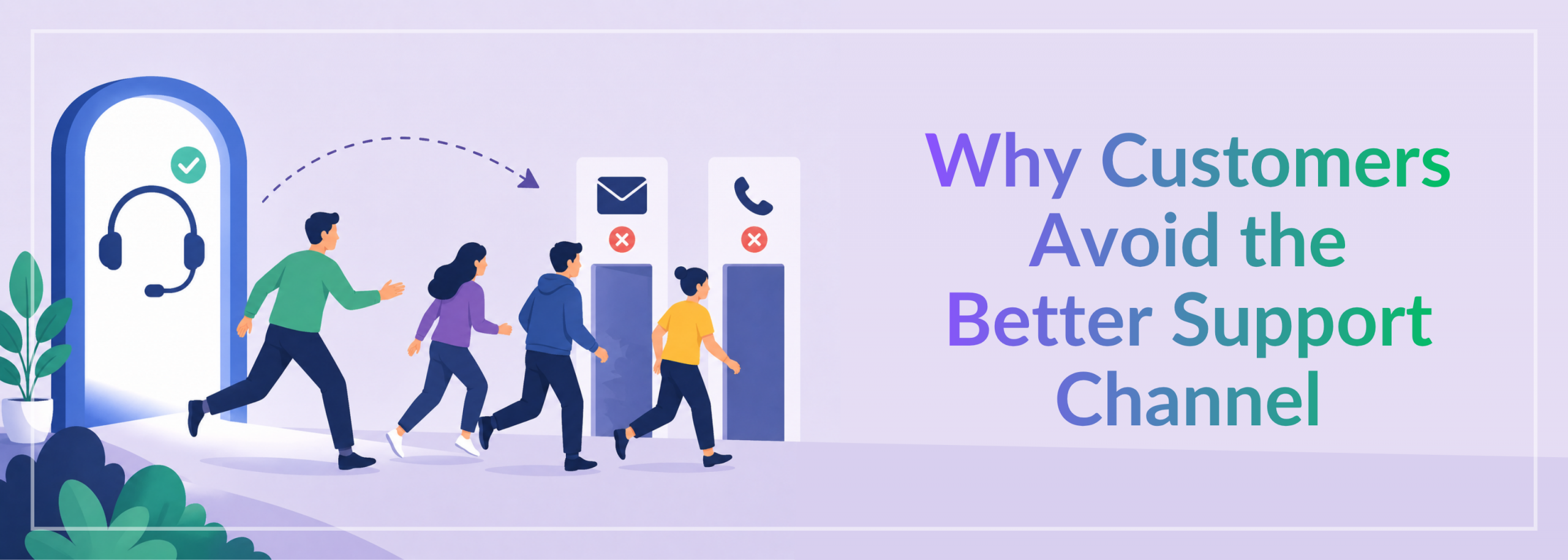
Why I Keep Watching Customers Run From the Better Support Channel

Last month, I noticed a charge on my credit card that I didn’t recognize. Nothing huge, but the merchant name was one of those vague payment-processor labels that tells you absolutely nothing. My pulse went up a little. I opened the bank app, tapped the transaction, hit “raise a dispute,” and the app immediately steered me toward a video call with a “fraud specialist.”
Faster, it promised.
More secure. Then it asked for camera permission. Then the microphone. Then it wanted a selfie to match my ID on file. Then it said the wait was nine minutes.
I was sitting at my desk with a half-finished cup of coffee, twelve unread emails open, and a meeting in twenty minutes. I closed the app and called the number on the back of my card. Got a human in three minutes. Dispute filed in five.
That whole experience has been bouncing around my head ever since, because I have spent years on the other side of that exact moment. I have sat in rooms where teams celebrated launching a richer channel to build out their omnichannel customer experience—such as video support, co-browse, in-app messaging, AR-guided troubleshooting, and then quietly watched the adoption numbers flatline a quarter later.
We always blamed the customer. They are not ready. They need education. The change curve is real. Give it time.
It is not that. I am pretty sure now that it is almost never that.
Why Do New Customer Support Channels Fail? The Richer the Channel, the Heavier It Feels
New customer support channels often fail because they inadvertently increase the effort required from the user. While channels like video and co-browse offer richer features, customers in a state of distress generally prefer the lowest-friction option, such as a traditional phone call, to resolve their issues quickly.
Here is the thing nobody wants to say out loud in a CX strategy meeting: customers do not come to support for a delightful experience. They come because something is broken, confusing, or making them anxious about money or time. In that exact state, a richer channel is the last thing they want.
A few years ago, I was helping a fintech client roll out video KYC. The product team was thrilled. Compliance loved it. The pilot went beautifully, and internal testers had no issues. Then we went live, and our drop-off rate at the video step was something like 62%. Sixty-two percent of customers got to the part where the camera turned on, and quit.
We did the postmortems. People were doing onboarding in bed at 11 pm. On a crowded bus. In a shared flat with three roommates. One guy emailed us to say he tried it three times and gave up because he could not find a quiet room without his kids running in. He just wanted a savings account.
That stuck with me. We had built something technically beautiful that demanded an environment most of our customers did not have when they were actually trying to use it.
What Is Customer Effort in CX? Why Effort Is Not Just Clicks
Customer effort in CX goes beyond the number of clicks required to solve a problem. It includes the mental overhead of learning a new tool, environmental constraints, and the anxiety of wondering if the chosen customer support channel will actually resolve the issue without further delays.
For a long time, I thought effort in CX was measured by the number of steps. Reduce the steps, reduce the effort, done. But after watching enough of these launches, I think effort is something messier than that.
It is also the mental overhead of figuring out what the channel even does. The trust you have to extend when something asks for your camera. The uncertainty about whether the agent on the other end can actually solve your problem, or whether you are about to waste twenty minutes only to be told you need to call a different number anyway.
That last one is the killer. I once watched a recording of a session where a customer started a co-browse session. The agent could not see the right screen. They spent six minutes troubleshooting the co-browse itself, and then the customer said, “Can I just call you?” and dropped off. The richer channel created a problem that did not exist before it showed up.
How Do Wait Times Affect Support Channel Adoption? The Premium Lane That Is Secretly Slower
Wait times severely impact the adoption of new customer support channels. If a newly launched digital channel is understaffed, the perceived wait time increases. Customers will quickly abandon the new channel and return to legacy options if they feel the new tech is a trap that slows down resolution.
Another pattern I see all the time: companies launch a fancy new channel, but they staff it lightly because it is new. So, the customers who actually try it end up waiting longer than the customers on the boring old phone line.
Customers figure this out fast. Maybe not consciously, but they notice. The fancy button starts to feel like a trap. Word gets around in households and offices. “Don’t use the video thing, it takes forever.” Then we are back at the helpline, and the data team is wondering why no one adopted the new channel.
I worked with a telco that had this exact problem with their app-based support. Average resolution on the app was actually quicker than the call center solution, but the perceived wait was longer because of how the queue was presented. They fixed the perception, not the actual speed, and adoption tripled in six weeks. Same channel. Same agents. Just less anxiety about whether it would be worth it.
What I Actually Believe Now
After enough of these projects, here is where I have landed.
Richer channels do not win because they are richer. They win when they are easier than the alternative. That is the entire sentence. Everything else, such as the demos, the slide decks, the immersive roadmaps that get nodded through in quarterly reviews, is decoration.
A video call is brilliant when someone needs to show an insurance agent a damaged appliance. It is a tax when someone wants to update their address.
I still think about that credit card dispute. Some banks spent real money building that fraud-specialist video flow that included vendor contracts, internal demos, training decks, and probably a steering committee that met every other Tuesday. And in the moment I actually needed it, I bypassed it all for a phone number printed on a piece of plastic.
That is not a customer education problem. That is the customer telling us, in the most honest way a customer can, what they were asking for all along.
They were never asking for richer; they were asking for easier.
We just kept hearing it wrong.