Customer Service Deflection: Why It Fails & When Human Support Matters

Customer service deflection is the practice of redirecting customers to self-service channels instead of human support. While it reduces workload, overuse can harm customer experience, reduce satisfaction, and limit valuable customer interactions.
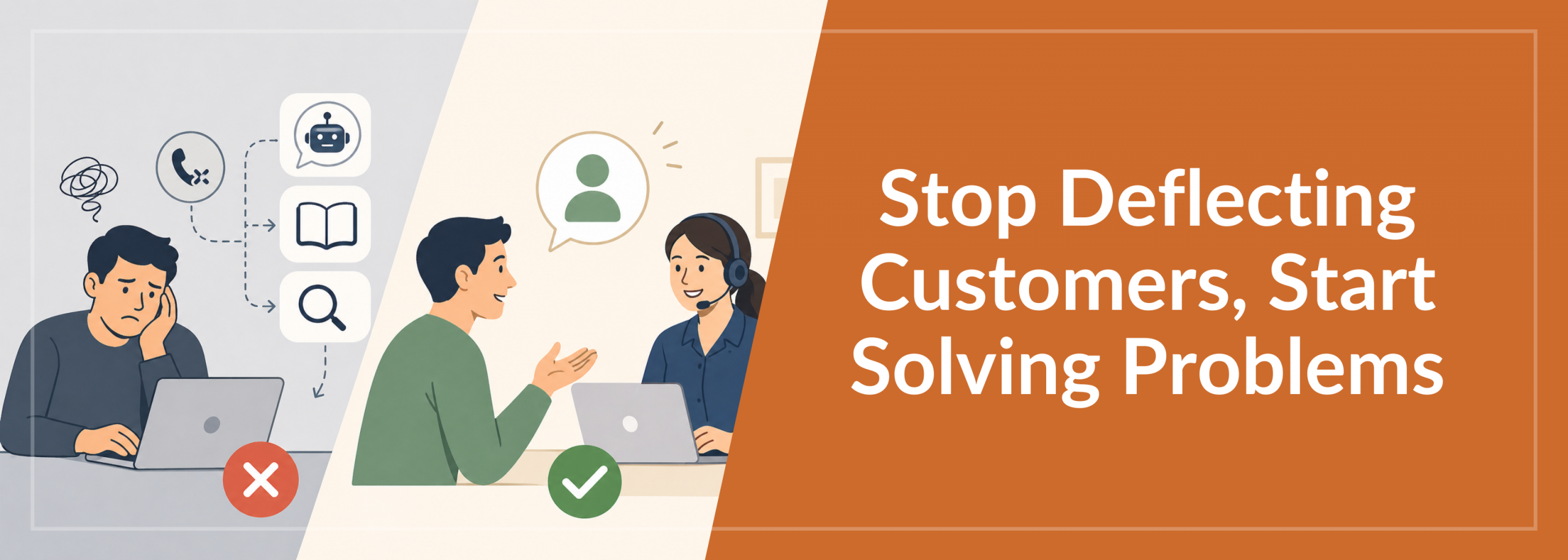
Stop Deflecting Your Customers. You’re Not Solving a Problem; You’re Creating One
The Best Customer Journey Is Not Always the One with Fewer Interactions
A few weeks ago, I was speaking with a customer success manager at a mid-sized company. She was energized, clearly proud of what her team was building, a set of self-service capabilities designed to redirect customers away from human agents and toward automated channels. The word she kept using was “deflection.” They were deflecting conversations to self-service, and she said it like it was an unambiguous win.
I asked her how many calls they receive per hour.
She paused. “We don’t get calls on an hourly basis. We get a few calls daily.”
A few calls daily. Not hundreds. Not thousands. A handful. And the strategic priority was to make sure even those didn’t reach a person.
That conversation has stayed with me, not because the technology was wrong, self-service has its place, but because of the assumption underneath it. Somewhere along the line, we started treating customer contact as a cost to minimize rather than a signal to interpret. And that assumption, scaled across an organization, leads to journeys that are optimized for efficiency but hollowed out of meaning.
The Deflection Reflex
The logic behind deflection is straightforward. Customers contact you with questions. Some of those questions are simple and repetitive. If you can answer them automatically, you save agent time, reduce costs, and resolve things faster. When you’re handling ten thousand calls a day, and most of them are balance checks or password resets, that math is sound.
But most organizations aren’t in that situation. Most B2B companies, and plenty of consumer ones, have a manageable volume of customers with real, layered relationships. Their customers aren’t calling to check a balance. They’re calling because something isn’t working, or because they’re confused about a feature, or because they’re evaluating whether to renew. Those aren’t transactions to deflect. They’re moments that carry weight.
The problem isn’t self-service itself. The problem is treating deflection as a blanket strategy and applying it uniformly, rather than asking what the right next step is for this particular customer, in this particular moment, given what we know about their history, intent, and urgency.
That’s an orchestration question, not an automation question.
The Right Action Depends on What the Journey is Telling You
Here’s where the shift happens. In a deflection-first model, the system asks one question: can we handle this without a human? If yes, route to self-service. If no, route to an agent. It’s binary, and it treats every inbound contact as the same kind of event.
In an orchestration model, the system asks a different set of questions. Who is this customer? What have their last few interactions looked like? Are they in the middle of an unresolved issue? Is their contract up for renewal in thirty days? Did they just submit a low satisfaction score? Are they a high-value account that’s shown signs of disengagement?
The answers to those questions should determine what happens next, and the answer isn’t always self-service or an agent either.
Sometimes the right action is a chatbot that resolves a simple question in thirty seconds. Sometimes it’s a direct line to a senior agent who already has context on the account. Sometimes it’s proactive outreach, like a call from the customer success team before the customer even has to reach out. And sometimes it’s nothing at all, because the customer’s journey is on track and the best move is to stay out of the way.
The point is that the decision should be made based on what the journey looks like at that moment, not based on a standing policy to minimize human contact.
Every Conversation is Telling you Something
There’s another cost to reflexive deflection that rarely shows up in the efficiency metrics. When a customer calls, they’re giving you information. Not just about the issue they’re raising, but about the state of the relationship.
Someone who calls about the same confusing feature twice in a week is telling you the feature needs work. Someone who asks how to cancel is telling you something about the offboarding experience. Someone who calls to say things are going well is a potential case study, a referral, a renewal you can count on. That signal is rich, specific, and timely. You lose almost all of it when the interaction gets routed to a chatbot that closes a ticket and moves on.
I’m not arguing that every interaction needs a human. I’m arguing that every interaction carries a signal, and an orchestrated journey is one in which that signal is read, interpreted, and used to shape what happens next, regardless of which channel handled it.
When self-service becomes a wall rather than a window, and when it exists to keep customers away from people rather than to serve them in the most appropriate way, you stop receiving those signals. And over time, you lose the ability to see what’s actually happening in your customer relationships until someone churns, leaving you to reconstruct the story after the fact.
Fewer Interactions is Not the Same as Better Interactions
This is the assumption I think needs to be challenged most directly. There’s a widespread belief in CX operations that a well-run journey involves minimal customer-initiated contact. If customers aren’t calling, the thinking goes, everything must be working.
Sometimes that’s true. Sometimes silence means satisfaction. But sometimes silence means the customer gave up trying to reach you. Sometimes it means they hit a self-service dead end, couldn’t find what they needed, and decided to solve the problem by switching to a competitor instead of navigating your support maze a second time.
The metric that matters isn’t how many interactions occurred. It’s whether each interaction was the right one for that moment, such as the right channel, the right level of support, the right amount of context. A journey with five well-timed, contextually aware, and appropriately routed interactions will always outperform a journey with one interaction forced through a channel the customer didn’t want.
Orchestration is what makes that judgment call possible. Without it, you’re applying the same routing logic to a first-time user with a billing question and a long-standing customer whose third support ticket in two weeks just went unresolved. Those are fundamentally different situations, and they deserve fundamentally different responses.
What a Relationship-First Journey Actually Looks Like
It doesn’t require complex technology to start. It requires a change in posture. Instead of asking “how do we reduce contact volume,” ask “how do we make sure the next interaction this customer has with us is the right one?”
For organizations with small, manageable customer bases, the ones getting a few calls a day, the answer is often simple. Answer the phone. Call people back. Use support conversations to ask how things are going beyond the immediate issue. Treat every inbound contact as intelligence about the health of the relationship, not overhead to be eliminated.
For organizations at scale, the answer is more systemic. Build the logic that reads customer signals, such as interaction history, sentiment trends, lifecycle stage, unresolved issues, and uses them to determine the appropriate next step. Route high-risk accounts to humans. Let simple queries resolve through self-service. Trigger proactive outreach when the data suggests a customer is struggling but hasn’t reached out yet. Suppress automated messages when someone is mid-conversation with an agent on the same topic.
That’s orchestration. Not routing everything to a person. Not routing everything to a bot. Reading the journey and choosing the action that fits.
The Goal was Never Fewer Conversations
The companies that will build the strongest customer relationships over the next decade won’t be the ones that figured out how to hear from their customers less. They’ll be the ones that figured out how to make every interaction, whether it’s self-service, agent-assisted, or proactively initiated, land at the right moment, through the right channel, with the right context.
Stop measuring success by how many conversations you avoided. Start measuring it by how many you got right.