From Reactive Support to Journey Orchestration: What Changes When AI Connects the Dots

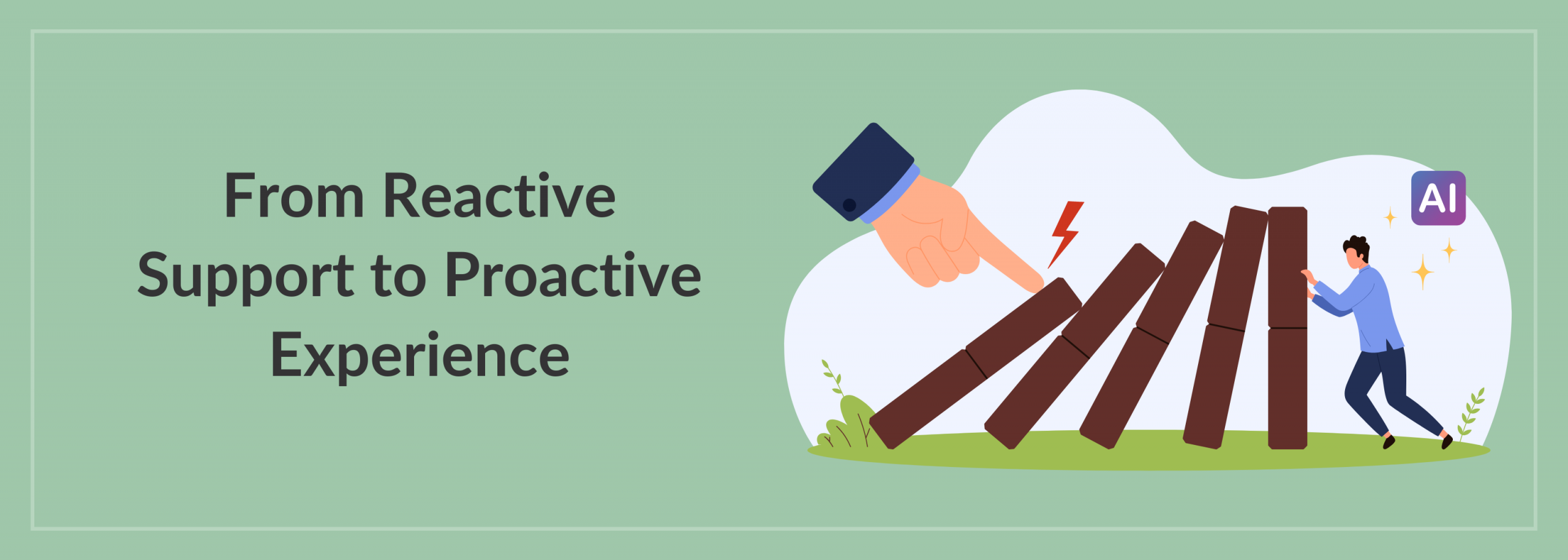
For years, customer support has been built like a fire brigade.
A customer faces a problem. They get frustrated. They reach out. We respond.
That flow has been so normal that we’ve rarely questioned it. But if you step back and look at it honestly, it’s a broken model. It assumes customers must suffer first before we’re allowed to help them.
The promise of AI, when used properly, is not faster firefighting.
It’s making sure fires don’t start.
But here’s the part most people skip over. Spotting a fire early is only useful if you can actually do something about it. And that’s where a lot of “proactive AI” falls flat. It detects. It flags. It alerts. Then it waits for a human to decide what to do.
That’s not orchestration. That’s a smoke alarm with no sprinkler system.
Real customer journey orchestration means the signal and the action are connected. The AI detects an issue in a customer’s journey and addresses it in the right channel at the right time, without waiting for the customer to call in.
Signals Are Everywhere. Actions Are What’s Missing.
Most organizations are already sitting on more signals than they know what to do with.
A backend error that quietly repeats. A checkout page where dwell times suddenly spike. A customer who keeps hovering, scrolling, clicking, and undoing actions. A spike in drop-offs at the same screen. Sessions that start confidently and then stall.
These patterns exist. Humans miss them because they’re too subtle, too frequent, or too spread out.
AI is good at catching them. That part, most teams have figured out.
But catching a signal is only half the problem. The other half, the harder half, is knowing what to do with it.
- Which signals need an in-app nudge?
- Which ones need a proactive call?
- Which ones mean you should reroute the customer’s next interaction to a senior agent?
- Which ones are noise?
That’s orchestration. It’s the layer between “we noticed something” and “we did something useful about it.”
Without it, you have dashboards full of insights and a support team that’s still waiting for the phone to ring.
Why Most AI in Support Still Feels Like a Chatbot With Better Grammar
Let me say something that might sound harsh.
Most AI in customer support today is doing clerical work with a fancy interface.
It waits. It listens. It matches. It responds.
That’s pattern execution. And the problem isn’t AI’s capability. It’s how narrowly we’ve defined its job.
We keep training systems to answer questions. We rarely teach them how problems emerge, where they sit in the customer’s journey, and what should happen next depending on where that customer is.
If all you teach AI is language, you’ll get polite responses.
If you teach it journeys, you get orchestration.
There’s a real difference between AI that says, “I see you’re having trouble with your bill, let me help,” and AI that recognizes this is the third time this customer has hit the same billing screen this week, their sentiment dropped on the last chat interaction, and the right move is to route them to a specialist before they even have to ask.
The first one is a chatbot. The second one is an orchestrator.
Training AI Like You’d Train a Good Agent
When a new agent joins your team, you don’t hand them a script and say, “Good luck.”
You teach them where customers usually struggle. Which issues look small but escalate fast? Which fixes actually calm people down? When to escalate and when to hold steady.
Good agents don’t just answer questions. They sense trouble.
AI can learn the same way, but only if we stop treating it like a universal brain and start training it problem by problem, journey by journey.
Take billing disputes. A well-trained orchestration system doesn’t just recognize the words “wrong charge.” It knows that customers who hit the billing page three times in a week, then switch to chat, then call within 24 hours, are on a trajectory. It’s seen that pattern hundreds of times. It knows what resolution worked, what made things worse, and at which point in that journey a human needs to step in.
That’s different from a chatbot that waits for someone to type “I was overcharged.”
When AI understands domains instead of keywords, it stops reacting blindly. It starts making judgments. That’s the shift from rule-based automation (“if this, then that”) to journey-aware orchestration (“this customer is at this point in their journey, and based on what’s happened so far, this is the best next move”).
That’s when AI stops sounding robotic. Because it’s no longer guessing.
Orchestration Changes What Agents Actually Do
There’s a quiet benefit to this that doesn’t get talked about enough.
When AI genuinely handles the routine, well-understood parts of a journey, human agents finally get room to do what they’re actually good at. Complex problem solving. Emotional reassurance. Edge cases. Figuring out why something keeps going wrong for a whole segment of customers.
I’ve seen teams burn out not because customers were difficult, but because agents were stuck answering the same questions 200 times a day. No learning. No growth. Just repetition.
When orchestration handles the first 60-70% of a journey, the calls that do reach agents are the ones worth having. The agent already has context. They know what the customer tried, what didn’t work, and where the journey broke down. The conversation starts with the problem, not with “Can you verify your account number?”
Journey orchestration changes the nature of the job itself. Agents stop being responders. They become specialists who handle the moments that genuinely need a human.
Ironically, AI doesn’t make support teams less human. It makes them more human by taking away the mechanical burden.
Good Orchestration is Almost Invisible.
One fear I hear a lot is: won’t proactive AI annoy customers by interrupting them?
It will, if done poorly.
But good orchestration isn’t about popping up with messages constantly. It’s about intervening only when the journey data says it matters.
A subtle in-app hint at the exact moment of confusion. A quick clarification before a mistake is made. A gentle reroute to the right agent before the customer has to explain their problem twice. A follow-up that arrives before the customer thinks to ask for one.
When this works well, customers don’t think “AI helped me.”
They think “that was easy.”
And that’s the highest compliment CX can receive.
The Equation That Leadership Cares About
Support costs don’t scale gracefully. Growth usually means more tickets, more agents, more pressure.
Journey orchestration changes that equation. When AI catches issues early and routes them correctly, fewer problems escalate. Ticket volumes flatten. Resolution times drop. Agent capacity goes further. Satisfaction improves without adding headcount.
This isn’t about cutting teams. It’s about letting growth happen without forcing support to play catch-up.
The Mistake I Hope Teams Avoid
As AI adoption accelerates, there’s one trap I keep seeing.
Teams chase the technology without building the understanding underneath it. They plug in AI, point it at their support queue, and expect orchestration to happen on its own.
It won’t.
Journey orchestration is a system you teach. You map the journeys that matter most. You define what signals mean in each context. You set up the actions and the guardrails. You refine it as customer behavior shifts.
If you rush it, you’ll get false positives, broken confidence, and more friction than you removed.
If you build it deliberately, you’ll catch problems before they become tickets. You’ll resolve more with less effort. And you’ll turn support from a cost center into something that actually drives retention.
Customer support has spent decades waiting for customers to raise their hand and say, “Something is wrong.”
AI gives us the chance to stop waiting.
But only if we move past using it as a talking machine and start using it as something that reads a journey, understands what’s going wrong, and acts on it.
That’s the difference between automation and orchestration.
And I think that’s where the real advantage gets built.