Why Your Business Should Move to 160-Series Numbers for Service Calls?

Are you a business that communicates updates, reminders, service alerts, or critical information to your customers using your phone system?
I am sure you must have heard of TRAI’s (Telecom Regulatory Authority of India) mandate to use 160-series numbers for all your service and transactional calls.
What does this really mean for your business?
Should you care about making the switch?
Let us break this down for better understanding.
What Are 160-Series Numbers, and Why Should You Care?
In simple terms, TRAI has designated 160-series numbers specifically for service and transactional calls.
According to TRAI’s Telecom Commercial Communications Customer Preference Regulations, businesses must use 160-series numbers for all service calls, including account alerts, transaction confirmations, OTP delivery, service notifications, and customer support callbacks.
So, if you’re reaching out to customers for any service or transaction-related information, you’ll need to use a number that starts with 160.
Types of Calls Requiring 160-Series:
- Account balance notifications
- Transaction alerts and confirmations
- One-Time Password (OTP) delivery
- Service appointment reminders
- Bill payment confirmations
- Account verification calls
- Technical support callbacks
What Is the Purpose of This Mandate From TRAI?
TRAI wants to make sure that your service and transactional calls come from numbers that are easily recognizable. This will help you avoid any fraudulent calls and being perceived as spam calls.
Research by the Indian Council for Research on International Economic Relations shows that mobile users in India don’t answer calls from unknown numbers due to spam concerns. By making sure service calls come from numbers that begin with 160, customers can immediately identify legitimate service communications.
By making sure service calls come from numbers that begin with 160, customers can trust the call is about something important, and not just another marketing pitch..
Why Should You Move to 160-Series Numbers?
Now, you might be thinking, “Why should I bother with this change?”
Let’s walk through a few compelling reasons:
1. Compliance
The number one reason to switch is compliance. TRAI has made it mandatory for all businesses making service calls to use 160-series numbers.
Non-compliance can result in penalties up to ₹50 lakhs under the Indian Telegraph Act, 1885, and potential blocking of your communication channels by telecom operators. According to TRAI guidelines, businesses have until [current regulatory deadline] to complete their migration
If you don’t comply, you could face some pretty harsh penalties. Besides, your customers will know they are receiving a call about something important.
In short, it’s just not worth the risk to ignore this rule.
2. Gain Customer Trust
Have you ever gotten a call from an unknown number and immediately hesitated to pick it up?
Most of us have.
When you use a 160-series number, you’ll know that it is a legitimate service call, not a marketing or spam call. This provides customers the transparency that will make them likely to answer the phone.
Using a 160-series number builds trust with your audience.
Customers are most likely to engage with calls that they know are from a trusted source, which improves the overall customer experience (CX).
3. Stop Being Ignored
One of the worst things that can happen to your business is customers being reluctant to pick your calls from an unknown number.
You will most likely miss out on providing important updates or notifications to your customers.
Besides, service providers and telecom companies are more likely to block unregistered numbers or numbers not following TRAI guidelines. With 160-series, you avoid the risk of being flagged as spam or being blocked.
4. Build Brand Reputation
By adhering to TRAI’s rules and using 160-series numbers, you demonstrate that you’re a responsible and professional business.
Customers appreciate companies that follow ethical practices, and over time, this can lead to a stronger brand reputation.
When your customers trust you, they’re more likely to engage with your brand.
Industry-Specific Benefits
Banking & Financial Services: 160-series numbers are crucial for OTP delivery, transaction alerts, and account notifications, ensuring customer trust in financial communications.
Healthcare: Appointment reminders, test results, and prescription notifications gain higher credibility when sent from recognized service numbers.
E-commerce & Retail: Order confirmations, delivery updates, and customer support calls see improved response rates with 160-series implementation.
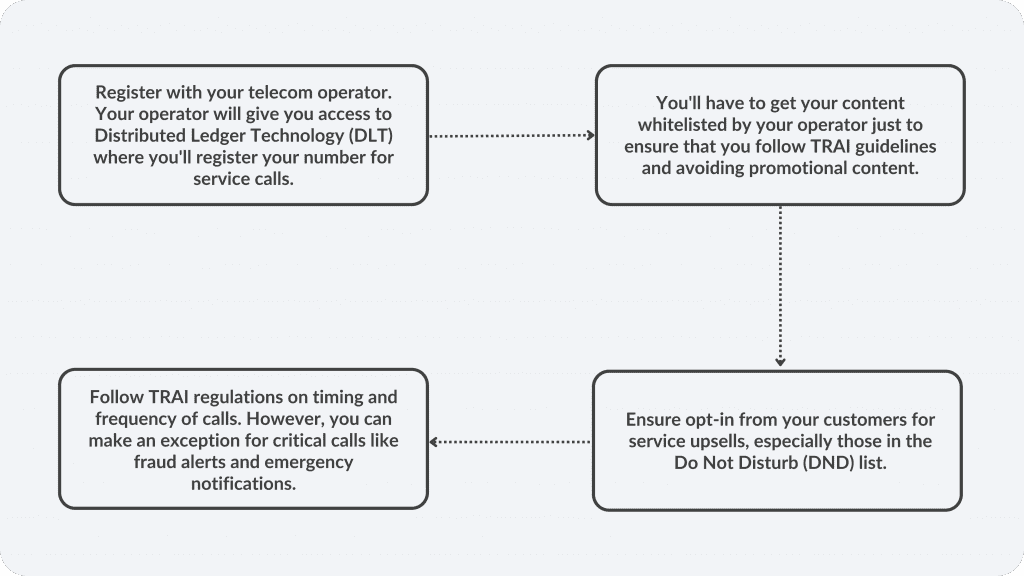
How Do You Make the Switch to 160-Series Numbers?
So, now that you’re convinced of the benefits, how do you go about switching to 160-series numbers?
Step 1: Registration Process (2-3 weeks)
- Submit the application through the registered telecom service providers
- Provide business registration documents, GST certificate, and use case documentation
- Pay registration fees (typically ₹1,000-₹5,000 per number block)
Step 2: Technical Setup (1-2 weeks)
- Configure your existing call center software for new number integration
- Update CRM systems with a new number series
- Test connectivity and call routing functionality
Step 3: Customer Communication (2-4 weeks before launch)
- Notify existing customers about the new service numbers
- Update website, mobile apps, and marketing materials
- Train customer service teams on new procedures
Step 4: Go-Live and Monitor
- Optimize based on initial results
- Implement a gradual rollout to test system performance
- Monitor call answer rates and customer feedback
Common Challenges & Solutions
Challenge 1: Customer Confusion During Transition Solution: Send SMS notifications explaining the new number format and its benefits for customer security.
Challenge 2: System Integration Issues Solution: Work with experienced telecom providers who offer API integration support and technical assistance.
Challenge 3: Staff Training Requirements Solution: Implement phased training programs and create quick reference guides for customer service teams.
How Is Switching To 160-Series Numbers Beneficial to You?
- You will be compliant.
- You will improve your brand’s reputation, gain customer trust, and avoid being flagged as spam.
- Improve transparency and enhance customer engagement
- Your likelihood of increasing call answerability is very high
The switch to 160-series numbers isn’t just about regulatory compliance—it’s about building a more trustworthy, professional communication channel with your customers. With improved call answer rates, enhanced brand reputation, and future-proof compliance, the investment pays for itself quickly.
Don’t wait until the last minute. The implementation process takes 6-12 weeks, and delaying could result in compliance issues and missed customer communications. Feel free to reach out to us if you have any questions or need help transitioning to 160-series numbers. We can make the process easy and hassle-free for you.
Frequently Asked Questions
160-series numbers are designated by TRAI specifically for service and transactional calls like OTP delivery, account alerts, and customer support. TRAI made them mandatory to help customers distinguish legitimate service calls from spam or marketing calls. Using these numbers builds customer trust and ensures regulatory compliance. Businesses must use 160-series for all service communications to avoid penalties up to ₹50 lakhs under the Indian Telegraph Act.
The initial setup costs range from ₹16,000-₹70,000, including registration fees (₹1,000-₹5,000), system integration (₹10,000-₹50,000), and staff training (₹5,000-₹15,000). Monthly operational costs include per-minute charges (₹0.50-₹1.50) and platform maintenance (₹2,000-₹10,000). Most businesses see positive ROI within 3-6 months due to improved call answer rates and reduced compliance risks.
The complete implementation process takes 6-12 weeks. Registration with telecom providers takes 2-3 weeks, technical setup requires 1-2 weeks, and customer communication should start 2-4 weeks before launch. The process includes document submission, system integration, staff training, and gradual rollout with monitoring. Starting early is crucial to avoid last-minute compliance issues.
Non-compliance can result in severe penalties up to ₹50 lakhs under the Indian Telegraph Act and potential blocking of your communication channels by telecom operators. Your service calls may be flagged as spam, leading to poor delivery rates and customer trust issues. Telecom operators increasingly use AI-powered systems to automatically block non-compliant numbers, disrupting your customer communication entirely
Yes, businesses report 40-60% higher call answer rates with 160-series numbers compared to regular mobile numbers. Customers recognize these numbers as legitimate service calls, reducing hesitation to answer. This improves customer engagement, reduces missed communications for important updates, and enhances overall customer experience. The professional appearance also strengthens brand reputation and customer trust in your communications.