What Are the Inbound and Outbound Processes in BPO? Meanings, Steps, and Real-World Examples

If you ask ten people what a BPO does, most will say, “They take calls.”
That’s technically true.
It’s also wildly incomplete.
Over the years, I’ve worked closely with contact centers, some handling collections, some managing customer service, some running aggressive sales campaigns. And I’ve realized something simple:
Inbound and outbound processes are not just types of calls. They are two completely different business engines.
One reacts. One initiates.
One waits for customers. One goes after them.
In this article, I want to walk you through what inbound and outbound processes in BPO really mean. How they work, what tools they use, what metrics matter, and where organizations usually get it wrong. I’ll explain it the way I’d explain it to a business leader who wants clarity, not jargon.
What Are the Inbound and Outbound Processes in BPO?
Let me simplify it first.
- Inbound process: Customers call you.
- Outbound process: You call customers.
That’s the surface-level distinction.
But underneath, the intent, flow, metrics, staffing model, and technology are entirely different.
Inbound processes focus on support, service, complaint handling, order management, and technical assistance.
Whereas, outbound processes focus on sales, lead generation, collections, reminders, follow-ups, and surveys.
One is a reactive service. The other is proactive engagement.
Now let’s go deeper.
Read our blog on : Proactive vs. Reactive Customer Service
What Is the Inbound Process in BPO?
When I think about inbound processes, I think about moments of need.
- A customer’s card has been declined.
- A shipment hasn’t arrived.
- An internet connection has gone down.
- A flight has been cancelled.
In all these situations, the customer initiates contact.
Definition
An inbound process in BPO is the handling of incoming calls or contacts from customers seeking assistance, information, support, or service.
These interactions can occur via phone calls, email, chat, WhatsApp, social media, IVR-based service systems, websites, and mobile apps.
Examples of Inbound Processes
Let me give you real examples I’ve seen:
Customer Support (Telecom)
A customer calls because their internet speed is slow.
The agent:
- Verifies identity
- Checks network status
- Guides basic troubleshooting
- Escalates if needed
Banking Support
A customer notices an unknown debit.
The inbound team:
- Verifies identity
- Blocks the card
- Raises a dispute case
- Initiates investigation
E-Commerce Order Tracking
Customer asks, “Where is my package?”
The agent:
- Checks order ID
- Provides shipment status
- Escalates to logistics if delayed
Technical Support
Laptop not turning on.
The agent:
- Follows scripted troubleshooting flow
- Logs issue
- Schedules service if required
In all these cases, the customer has a problem or query.
Inbound is driven by demand.
What Is the Outbound Process in BPO?
Outbound is a completely different mindset.
Here, the company initiates contact.
Sometimes to sell, sometimes to recover money, and sometimes to retain a customer.
Definition
An outbound process in BPO involves placing outgoing calls or contacts with customers or prospects to make sales, conduct follow-ups, collect payments, conduct surveys, or drive engagement.
It is proactive.
It requires strategy.
It is often revenue-linked.
Examples of Outbound Processes
Telemarketing
Calling prospects to sell:
- Credit cards
- Insurance policies
- Telecom plans
Loan Collections
Calling customers who have missed EMI payments.
The agent:
- Reminds about the due amount
- Negotiates payment
- Updates promise-to-pay date
Lead Follow-Ups
A customer completed an online form.
Outbound team:
- Calls within 5–15 minutes
- Qualifies interest
- Schedules demo
Renewal Reminders
Insurance policy about to expire.
Agent calls:
- Explains benefits
- Persuades renewal
Outbound requires persuasion.
Inbound requires resolution.
Two different skill sets.
Inbound Process Flow in a Call Center
Let me break down the typical inbound flow the way I’ve seen it implemented.
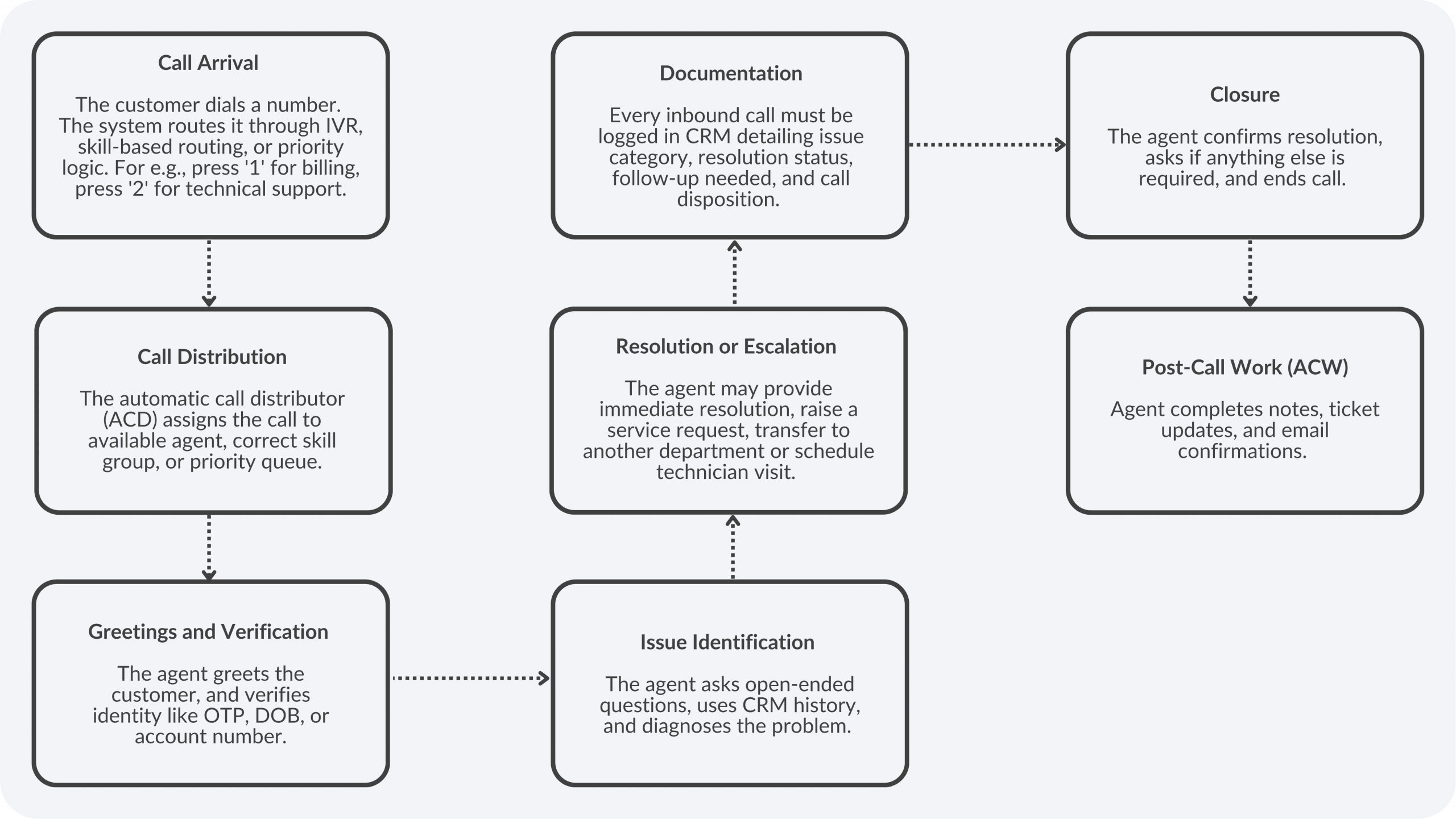
Inbound flow focuses on accuracy, speed, first contact resolution (FCR), and customer satisfaction.
Outbound Process Flow in a Call Center
Outbound is more strategic.
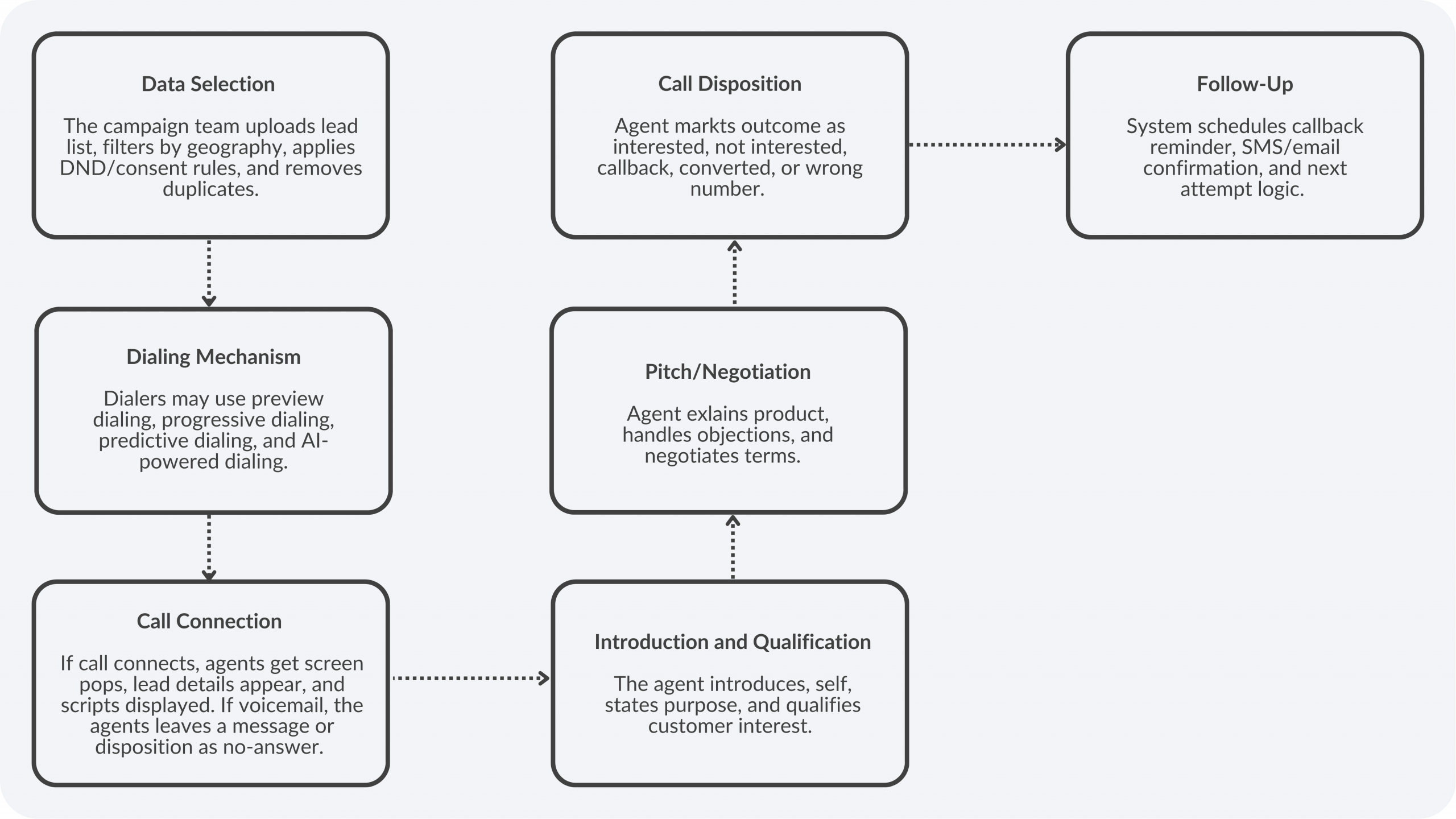
Outbound flow focuses on connect rate, conversion rate, revenue per agent, and promise-to-pay adherence (in collections).
Inbound vs Outbound Process
Let me compare them across dimensions that matter.
| Factor | Inbound Process | Outbound Process |
| Initiator | Customer | Organization |
| Objective | Resolve issue | Generate revenue / engagement |
| Volume Driver | Customer demand | Campaign planning |
| Skill Requirement | Empathy + Problem-solving | Persuasion + Objection handling |
| Tools Used | IVR, ACD, CRM, Knowledge base | Dialer, CRM, Lead scoring system |
| Key Metrics | AHT, FCR, CSAT | Connect rate, Conversion rate, RPC |
| Emotional Tone | Often frustrated customers | Often uninterested prospects |
| Compliance | Data privacy, recording consent | DLT, calling windows, consent management |
Inbound protects reputation.
Outbound drives growth.
Real Examples: Inbound and Outbound in Action
Let me share two real-world scenarios.
Banking Inbound Support
The customer sees an unauthorized transaction and calls customer support.
Inbound team:
- Verifies identity
- Blocks card
- Files a chargeback
- Issues temporary credit
Metrics measured:
- First contact resolution
- Handling time
- Customer satisfaction score
Impact:
Trust preserved.
Loan Collections Outbound
The customer missed a loan EMI.
Outbound agent:
- Calls the customer
- Explains overdue amount
- Negotiates part-payment
- Captures promise-to-pay
Metrics measured:
- Right party contact (RPC)
- Recovery rate
- Collection efficiency ratio
Impact:
Cash flow improved.
Both processes are critical.
But they operate with different physics.
Tools Used in Inbound and Outbound Call Center Processes
Technology plays a huge role.
Inbound Process Tools
- IVR (Interactive Voice Response)
- ACD (Automatic Call Distributor)
- CRM system
- Ticketing software
- Knowledge base system
- Call recording solution
- Workforce Management (WFM)
These tools ensure:
- Efficient routing
- Proper documentation
- Service-level compliance
Outbound Process Tools
- Predictive dialer
- Progressive dialer
- AI dialer systems
- Campaign management platform
- Lead scoring system
- Consent management platform
- Analytics dashboards
Outbound tools focus on:
- Maximizing agent talk time
- Reducing idle time
- Increasing conversions
KPIs to Measure Inbound and Outbound Process Performance
Metrics define behavior.
If you measure the wrong thing, you get the wrong outcome.
Inbound KPIs
- Average Handling Time (AHT)
- First Contact Resolution (FCR)
- Service Level (e.g., 80% calls answered in 20 sec)
- CSAT (Customer Satisfaction)
- Call Abandonment Rate
- Quality Score
Inbound success = Efficiency + Satisfaction
Outbound KPIs
- Connect Rate
- Right Party Contact (RPC)
- Conversion Rate
- Revenue per Agent
- Cost per Acquisition
- Promise-to-Pay Kept Rate (collections)
- Dialer Utilization Rate
Outbound success = Productivity + Revenue
What Most Organizations Get Wrong
I’ve seen companies try to run outbound like inbound.
They measure AHT in sales.
They pressure agents to keep calls short.
This results in lower conversions.
Similarly, some companies treat inbound like a cost center.
They push agents to reduce talk time.
This increases repeat calls and customer frustration.
Inbound and outbound require different playbooks.
Different incentives.
Different training.
Different management style.
The Human Factor
One thing I’ve learned:
Inbound agents need emotional intelligence. Outbound agents need emotional resilience.
Inbound agents absorb frustration. Outbound agents face rejection.
Both roles are demanding.
And both deserve structured processes, the right tools, and realistic metrics.
When someone asks me:
What are the inbound and outbound processes in BPO?
I no longer give the textbook definition.
I say this:
- Inbound protects the brand. Outbound fuels the brand.
- Inbound solves problems. Outbound creates opportunities.
- Inbound is about listening. Outbound is about initiating.
If you design both well with clear flows, proper tools, aligned KPIs, and trained agents, you build a strong customer engagement engine.
If you mix them up or measure them incorrectly, you create confusion.
Ultimately, BPO is not about calls.
It is about conversations with intent.
And the intent behind inbound and outbound is fundamentally different.
Once you understand that difference, not just conceptually but operationally, you start designing processes that actually work.
Frequently Asked Questions
Inbound processes handle customer-initiated interactions such as support calls, complaints, and service requests.
Outbound processes involve company-initiated calls, such as sales, collections, renewals, or follow-ups.
Inbound focuses on resolution and retention, while outbound focuses on revenue and engagement.
Inbound examples include customer support, order tracking, technical assistance, and billing queries.
Examples of outbound include telemarketing, loan collections, renewal reminders, lead follow-ups, and customer surveys.
Inbound flow starts with call routing (IVR/ACD), agent verification, issue resolution, and documentation.
The outbound flow begins with campaign data selection, automated dialing, qualification, pitch or negotiation, and call disposition.
Inbound is reactive and service-driven. Outbound is proactive and target-driven.
Inbound KPIs include Average Handling Time (AHT), First Contact Resolution (FCR), Service Level, CSAT, and call abandonment rate.
Outbound KPIs include Connect Rate, Conversion Rate, Right Party Contact (RPC), Revenue per Agent, and Cost per Acquisition.
Inbound typically uses IVR systems, CRM software, ticketing tools, ACD routing, and call recording systems.
Outbound uses predictive or AI dialers, campaign management platforms, lead-scoring systems, and compliance-filtering tools.
Outbound processes directly generate revenue through sales or collections. Inbound processes protect revenue by improving customer satisfaction and reducing churn. Long-term profitability depends on how well both processes are designed and measured.
Yes. Many BPOs operate blended models in which agents handle inbound calls during peak hours and outbound campaigns during non-peak hours. However, success requires proper workforce planning, clear KPIs, and distinct skill training.
Inbound agents need strong problem-solving ability, empathy, and product knowledge.
Outbound agents require persuasion skills, objection-handling skills, resilience to rejection, and a target-oriented approach.