Customers Still Want a Human. I’ve Stopped Fighting It

I’ve sat in on a lot of go-live weeks for voice bots, and one moment shows up in nearly all of them.
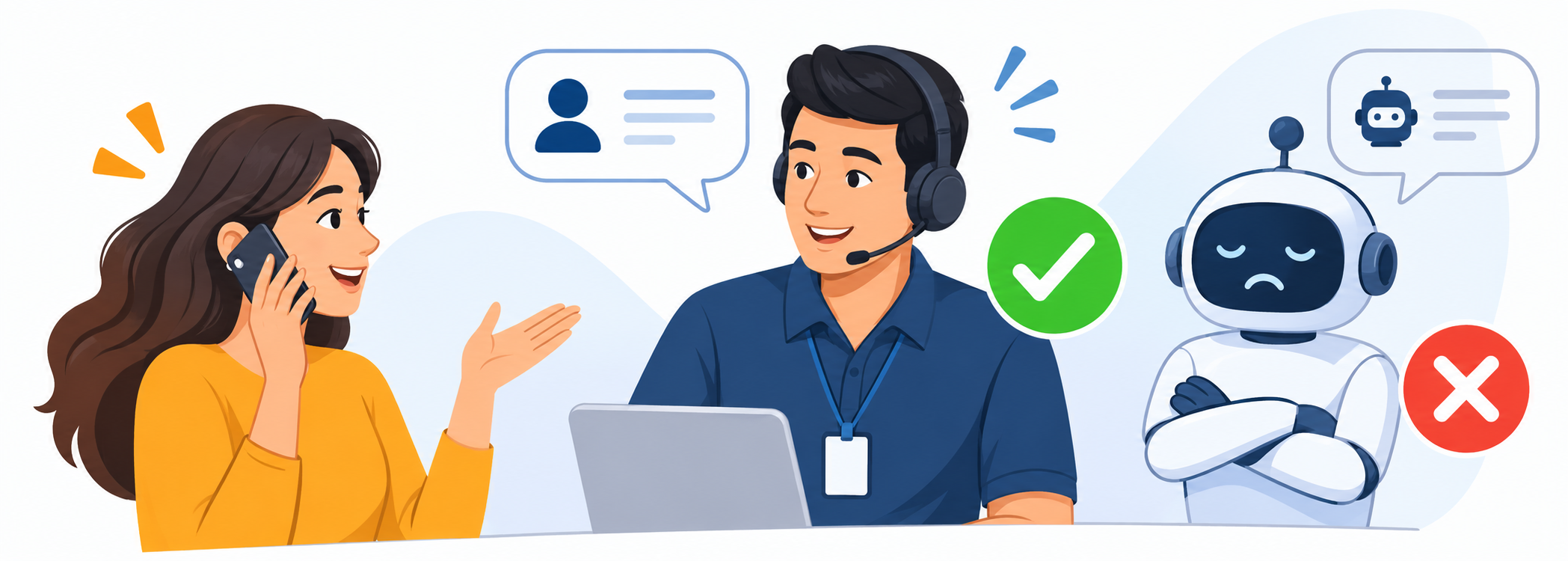
The bot is working. It handles accents, confirms details, and copes when people talk over it. The dashboard looks healthy. And still, caller after caller says some version of “can I just talk to someone?” They aren’t angry, or even all that impatient. They just want a person.
That moment doesn’t surprise me anymore. What still surprises me is how surprised the room usually is. Teams spend weeks tuning intents and prompts, and almost no time asking whether these callers wanted a bot in the first place.
The Numbers Keep Saying the Same Thing
Every year a new survey lands, and every year it says roughly what the last one did. The one that stuck with me this year came from Gartner. They asked more than 3,500 B2B and B2C customers early in 2026, and 87% said a company using generative AI for service has to keep a human within reach.
Here’s the part I find more interesting. Half of those same people said AI had actually made their interactions easier. So, customers aren’t rejecting the technology. They’re happy to use it. They just don’t want to be locked inside it.
Two other findings from that study keep rattling around in my head. Customers are about three times more likely to take a service problem to a tool like ChatGPT than to the company’s own chatbot, and use of company bots has barely moved since 2022. People clearly like AI. What they avoid is AI that seems built to keep them away from help.
The second one stings a bit if you sell into this space. Service leaders now put a bigger share of their budget into AI than any other function Gartner tracks, yet only about a quarter of them report a positive financial return. We’ve been spending on half the problem.
When People Reach for a Person
Listen to enough calls, and you start to see a pattern in when people ask for a human. It’s rarely the simple stuff. Nobody is begging for an agent to reset a password or check where a parcel is.
It’s the call about a charge they can’t explain, three days before rent is due. It’s the insurance claim after a car accident. It’s the customer who already tried the app twice, failed both times, and now has a story to tell before they’ll even get to the question.
What those calls share is that the customer isn’t only bringing a problem. They’re bringing stress, or confusion, or some history with your brand. A good agent picks up on that and adjusts. They slow down, drop the script, or say “okay, let me sort this out” in a way that actually lands.
Bots have become very good at understanding words. Reading the person behind the words is a different job, and it’s the job customers are quietly asking for every time they press zero.
A Confession From the Platform Side
I’ll own my part in this. For years, plenty of us on the vendor side sold containment as the headline number. Keep the call out of the queue, show the deflection rate climbing, put it on a slide. Buyers loved it, and honestly, I understand why. When you’re the one defending cost per contact in a quarterly review, containment is the number that saves you.
What we didn’t sell nearly as hard was the moment the bot hands over. That moment was usually awful. The customer had already given their account number, explained the issue, and answered a couple of questions. Then they reached an agent who knew none of it, and they started again from the top.
If you set out to teach customers not to trust automation, you’d struggle to design a better lesson. Every bad handoff tells them the bot was a waste of their time. So next time they skip it and ask for a person straight away, and then we wonder why containment has stalled.
What Good Looks Like Now
The deployments I like best these days don’t treat AI and agents as two separate lanes. They treat them as one team working the same conversation.
The AI picks up, confirms who the customer is, works out why they’re calling, and pulls up what’s relevant. If it can resolve the issue with confidence, it does. If it can’t, or the customer sounds like they need a person, it passes them across with everything attached. The agent sees the summary, the intent, and the history before they say hello.
Voice AI has made this far more practical. I spend a good chunk of my week with voice AI teams now, and the conversations they handle are miles ahead of where they were even two years ago. But the strongest ones I meet aren’t pitching “replace your agents.” Their pitch is “let your agents spend the day on calls that actually need them.” That’s an easier story to believe, and a much easier one to deliver.
One line from the Gartner research stuck with me too. Their analyst argued that AI shouldn’t be a compulsory first stop for every single issue. I’d go a step further. Some calls should go straight to a person, and your platform should be smart enough to know which ones.
If You’re Building or Buying
Here’s what I’d say to anyone weighing up contact center tech right now:
- Stop treating deflection as the finish line. A deflected contact that leaves the customer unhappy isn’t resolved. It usually comes back on another channel, angrier.
- Put real money into the handoff. Context transfer, summaries, and warm transfers are where trust in your automation is won or lost.
- Decide which contacts skip the bot. Fraud, bereavement, a complaint that’s already been escalated once. Send those to a skilled person from the first ring.
- Make the way out obvious. Customers relax when they know a human is reachable. Hide that option, and they just fight harder to find it.
- Measure what the customer felt. Track repeat contacts, effort, and sentiment next to cost, or you’re only seeing half the picture.
Where I’ve Landed
I used to think the goal was a contact center where nobody needed to talk to a human. I don’t think that anymore. The goal now, for me, is a contact center where nobody has to fight to reach one, and where the person they reach already knows why they called.
None of this is an argument for slowing down on AI. I’m more excited about what it can do in a contact center than I’ve been about anything in years. It’s an argument for being honest about what it’s for, and for building the human part of the journey with the same care we put into the bot.
The fix is often smaller than people expect. Let the bot offer a person the moment a caller hesitates, and pass everything across when they say yes. In my experience, once people know the door is open, fewer of them feel the need to walk through it.