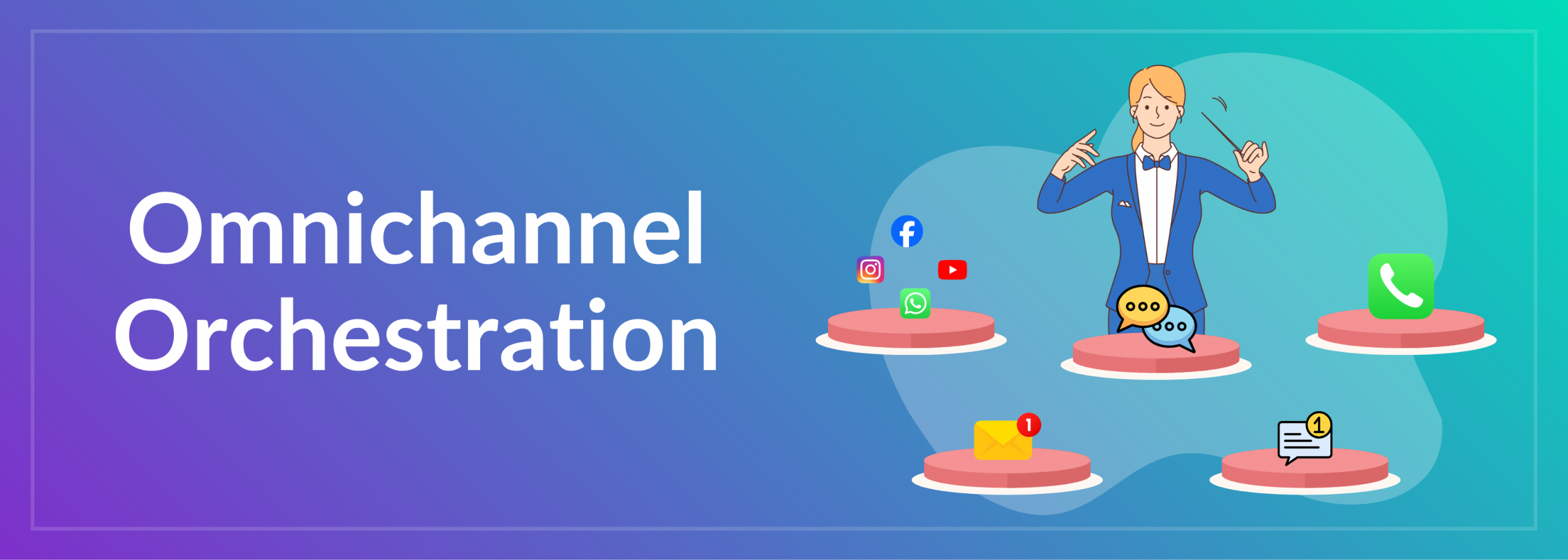
Omnichannel Orchestration: You Built More Roads. You Forgot the Traffic Control System

There is a quiet contradiction sitting at the heart of most omnichannel contact center strategies today.
Organisations invest heavily in adding channels, such as WhatsApp, voice bots, live chat, and AI-powered systems.
They announce that they have built a connected customer experience, and then watch their contact volumes stay stubbornly high, and their satisfaction scores refuse to move.
The channels work. The experience doesn’t.
The reason, almost universally, is the same. They built more roads. They never built the traffic control system.
Think of the customer journey as a road network. More channels mean more roads; more ways for a customer to reach you, more entry points, more options.
That is genuinely useful. But roads without traffic control don’t move people faster or more smoothly. They create more opportunities to get lost, to hit a dead end, or to be forced to start the journey over from the beginning.
Customer journey orchestration platform is the invisible system that reads what is happening in real time, anticipates where things are about to break down, and ensures that every handoff, every signal, every transition still gets the customer to their destination without asking them to explain, from scratch, why they left home in the first place.
Most organisations have invested in the roads. Almost none have built the traffic control system that makes them work together.
The Problem Hiding in Plain Sight
Here is what that looks like in real life practice.
A customer decides to open a bank account online. They begin filling in the application, moving through the form steadily, until the KYC verification step fails.
The digital journey can’t proceed. The system routes them to a human agent to resolve it.
The agent picks up the call.
And then asks: “How can I help you today?”
Everything the customer just did: every field filled in, every document uploaded, the precise point at which the process broke down is invisible to the agent.
The customer has to reconstruct their own journey verbally, from the beginning, for someone who should already know all of it.
What was a minor technical friction has now become a conversation that feels, from the customer’s side, like starting over entirely.
This is not a channel problem.
The bank had a digital channel and a voice channel. Both functioned.
The failure was that neither channel knew what the other knew, because the orchestration between them was not happening in real time.
By the time the agent received the call, the context had either not transferred at all or had transferred too slowly to be useful.
The traffic control system wasn’t reading the live road. It was working from a map drawn earlier that morning.
The Gap Between Channels and Orchestration
A telco company recently launched WhatsApp, live chat, voice bots, and AI-powered email support and declared, with some justification, that they had built a true omnichannel customer journey.
Then a customer contacted them because their bill had suddenly doubled.
They started on WhatsApp.
The bot returned a payment FAQ. They moved to voice. The agent asked them to explain the issue again. After the call, an automated email arrived asking whether their broadband installation issue had been resolved. There was no broadband installation issue.
What the customer experienced was not an omnichannel journey. It was four separate interactions that happened to involve the same person. The channels were connected in the sense that they all belonged to the same company. They were not connected in any way that mattered to the customer moving through them.
Orchestration in that situation would have looked entirely different.
The bill spike would have been a live signal, detected the moment it was generated. The customer’s value and likely sentiment would have been assessed before they even made contact. The WhatsApp conversation would have been summarised and available to the voice agent the instant the call connected.
The post-call survey about a non-existent broadband issue would never have been sent, because a properly orchestrated post-contact workflow would have known what the call was actually about.
The customer would have felt one very specific thing: this company remembered me and it reduced churn rate.
Without real-time orchestration, that feeling is impossible. And without that feeling, it doesn’t matter how many channels you add.
Why Is Real-Time the Whole Game
The most common mistake organisations make when they believe they have achieved orchestration is assuming that moving data between systems is sufficient. It isn’t. Data that moves slowly is, in practice, almost as useless as data that doesn’t move at all. Journey moments have a short window.
A customer who abandons a form, opens a chat, and then calls support fifteen minutes later is not the same customer they were an hour ago in terms of context, sentiment, and need.
If the orchestration layer is working off a profile last updated during a scheduled sync, it is reacting to a version of the customer that no longer exists.
Real-time is not a technical nicety. It is the entire foundation. Without it, every handoff is a reset. Every transition between channels is a small act of forgetting.
And the cumulative effect of those resets across an entire customer base, across thousands of interactions a day, is an experience that feels disjointed regardless of how sophisticated the underlying technology is.
Related Article : Customer Journey Orchestration in Financial Services
Where AI Fits, and Where It Doesn’t
There is a version of this conversation where AI is presented as the answer. It isn’t. AI can be a meaningful part of the solution, helping to detect signals, surface next-best actions, or summarise context for an agent in the moment. But A
I that sits on top of a fragmented, non-real-time data infrastructure doesn’t fix orchestration. It accelerates the wrong decisions faster.
The foundation has to be right first.
- Clean identity resolution.
- Live data that moves at the speed of the customer.
- Clear ownership of what happens at every transition point.
- Governance that prevents one team’s workflow from contradicting another’s.
AI can enhance an already working system. It cannot substitute for one that isn’t.
Here is the only question that matters
When a customer moves from one channel to another, does the next interaction know everything the previous one did immediately, completely, without the customer having to say a word?
If the answer is no, you have channels. You don’t have orchestration.
Building more roads is the easy part. Building the system that makes every road aware of every other road, in real time, without gaps, is the work. And until that work is done, the experience will keep feeling exactly the way your customers are telling you it feels: like dealing with several different companies that happen to share the same name.