How IVR and ACD Work Together to Route Calls in a Cloud Contact Center

Whenever I speak with companies that are setting up or modernizing a contact center, the conversation almost always reaches a moment where someone asks a deceptively simple question:
How exactly does the system decide which agent should answer a call?
Behind that simple question lies one of the most important components of a contact center: the partnership between IVR (Interactive Voice Response) and ACD (Automatic Call Distribution).
These two systems quietly orchestrate millions of conversations every day.
When they work well, customers reach the right person quickly, and the service feels seamless.
When they don’t, customers get trapped in endless menus or transferred between agents who cannot help them.
In my experience working with contact center systems, IVR and ACD together form the backbone of modern contact centers. Understanding how they work together is key to designing customer experiences that actually feel smooth.
Let me walk you through how this partnership works.
Why IVR and ACD Are the Backbone of Modern Contact Centers
Every contact center has one core operational challenge:
How do you connect the right customer to the right agent at the right time?
Customers call for very different reasons. Some want to check their account balance. Others want technical support. Some want to complain. Some want to buy something.
If every call simply rang through to the next available agent, two problems would immediately arise.
- Customers would reach agents who may not have the right skills.
- Agents would spend time transferring calls instead of solving problems.
This is where IVR and ACD come in.
Think of IVR as the front door of the contact center, greeting customers and understanding their needs. Think of ACD as the traffic controller, deciding which agent or queue should receive the call.
Together, they ensure that calls are filtered, understood, and routed intelligently.
Without them, contact centers would quickly descend into chaos.
What is IVR in a Cloud Contact Center?
IVR, or Interactive Voice Response, is the automated system that interacts with callers when they first connect to a contact center.
You have probably encountered IVR hundreds of times.
Press 1 for sales.
Press 2 for support.
Press 3 for billing.
Traditionally, IVR relied on keypad inputs. Today, in modern cloud contact centers, IVR systems have evolved significantly.
They can now recognize spoken responses, authenticate customers, retrieve customer data from CRM systems, provide self-service options, and collect information before routing the call.
In other words, IVR is no longer just a menu system. It has become an intelligent intake layer that gathers context before a human agent becomes involved.
And that context becomes extremely valuable for the next stage of the process, which is call distribution.
What is ACD, and How Does It Route Calls?
ACD stands for Automatic Call Distribution.
Its job is to determine where the call should go once the system understands the caller’s intent.
If IVR collects information, ACD uses that information to make routing decisions.
ACD systems typically consider several factors when routing calls.
- Is the agent available?
- What are the agent’s skill sets?
- What is the queue priority?
- What is the customer profile?
- What are the acceptable wait times?
- What are the service level targets?
This is how the ACD systems work.
If a caller indicates they need help with a credit card dispute, the ACD system will route that call to agents trained in dispute resolution.
If a high-value customer calls, the system will route the call to a dedicated support team.
ACD helps ensure that calls are matched with the best resources available at that moment.
Step-By-Step: How IVR and ACD Work Together
Here’s what typically happens when a customer calls a cloud contact center.
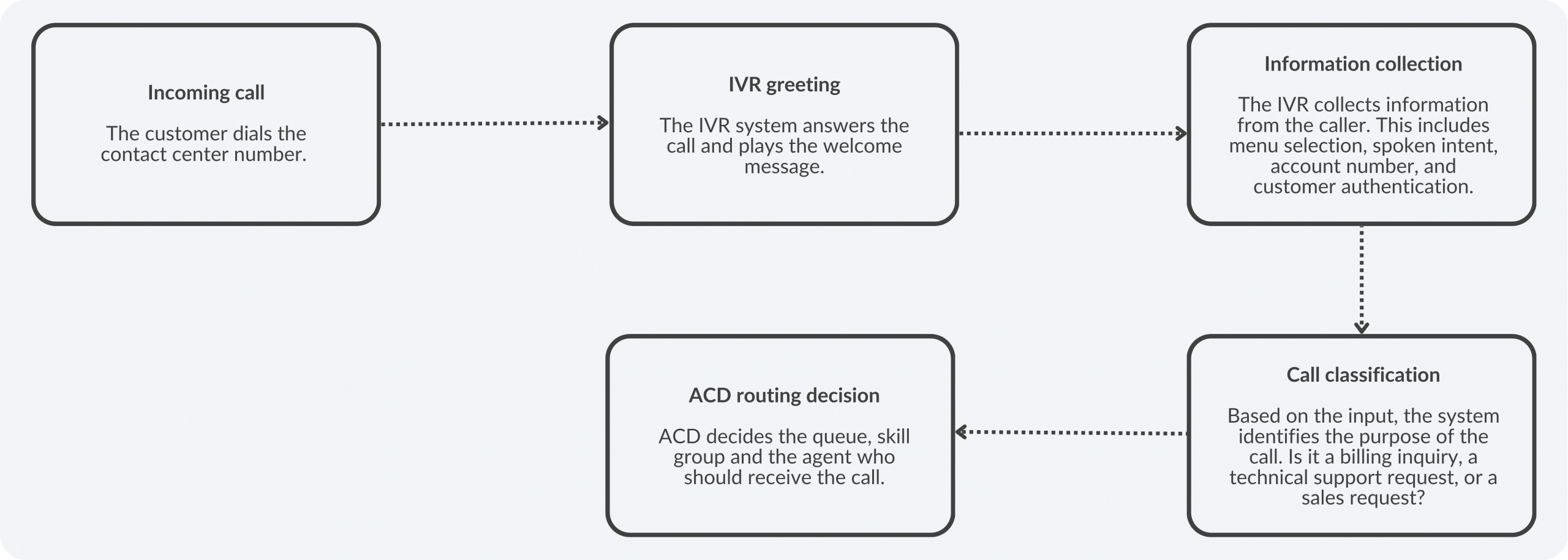
From the customer’s perspective, this entire orchestration happens within seconds.
Example Call Flow in a Cloud Contact Center
I recently called my Internet Service Provider. I was greeted by an IVR system that offered a few menu options.
One of them was, “My Internet was not working.”
I chose that.
Immediately, the system asked me to enter my account number or mobile number.
After that, the ACD system took over. It understood that I am a residential customer located in Chennai.
It routed my call to the technical support queue, where an agent well-versed in connectivity issues answered. The agent had all my information and was able to address my issue immediately.
I felt good because the system understood the problem immediately, and that is the power of IVR and ACD working together.
Benefits of Integrating IVR and ACD
When IVR and ACD are properly integrated, you get several advantages.
- You can reach the right agent faster without unnecessary transfers.
- Your agents have to spend less time identifying issues because key information is already collected.
- You would feel that the system understands your needs.
- Self-service will help you address most of your queries, considerably reducing human intervention.
- Your agent’s skills are optimally used.
Advanced Capabilities When IVR and ACD Work Together
Advanced capabilities now include:
- Your calls get routed to the agents with the right skills to address your queries.
- As a privileged customer, you receive faster service through priority routing.
- Your data from CRM systems influences routing decisions.
- AI-powered intent detection using natural language processing, which allows IVR systems to understand your requests accurately.
- You receive routing based on skills, data, and intent across all channels using omnichannel routing.
In many ways, IVR and ACD together become the decision engine of the contact center.
Best Practices for Designing IVR + ACD Call Flows
Designing effective IVR and ACD workflows requires careful thought.
Here are a few principles I always recommend.
- Don’t overwhelm your callers with too many options on your IVR menus.
- Use customer data wisely and personalize the interaction.
- Aim for first call resolution, and your routing rules should be configured for this objective.
- Use self-service to solve real problems, and not simply to deflect calls.
- Continuously analyze call data to improve your routing logic.
Well-designed flows can dramatically change how customers experience a contact center.
In the world of cloud contact centers, technologies like AI, analytics, and automation often receive the most attention.
But beneath all those innovations, two systems quietly continue to do the heavy lifting.
IVR understands the customer’s intent. Whereas ACD ensures the customer reaches the right agent.
Ultimately, a good customer experience is expected to ensure that every conversation reaches the right place at the right time.
Frequently Asked Questions
IVR (Interactive Voice Response) interacts with callers first and collects information about their request through menu options or voice input. ACD (Automatic Call Distribution) then uses that information to route the call to the most appropriate agent or queue based on routing rules, agent availability, and skill sets.
IVR gathers information about the caller’s intent, such as the type of support needed. The ACD system then uses that information to decide where the call should go. In most contact centers, ACD is responsible for routing calls.
When a call arrives, the IVR interacts with the caller and identifies the reason for the call. This information is passed to the ACD, which evaluates routing rules, agent skills, and availability before directing the call to the appropriate queue or agent.
IVR gathers the caller’s request and account information before the call reaches an agent. ACD then routes the call to agents who have the right skills to handle that issue. This reduces call transfers and increases the chances of resolving the problem in the first interaction.
IVR and ACD together ensure that calls are understood and routed efficiently. IVR collects context from the caller, while ACD distributes calls intelligently across agents and queues. This improves efficiency, reduces wait times, and enhances customer experience.
ACD systems typically evaluate agent availability, skill sets, queue priorities, customer profiles, and service-level targets. These factors help ensure that each call reaches the most suitable agent or team.