Generative AI Is Changing Customer Journey Orchestration, Not Just Customer Conversations

A few years ago, I was booking a spa service online. The chat window popped up and walked me through a rigid sequence: name, phone number, city, and what I was looking for. One question at a time. I played along, got what I needed, and booked the slot. It worked.
The next time, I tried to be efficient. When it asked for my name, I typed everything at once: name, number, city, and what I wanted. The bot told me it didn’t understand and asked for my name again. So, I went back to answering one field at a time like a good little customer.
That was a rule-based engine doing exactly what it was programmed to do and nothing more. No understanding of context. No memory. No ability to interpret what I was clearly trying to tell it.
I think about that experience a lot now, because the conversation around generative AI in customer experience has gotten stuck in a version of the same trap. We’ve moved from rigid chatbots to language models that can hold a natural conversation, and that’s genuinely impressive. But most of the attention is still focused on the conversation layer, like making the chat smarter, the responses more fluent, and the tone more human. And while that matters, it misses the bigger shift that’s actually underway.
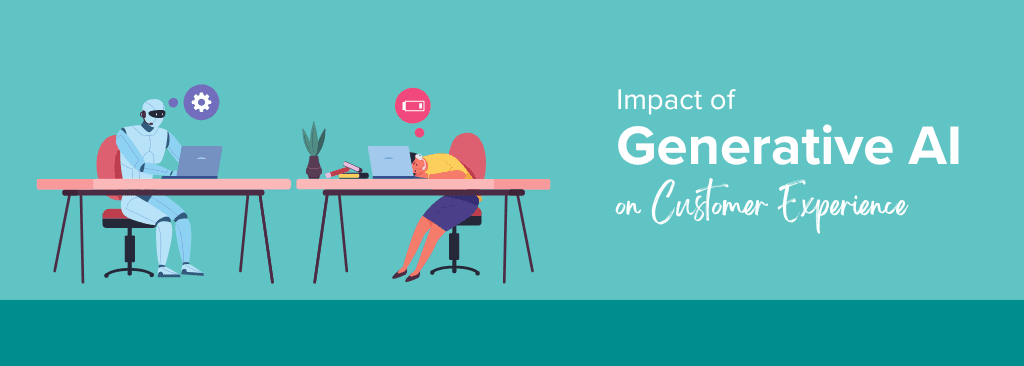
Generative AI isn’t just a better chatbot. It’s the layer that can finally make customer journey orchestration work the way it was always supposed to.
The Chatbot upgrade is Real, but it’s the Smaller Story
I don’t want to dismiss what AI has done for customer conversations. The improvement is significant. Traditional bots could handle transactional queries, such as checking my balance, tracking my order, and resetting my password. But anything that required understanding context or intent fell apart. Roughly a quarter of customer requests are contextual, and legacy systems simply couldn’t handle them.
Generative AI can. It reads intent. It holds context across a conversation. It can pull from structured and unstructured data to give an answer that actually respects the customer’s time instead of bouncing them through a decision tree. For agents, it generates call summaries, surfaces relevant knowledge base articles, and reduces the time to resolution.
All of that is valuable. But it’s still focused on a single interaction, which is making one conversation better. The real question is what happens when you point that same intelligence at the entire journey.
From Understanding a Conversation to Reading the Full Journey
Here’s what I mean by that. A customer calls your support line about a billing issue. A good AI assistant handles the call well. It understands the problem, pulls up the account, and helps resolve it. That’s the conversation layer working.
But orchestration asks a different set of questions.
What happened before this call?
Did this customer visit the billing FAQ page twice last week?
Did they open a payment failure email three days ago and not click through?
Did they downgrade their plan last quarter?
Is their contract renewal coming up in 45 days?
When AI operates only at the conversation level, it solves the immediate problem. When it operates at the journey level, it recognizes that this billing call is a symptom of something larger, maybe a customer who’s been quietly disengaging for weeks. The response to that isn’t just fixing the invoice. It’s triggering a retention workflow, adjusting the tone and timing of the next outreach, and making sure the renewal team knows this account needs attention before the automated reminder goes out.
That’s the difference between AI-assisted interaction and AI-assisted orchestration. One makes a moment better. The other connects the moments into something coherent.
Check this article on : Revolutionize Your Customer Experience with AI
Signals are Everywhere. Connecting them is the Hard Part
Every customer leaves a trail of signals across your systems. Page visits, support tickets, email opens, purchase frequency shifts, survey responses, app usage patterns. Most organizations capture this data. What they don’t do is synthesize it into a real-time picture that informs the next action.
This is where generative AI changes the game in ways that go well beyond chat. These models can process and interpret signals across channels and data types, such as structured records in your CRM, unstructured notes from a support call, behavioral data from your app, and do something that used to require a team of analysts and a two-week turnaround: figure out what’s actually going on with this customer right now and what should happen next.
Think of it as the difference between a dashboard and a decision. Dashboards show you that customer churn risk is elevated for a segment. AI-powered orchestration identifies that this customer’s behavior pattern matches early churn indicators and initiates the right response through the right channel, with the right message, at the right time, without waiting for someone to notice a number on a screen.
The models aren’t perfect. Nobody who works closely with AI would claim they’re right 100% of the time. But they don’t need to be perfect to be transformative. They need to be fast, contextual, and connected to the systems that actually reach the customer. That’s a bar they’re clearing now in ways they couldn’t two years ago.
The Transition Most Organizations haven’t Made Yet
Here’s what I see happening in most companies. They’ve adopted AI at the interaction layer. The chatbot is smarter. The agent assist tools are generating summaries and suggesting responses. Maybe there’s some sentiment analysis running in the background. That’s a meaningful step, and the ROI is usually visible pretty quickly.
But the orchestration layer, the part where AI reads across the full journey and coordinates what happens next, is still mostly manual or rule-based. Marketing sends campaigns on a schedule. Support reacts when someone reaches out. Sales is following up based on lead scores calculated last Tuesday. Nobody is connecting these actions in real time based on what the customer is actually doing right now.
The transition from AI-assisted interactions to AI-assisted orchestration requires two things most organizations find uncomfortable. First, it requires breaking down data walls so the AI has a unified view of the customer, not a fragmented one. Second, it requires giving the system enough authority to act, not just recommend, but actually trigger a workflow, suppress a campaign, or route a customer differently based on what it’s reading in the moment.
That second part is where trust becomes the bottleneck. And it’s understandable. Handing decision-making authority to an inherently probabilistic model feels risky. But the alternative of having all the signals, all the data, all the AI capability, and still relying on manual handoffs between siloed teams is its own kind of risk. It’s the risk of knowing what you should do and being too slow to do it.
Where this is Heading
I’m not going to pretend I know exactly how this plays out. Regulation is coming on data privacy, on how AI systems make decisions that affect customers, on transparency. The organizations that get ahead of that, that build their orchestration layer with compliance and governance baked in rather than bolted on, will have an advantage.
What I do know is that the companies still thinking of generative AI as a chatbot upgrade are seeing about a tenth of what’s possible. The real shift isn’t in how you talk to customers. It’s in how you read what they’re telling you, through their actions, their patterns, their silences, and coordinate your response before they have to pick up the phone and explain it themselves.
That’s orchestration. And AI is what finally makes it practical.